|  Gen
info Gen
info
Equisetum species date back to millions of years ago in the Paleozoic area.
Horsetail belongs to a species of
a primitive nonflowering plant in the genus Equisetum, most common of
which are E. hyemale and E. arvense. Another, E. palustre, contains
a toxic alkaloid, palustrine, and should be avoided.
Horsetail is an herbal remedy used in ancient Roman
and Greek medicine. Equisetum is Latin rooted, equus meaning
"horse," and seta meaning bristle.
 Botany Botany
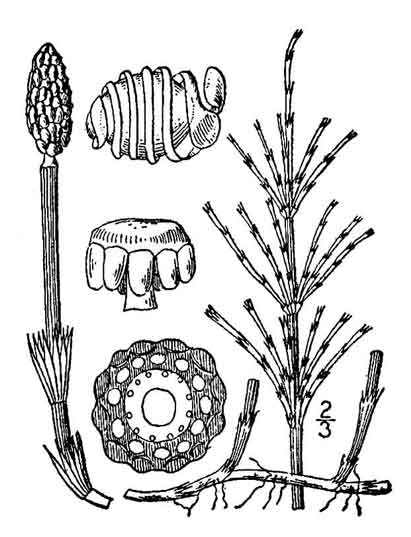
Horsetail is a ferny perennial cryptogam with jointed rootstocks.
Sterile stems are hollow, simple and erect, smooth and regularly striated, up to 60 centimeters tall,
rarely up to 40 inches tall, 3-5 millimeters, branched, usually without sub-branches. Inconspicuous scalelike leaves occur in whorls at the nodes and connected at the bases. Rhizome looks
like a string of beads, branched and creeping, similar to aerial stems except they are not hollow, extending to a depth of 100 centimeters or more.
Distribution
- Difficult to eradicate once cultivated and established.
- Often toxic to surrounding vegetation due to its high level of alkaloids. (25)
- Used for erosion control by sides of ponds.
- Popular for ornamental or landscaping use.
Constituents
- Phytochemical screening yielded flavonoids, alkaloids, terpenoids, saponins, phytosterols, and amino acids. (22)
- Contains high amounts of silica—one of the highest plant sources for the bone strengthening mineral.
-
Pharmacognostical studies on sterile stems showed the presence of xylem vessels, cortex, parenchyma, stomata, and silica granules. Volatile oil content was 1.5%, moisture 15%.
- Yields benzoic acid derivative hippuric acid and quercetin derivative homovanillic acid as metabolites.
- Yields sterols: beta-sitosterol, campesterol, isofucosterol, and trace amounts of cholesterol.
-
Horsetail contains
silicon; considered as a natural supplement for osteoporosis.
- Also, has a high silica content. which accounts for its use as a natural
scouring or sanding pad.
- Flavanoids probably responsible for its diuretic action.
- Rich in nutrients and minerals: calcium, potassium, magnesium.
- Study of volatile constituents of sterile stems yielded
major constituents of hexahydrofarnesyl acetone (18.34%), cis-geranyl acetone (13.74%), thymol (12.09%) and trans-phytol (10.06%). (see study below) (20)
- Study of extracts for phenolic acid identification yielded isoquercitrin, apigenin 5-0-glucoside, kaempferol 3-O-glycoside, di-E-caffeoyl-meso-tartaric acid, phenolic acid 1 and phenolic acid 2. (23)
- Nutritive components of fresh aerial parts as percentage of dry weight are: Dry matter 100, ash 18.5, crude fiber 23.5, ether extract 2.4, nitrogen free extract 50.3, protein (nitrogen x 6.25) 5.3, digestible protein for cattle (2.4) goats (1.5) horses (2.0) rabbits (2.8) sheep (1.9).
(25)
- Study on chemical composition of essential oil yielded 3,7,11,15-tetramethyl-2-hexadecen- 1-ol (1), hexadecan-1-ol (2), linolenic acid methyl ester (3), octadecanoic acid methyl ester (4), phthalic acid (5), gibberellic acid. (32)
- Root extract yielded seven chemical constituents: apigenin (1), luteolin (2), luteolin-5-O-β-D-glucopyranoside (3), isoquercetin (4), apigenin-5-O-glucoside (5), ursolic acid (6), and oleanolic acid (7). (see study below) (39)
Properties
- Considered anodyne, antiseptic, cardiac, carminative, diaphoretic,
diuretic, galactagogue, vulnerary.
- Considered astringent, a good clotting agent, stopping epistaxis.
- Considered excellent genitourinary astringent.
-
Styptic effect, strengthening and regenerating to the connective tissue.
- Studies have shown antimicrobial, antidiabetic, radiomodulating, sedative, anticonvulsant, wound healing, diuretic, anti-osteoporotic, immunomodulatory,
anti-inflammatory, membrane stabilizing, antioxidant properties.
Part utilized
Stems
Uses
Edibility / Culinary
- Young
shoots can be eaten boiled.
Folkloric
- Decoction used for
kidney problems, rheumatism, gout, venereal diseases.
- Used for sprains, eczema, hair rinse.
- Used for wounds. Never apply topically to open wounds!
- Traditionally used in Europe as a herbal diuretic for edema and fluid
retention.
- Considered for osteoporosis, nephrolithiasis and wound healing.
- Used for cholelithiasis, liver problems, hyperuricemia, diarrhea.
- Used externally, to facilitate wound healing.
- Decoction used for bleeding wounds and wound healing.
- Decoction added to herbal baths to facilitate healing sprains and skin
conditions.
- In China, used for fever, conjunctivitis, corneal disorders, dysentery, hemorrhoids, swellings.
- In Serbian traditional
medicine, used for infections of the urinary tract.
- In Europe traditionally used as a diuretic for the treatment of edema. Approved by the German Commission E for this indication. Also, occasionally used for osteoporosis, kidney stones, urinary tract inflammation, and wound healing.
Others
- Ornamental: stems used for flower arrangements.
- Cleaning: Scouring and sanding from its high silica content.
- Dye: Yields a yellowish green color when mordanted with alum; deeper
green with iron.
- Cosmetic: Used in cosmetics and shampoos.
New formulations
• In Italy,
a horsetail-calcium formulation used for treatment of osteoporosis and
fractures.
• Silica: Silica extracted from horsetail is utilized for manufacture of remineralizing and diuretic medicinal products. Other potential uses of biogenic silica include industrial applications (abrasives, toothpaste, protective clothing, optical fibers, paint thickeners, etc.), detergents, and cleaners. (25)
• Hair loss: The silica content together with its other minerals and elements (flavonoids, alkaloids, sterols, etc) are common ingredients in commercial products being touted in the treatment of hair loss.
Studies
• Essential
Oil / Antimicrobial Activity: Study
on the volatile constituents of the stems of EA identified 25 compounds.
The major constituents were: hexahydrofamesyl acetone, cis-geranyl acetone,
thymol and trans-phytol. The 1:10 dilution of the essential oil showed
broad spectrum of strong antimicrobial activity against all tested strains. (3)
• Anti-Diabetic:
Effect of Equisetrum arvense in Histological
Changes of Pancreatic B-cells in Streptozotocin-Induced Diabetic Rats:
Study showed the methanolic extract of EA produced significant antidiabetic
activity. (4)
•
Herbal Radiomodulator: A study was done
to identify nontoxic and effective radioprotective compounds that can
reduce the adverse effects of radiation. E. arvense, together with other
medicinal plants, was examined in vitro on cultured human peripheral
blood lymphocytes. Equisetum
arvense yielded the saponoside equisetonin, with small amounts of vitamin
C, malic acid, oxalic acid, linoleic acid and oleic acids. Extract of
E arvense significantly enhanced the incidence of micronuclei compared
to control. (6)
• Acute Hepatotoxicity Study / No Toxicity: Study evaluated the acute hepatotoxicity of E. arvense in Wistar rats using graded doses of 30, 50, and 100 mg/kg. Results no significant changes in hepatic enzyme activities. Anatomopathologic exam of hepatic tissue showed organ with preserved lobular structure.
(7)
• Sedative / Anticonvulsant: A study on the hydroalcoholic extract of E arvense showed anticonvulsant and sedative effects. It increased latency, decreased severity, reduced incidence and protected animals from death. Phytochemical analysis detected tannins, saponins, sterols and flavonoids.
(9)
• Methylsulfonylmethane (MSM):
MSM, a dimethyl sulfone, has been isolated from plants like Equisetum arvense.
MSM has shown therapeutic promise in animal studies. It has been proven to have anti-inflammatory and antioxidant effects. (10)
• Wound Healing: (1) A study using wound closure ratio and histopathologic studies showed E. arvense ointment exhibited significant wound healing activity in rats. (2) Study in rabbits showed a positive effect on wound contraction which was attributed to silica, silicic acid, silicon and saponins in EA. (14)
• Sedative / Pre-Anesthetic / Anti-Anxiety / Anticonvulsant Effects: A study showed an E. arvense extract to have sedative, pre-anesthetic and anti-anxiety effects. Results showed increase in sleeping time, increase in first-convulsion latency and decreased severity of seizures. (13)
• Diuretic: Studies have shown a mild diuretic effect, without an increase in the excretion of electrolytes. It is considered particularly suited for metabolic and hormonal edema of menopause. Diuretic action has been attributed to flavonoids and saponins.
• Subchronic Dietary Toxicity Study / Functional Food Ingredient Potential: Administered in various dietary doses in rats, no toxicity was detected with reference to clinical signs, body weight, urinalysis, hematology, blood chemistry, and organ weights.
• Pro-Apoptotic: Study of water extract from sterile stems showed dose-dependent cytotoxic effects on human leukemic U 937 cells. Also noted were DNA fragmentation, externalization of phophatidilserine, mitochondrial transmembrane potential collapse. Results suggest the the cytotoxicity was due to apoptosis. (15)
• Cognitive Enhancement: Study aimed to verify if chronic administration of the hydroalcoholic extract of stems from EA reverses the cognitive impairment in aged rats. Results showed both short- and long-term retention of inhibitory avoidance task and ameliorated cognitive performance in reference and working memory. Assays showed diminished thiobarbituric acid reactive substances as well as nitrite formation. The cognitive enhancement effects was attributed, in part, to its antioxidant action.
(16)
• Effects on RBC Membrane Stability: Study evaluated the effects of hydroalcoholic stem extract on male rat RBC membrane stability. Results showed anti-stabilizing activity on RBC membrane stability to which the inflammatory effects of horsetail can be partly attributed to. (18)
• Acute Diuretic Effect: In a double-blind, randomized clinical trial of 36 healthy male volunteers, a standardized dried extract of E. arvense produced a diuretic effect equivalent to that of hydrochlorothiazide without causing significant electrolyte changes. Findings also suggested the drug is safe for acute use. (19)
• Antimicrobial / Essential Oil: Study of the essential oil of stems for antimicrobial activity
showed a broad spectrum of very strong antimicrobial activity against all tested strains, viz., Staphylococcus aureus, E. coli, K. pneumonia, P. aeruginosa, S. enteritidis, Aspergillus niger and C. albicans. (20)
• Antioxidant / Herbal Gel: An herbal gel formulated from a methanolic extract showed dose dependent scavenging of free radicals in various methods, viz., DPPH radical scavenging, H2O2 assay and NO assay methods. (21)
• Antibacterial / Urinary Tract Pathogens: Study on ethanolic and aqueous extracts of EA showed antibacterial activity against all selected urinary tract pathogens, viz., E. coli, K. pneumonia, P. mirabilis, P. aeruginosa, S. aureus, S. saprophyticus and E. faecalis. The ethanolic extract showed higher degree of activity. (24)
• Silica Source / Osteoporosis: Horsetail is one of the richest plant sources of silica known to mankind. Silica gives bone strength and prevents wrinkling. Collagen, which provides elasticity to skin, is made of silica. Silica is found in almost all herbal kidney and bladder cleansing formulations and tinctures. (25) In a study of 122 Italian women who took horsetail dry extract of Osteosil calcium 270 mg twice daily (a horsetail/calcium combination used in Italy for osteoporosis and fractures), results showed improved bone density. However, the study was criticized for being poorly designed. (5) (26)
• Immunomodulatory / Anti-Inflammatory: Study evaluated the immunomodulatory capacity of a standardized commercial common horsetail extract on human primary lymphocyte function in vitro.
Results showed dose dependent inhibition of T-cell proliferation without induction of apoptosis or necrosis, mediated through inhibition of lymphocyte activation. Treatment also inhibited effector functions as shown by reduced production of IFN-γ and TNF-α. Results indicate EA extract interferes with the polyfunctionality of immunocompetent cells to provide an anti-inflammatory mode of action. (29)
• Effect on Post-Episiotomy Pain and Wound Healing / Randomized Placebo Controlled Trial: Study evaluated the effect of topical application of E. arvense ointment in wound healing, reduction of inflammation and pain relief after episiotomy in nulliparous mothers.
Results showed a 3% ointment promoted wound healing and relieved pain during the 10-day period after episiotomy. (30)
• Gel Formulation for Burn Injury / Antioxidant: Study evaluated an herbal gel for use in the treatment of wounds and burns.
By DPPH assay, the herbal gel exhibited concentration dependent free radical scavenging activity. The formulation was studied for gelling property, homogeneity, extrudability, and spreadability. (31)
• Ointment for Dermal Diabetic Wound Healing: Study evaluated the effect of Equisetum arvense ointment on dermal diabetic wound healing
in STZ-induced diabetic rats. Results showed significant diabetic wound healing activity. Treatment with 5%-10% ointment were found to have statistically higher wound closure than control and petroleum jelly-lanolin groups with 99.71% and 99.93% wound closure ration (p<0.05) and higher dermal and epidermal regeneration, angiogenesis, and granulation tissue thickness. (33)
• Inhibitory Effect on Leishmania Promastigotes Growth and Metabolism: Study studied the inhibition effect of Equisetum arvense and Urtica piluifera extracts on growth of Leishmania tropica, promastigotes and metabolism activates. Results showed promising in vitro antileishmanial activity. The extracts exhibited an inhibitory effect on promastigotes number, together with inhibitory effect on total proteins and carbohydrates of cell membrane and number of promastigotes nucleic acids. (34)
• Cytotoxicity Study: Study evaluated an ethanolic extract and fractions of aerial parts for cytotoxicity. The ethyl acetate layer showed a high percentage of cytotoxicity by HPLC analysis. The plant yielded flavonoids, mainly isoquercetine, which exhibited significant cytotoxicity on HeLa cells.
(35)
• Anxiolytic / Sedative / Stems: Study evaluated various extracts of E. arvense stems for anti-anxiety
activity in mice using elevated plus maze model. Results showed anxiolytic effect with mild sedative effect. The effect was lower than that of diazepam. The activity was attributed to the flavonoid content.
(36)
• Anti-Urolithiatic / Diuretic: Study evaluated the effect of E. arvense extracts of aerial parts on kidney stones and diuretic action.
Results showed dissolution of the kidney stones during treatment and exhibited safe and strong diuretic activity. Results suggest a potential for fragmentation of large kidney stones besides removal of small stone and sands from the kidney. (37)
• Antioxidative / Antiproliferative: Study
investigated the antioxidative and antiproliferative activity of different horsetail extracts. Results showed the suppression of formation of lipid peroxyl radicals in a dose dependent manner. The n-butanol, methanol, EA, and water extracts showed significant peroxyl radical scavenging activity. The EA extract exhibited the most prominent antiproliferative effect, without inducing any cell growth stimulation on human tumor cell lines. (38)
• Influence on Urinary Bladder Activity / Roots: Study investigated the influences of ethanol root extract of E. arvense
on urinary bladder activity in rats. Results showed the extract affected urinary bladder activity by decreasing adenosine-triphosphate release. (see constituents above) (39)
• Wound Healing / Effect on Wound Contraction: Study investigated the effect of EA on wound healing on full-thickness skin wounds in rabbits compared to povidone iodine and sodium chloride.
Results showed more effective wound contraction on full-thickness skin wounds compared to other solutions. The positive effect on wound contraction may be due to silica, silicic acid, silicon, and saponins in E. (40)
Toxicity
concerns / Interactions
• Toxic in large amounts. Horsetail growing in
highly fertilized areas draw selenium and nitrates from the soil. Children
using the hollow stems as blowgun may also be at risk.
• Diuretic effects may enhance toxic effect of certain medications,
such as digoxin (heart failure), phenytoin (anticonvulsant), anticoagulants.
The diuretic effect can also cause potassium loss.
• Horsetail may affect the body's ability to excrete lithium and increase its effects.
• Chronic herb use can decrease thiamine or vitamin B1 level because of thiaminase content.
Availability
- Cultivated
- Tea bags (Horsetail Herbal Tea), capsules, powdered extract, supplements in the cybermarket.
|