Gen info Gen info
- Ipomoea is the larges genus in the plant family Convolvulaceae, with over 600 species. The large diverse group has common names like morning glory (most common), water convolvulus or water spinach, sweet potato, bindweed, moonflower, among others. The genus occurs throughout the tropical and subtropical regions of the world, consisting of annual and perenn8ial herbaceous plants, lianas, shrubs, and small trees; most are twining climbing plants. (6)
- Etymology: The genus name Ipomoea derives from Ancient Greek ἴψ, meaning wormwood, and homoios, meaning "resembling", referring to their twining habit. (6) Alternatively, Ipomoea means "worm-like", referring to the coiled flower bud.
Botany
• Aurorang-gubat is a large, smooth, perennial climber rising from stout, somewhat fleshy roots. Leaves are on long petioles, rounded in outline, and heart-shaped at the base. Lobes are 5 to 7, usually lanceolate, 5 to 15 centimeters long, often reaching nearly to the base. Flowers are 3 to 5, on a stalk in the leaf axil. Sepals are ovate, concave, and 1 centimeter long. Corolla is pink, purple, broadly bell-shaped, smooth and about 6 centimeters long. Capsules are ovoid, 1 centimeter long or less.
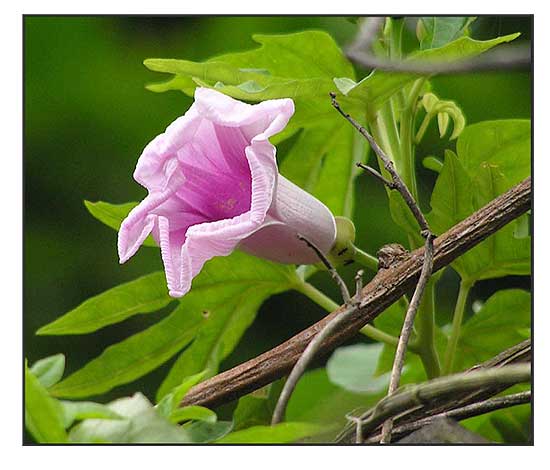 • Large, glabrous liane with tuberous roots; stems twining. Leaf-blade orbicular in outline, entire or palmately 3–9-lobed, 6–24 cm. long, 6–18 cm. wide, cordate or truncate at the base; lobes lanceolate to ovate, acuminate at the apex, entire; petiole 3–11 cm. long. Inflorescences few- to many-flowered; peduncles 2.5–20 cm. long; pedicels 0.9–2.5 cm. long; flower-buds globular. Sepals markedly convex, clasping the corolla-tube, orbicular or elliptic, 6–12 mm. long. Corolla reddish-purple, funnel-shaped, with the tube narrow below, 5–6 cm. long. Capsule ovoid, obtuse, 1.2–1.4 cm. long. Seeds 6–7 mm. long, black, covered with ± 7 mm. long silky hairs. (JSTOR: Global Plants) • Large, glabrous liane with tuberous roots; stems twining. Leaf-blade orbicular in outline, entire or palmately 3–9-lobed, 6–24 cm. long, 6–18 cm. wide, cordate or truncate at the base; lobes lanceolate to ovate, acuminate at the apex, entire; petiole 3–11 cm. long. Inflorescences few- to many-flowered; peduncles 2.5–20 cm. long; pedicels 0.9–2.5 cm. long; flower-buds globular. Sepals markedly convex, clasping the corolla-tube, orbicular or elliptic, 6–12 mm. long. Corolla reddish-purple, funnel-shaped, with the tube narrow below, 5–6 cm. long. Capsule ovoid, obtuse, 1.2–1.4 cm. long. Seeds 6–7 mm. long, black, covered with ± 7 mm. long silky hairs. (JSTOR: Global Plants)
Note:
The species is similar to the common "aurora" (Ipomoea cairica), differing only in its much larger leaves and flowers.
Distribution
- In La Union, Bulacan, Bataan, and Rizal Provinces in Luzon; and in Culion, Coron, and Mindanao, In thickets along the seashore and along streams at low altitudes. (Quisumbing)
- Sometimes cultivated for its flowers and its shade.
- Pantropic.
Constituents
- The fresh tuber, collected when the vine has died, contains resins with properties similar to Jalap resins as regards color reactions, etc.
- Resin yields a sugar and starch.
- Phytochemical study showed the presence of fixed oil, carbohydrate, tannins, phenolic compound, alkaloids, saponins, sterols, flavonoids in an acetone alcohol and aqueous extract.
- Study identified beta-sitosterol and taraxerol.
- Alkaline hydrolysis of ether-soluble resin glycoside (jalapin) fraction of leaves and stems of I. digitata yielded 6 organic acids viz. isobutyric, (5)-2-methylbutyric, tiglic, n-decanoic, n-dodedcanoic, and cinnamic acids, and two glycosidic acids, quamoclinic acid A and operculinic acid. A new resin glycoside, digitatajalapin 1 was isolated from the jalapin fraction, with three known resin glycosides. (9)
- Study of tuberous roots isolated β-sitosterol,
t-cinnamic acid [undecyl(E)-3-(4- hydroxyphenyl)-2-propenoate], an unknown coumarin and a lignan type resin glycoside. ( see study below) (15)
- Ethanolic extract of roots yielded two compounds: Scopoletin (7-hydroxy-6-methoxycoumarin) and β-sitosterol glucoside. (16)
Properties
- Considered purgative, aphrodisiac. galactagogue, mucilaginous, tonic.
- In traditional Indian medicine, considered nervine, diuretic, tonic, spermatogenic, anti-inflammatory, aphrodisiac, lactagogue.
- Tubers considered tonic, hypolipidemic, hypoglycemic, galactogenic, antioxidant, antimicrobial, aphrodisiac, demulcent, alterative, cholagogic, digestive.
- Studies have suggested antibacterial, anti-diabetic, antihypertensive, spasmogenic, hypolipidemic, spermatogenic, atherogenic, fibrinolytic, antioxidant, galatagogue, anticancer, anti-inflammatory properties.
Parts used
Roots, flowers.
Uses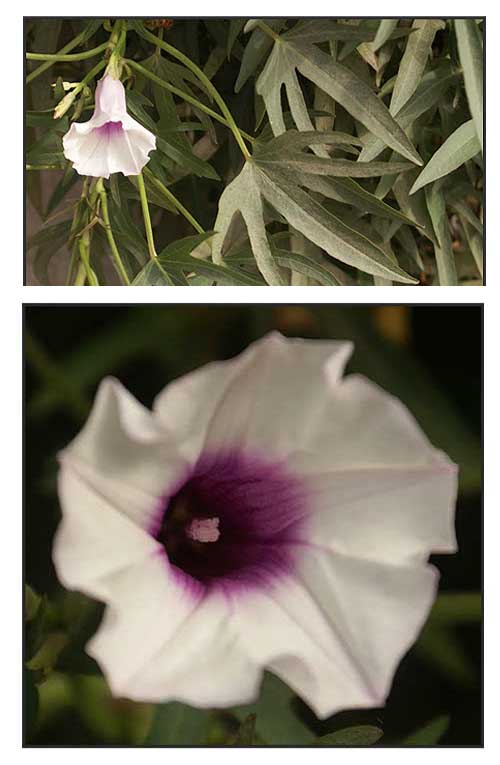
Edibility
- In India, tubers are eaten raw.
Folkloric
- In the Philippines and India, roots used for fever and bronchitis; considered tonicm alterative, aphrodisiac, demulcent, lactagogue, and cholagogue. (13)
-
In Peninsular Malaysia, pounded roots applied to swellings. (13)
- Powdered roots used for spleen and liver diseases, menorrhagia, debility, and fat accumulation. (13)
-
In India, the bitter, tuberous roots are used as tonic, alterative, aphrodisiac and demulcent.
- In the Konkan region of India, root is peeled, cut in small pieces, and dried for use as aphrodisiac.
-
Used for uterine pain, sexual debility, infertility, lactation, infertility, hepatosplenomegaly, gastric ulcer, ulcerative colitis.
- As galactagogue, powdered root-stock, given with wine.
- Roots used for snake bites.
- Powdered roots used as a cholagogue for splenic and liver enlargement.
- Powdered tuber with honey used for high blood pressure and heart disease.
- Powdered sun-dried root, boiled in sugar and butter, promotes weight gain and moderates menstrual discharge.
- In West Bengal, India, raw tubers are eaten as astringent and to treat blood dysentery. Juice of tubers given with one glass of cow milk for seven days to increase lactation. Sun-dried root powder, boiled in sugar and butter is used to promote weight gain and to moderate menstrual discharge. Tubers are used for general debility, spermatorrhea, fever, bronchitis, scorpion stings and menorrhagia.
- Confection made of powdered root, equal parts of wheat flour and barley, milk, ghee, sugar and honey is used as a restorative for emaciated and debilitated children.
- As an aphrodisiac, powdered root is macerated in its own juice and administered with honey and clarified butter.
- In Bangladesh, tablets made from mixture of tuber paste of Ipomoea digitata and leaf pulp of Aloe barbadensis taken for bloating. Tuber of I. digitata mixed with paste of root of Wedelia chinensis taken orally with raw cow's milk or molasses for enhancement of memory. (22)
Others
- Herbal combo to prevent premature ejaculation: One of 8 ingredients in a herbal preparation for premature ejaculation, low sperm count, erectile dysfunction. (8)
- Fodder: Used as fodder for cattle.
- Coagulant: In India, seeds are used for coagulating milk. (13)
Studies
• Paniculatin / Glycoside / Various pharmacologic Effect: Study isolated a glycoside, paniculatin, from the tubers of Ipomoea digitata. Pharmacologic effects included elevation of blood pressure, stimulant effect on the myocardium and respiration, a vasoconstrictor and bronchoconstrictor effect, and a spasmogenic effect on the gut, and an oxytoxic activity. (2)
• Phytochemicals / Secondary Products / Antibacterial: Study isolated B-sitosterol, t-cinnamic acid, an unknown coumarin, a lignan-type resin glycoside from the tuberous roots of Ipomoea digitata. One of the compounds showed significant antibacterial activity against Pseudomonas aeruginosa and E coli. (3)
• Anti-Diabetic / Toxicity Study / Tablet Formulation: Study evaluated the antidiabetic activity of tablet formulation using a novel dry plant extract (tuberous root) using various excipients viz., carbopol, ethylcellulose, MCC, dibasic calcium phosphate, and PEG-400. Oral toxicity study done in mice by OECD guideline 423 showed no death up to 5000 mg/kg dose. F3 and F6 formulation, chosen as best in terms of disintegration time, showed statistically significant anti- diabetic activity and suggests promise for future research. (4)
• Antihypertensive / Cardiovascular Benefits / Hypolipidemic: Tuber powder was evaluated for antihypertensive potential and lipid effect in a single blinded, placebo controlled study. Results showed decrease in systolic, diastolic and mean blood pressure, increased fibrinolytic activity and total antioxidant status with a significant reduction in total cholesterol, LDL and atherogenic index. (7)
• Resin Glycosides: A jalapin fraction yielded a new resin glycoside, digitatajalapin 1, with three known resin glycosides. (see constituents above) (9)
• Antioxidant / Roots: Study of a methanol extract of root of I. digitata showed good antioxidant activity using DPPH, superoxide anion scavenging and iron chelating assays. (12)
• Antidiabetic / Tubers: Study evaluated the hypoglycemic activity of Ipomoea digitata tuber extract in STZ-induced diabetic rats. Results showed considerable hypoglycemic activity, which may be due to the presence of active principles flavonoids and ß-sitosterol. (14)
• Antibacterial / Roots: Study of tuberous roots yielded β-sitosterol, t-cinnamic acid [undecyl(E) -3-(4- hydroxyphenyl)-2-propenoate], an unknown coumarin and a lignan type resin glycoside from the tuberous roots of Ipomoea digitata. One of the compounds exhibited significant antibacterial activity against Pseudomonas aeruginosa and E. coli. (15)
• Pharmaceutical Gum / Seeds: Study showed Ipomoea digitata seed gum and its graft copolymer with polyacrylamide has the potential to be used as a pharmaceutical gum. The seed gum has structure and properties similar to guargum and locust bean gums -- gums of pharmaceutical importance. (17)
• Enhancement of Spermatogenesis / Roots: Study evaluated the potential of ID on reproductive status of neem oil-induced infertility in male albino rats. Results showed significant increase in sperm density and sperm motility (p,0.01) along with increase in testis and epididymis weight. The presence of ß-sitosterol in the root of ID possibly enhances the process of spermatogenesis as evidenced by histo- morphological studies. Results suggest a potential candidate for the management of male infertility. (18)
• Cardiovascular benefits Hypolipidemic / Antihypertensive / Antioxidant / Tubers: Single blinded, placebo controlled study evaluated Ipomoea digitata tuber powder for antiphypertensive potential and effects on lipid profile, fibrinolytic activity and total antioxidant status in patients with stage 1 hypertension. Results showed significant (p,0.001) decrease in systolic, diastolic, and mean blood pressure, increased fibrinolytic activity and antioxidant status with a significant reduction (p,0.05) in total and LDL cholesterol and atherogenic index. (20)
• Galactagogue / Lactovedic: Study evaluated the galactagogue activity of Lactovedic, an ayurvedic polyherbal formulation containing I. digitata (Vidarikand), along with Jivanti, Shatvari, Yashtimadhu and Shatapushpa. Study showed an increase in serum prolactin, protein content and glycogen of mammary gland. Significant increase in milk secretion in ducts as shown in transverse section of lactovedic treated groups' mammary gland. (21)
• Antiurolithiatic / Roots: Study evaluated the in vitro antilithiatic activity of ethanolic extract of roots of I. digitata. Inhibitory effect on in vitro crystallization was evaluated by nucleation assay. Cystone was used as standard. Spectrophotometric assay evaluated inhibitory activity by effect on nucleation and rate of aggregation in calcium oxalate crystals. Results showed a positive effect on inhibition for formatting precipitation of calcium and potassium in vitro. (23)
• Renoprotective / Roots: Study evaluated the nephroprotective activity of I. digitata in gentamicin induced kidney dysfunction in rats evidenced by increased levels of urea, creatinine, sodium and decreased level of proteink, potassium and non-enzymatic antioxidants such as vitamin C and E. Supplementation of I. digitata in gentamicin intoxicated rats restored the altered parameters. The nephro-protective activity may be due to phytochemicals like flavonoids, alkaloid, saponin, among others. (24)
• Silver Nanoparticles / Antibacterial / Dye Degradation / Flowers: Study reports on the green synthesis of silver nanoparticles using aqueous flower extract of I. digitata. Antibacterial potential of the AgNPs using well diffusion method showed appreciable growth inhibition of multidrug-resistant bacteria like E. coli and S. epidermis. The NPs showed good catalytic reduction of methylene blue in the presence of NaBH4. (25)
• Anticancer Against A549, MCF-7, and HepG2: Study evaluated the in vitro anticancer activity of an ethanol extract of I. digitata against A549, MCF-7 and JHepG2 cancer cell lines using MTT assay. Phytochemical study revealed carbohydrates, alkaloids, tannins, flavonoids, phytosterols, and saponins. The ethanol extract significantly reduced percent viability of A549, MCF-7, and HepG2 cancer cell lines with IC50s of 69.94, 81.94, and 47.28 µg/ml respectively. (26)
• Umbelliferone and Maturity Stage of Milk Yam Tuber: Study evaluated the identification of the maturity stage of milk yam tuber containing maximum concentration of umbelliferone - a coumarin present in tubers. HPLC (high-performance liquid chromatography) and HPTLC (high-performance thin-layer chromatogratphy) assessed the presence of umbelliferone in immature tubers (6 months after planting), overmature tubers (39 months after planting), and tubers at optimum maturity (21 months after planting). HPLC and HPTLC results showed umbelliferone to be higher in over mature tubers (0.44 and 0.42 µg/g respectively), followed by optimally mature (0.31 and 0.22 µg/g), and immature tubers (0.20 and <0.11 µg/g, respectively). Results reveal developmental stages affect umbelliferone concentration in milk yam tubers and increases as the plant ages. (27)
• Anticancer / Anti-Inflammatory / Leaves: Study evaluated the anti-cancer and anti-inflammatory properties of I. digitata tuber and H. gossypiifolia leaf extracts encapsulated in chitosan nanoparticles (CSNPs), especially their effects on inhibiting NF-kB, Wnt/ß-catenin, and MAPK signaling pathways in colorectal cancer models. Methanol extracts of tubers of I. digitata and leaves of J. gossypiifolia were encapsulated into chitosan nanoparticles using ionic gelation method. Cytotoic effects were evaluated against HCT116 and SW480 colorectal cancer cell lines using MTT assay. Treatment with extract-loaded CSNPs resulted in significant reduction of cell viability in both HCT116 and SW480 colorectal cancer cells, with IC50s of 22.3 and 34.8 µg/mL. Chitosan NPs carrying extracts from I. digitata and J. gossy-piifolia effectively slowed down growth of colorectal cells by targeting cancer-related and inflammatory pathways. Results suggest potential as natural options for colorectal cancer treatments. (28)
Availability
Wild-crafted.
Herbal products in the cybermarket.
|


_Ipomoea_digitata_-香港西貢獅子會自然教育中心_Saikung,_Hong_Kong-_(9200880164).jpg)