 Gen info Gen info
- Crotalaria is a genus of flowering plants in the family Fabaceae, commonly known as rattlepods. The genus contains over 700 species of herbaceous plants and shrubs.
- Crotalaria verrucosa, the blue rattlepod, is a species of flowering plant in the legume family, Fabaceae.
- Etymology: The genus name Crotalaria derives from Ancient Greek krotalon, meaning "rattle", the same root as the name for rattlesnakes, crotalus. The specific epithet verrucosa derives from Latin, meaning :wart-like", referring to the appearance of pods and leaves. The common names rattlepod or rattlebox refers to the seeds in the pod, becoming loose as they mature, which rattle when shaken.
 Botany Botany
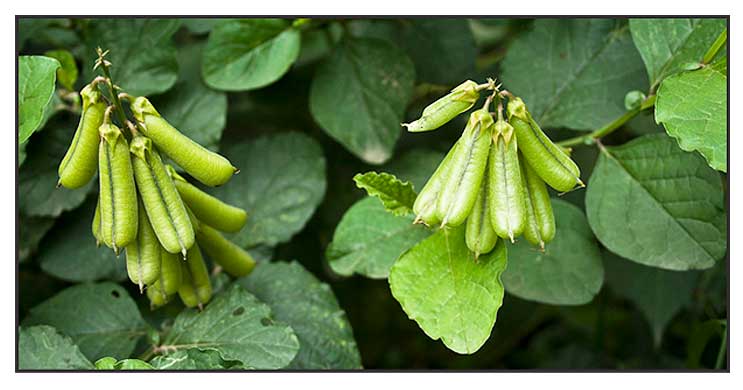
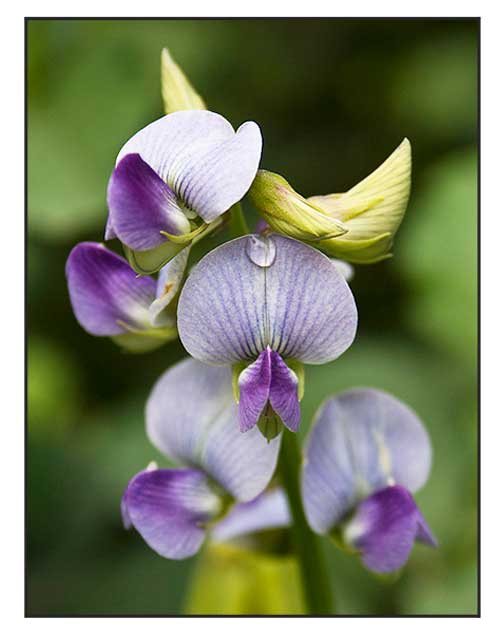
• Annual, subwoody herb, 0.5-1 m tall, with many quadrangular, velvety hairy, yellow branches. Leaves simple, ovate to elliptical, 5-14 cm × 4-9 cm, pubescent; petiole 4-8 mm long; stipules sickle-shaped, 5-20 mm × 4-14 mm, auricled, persistent. Inflorescence a lax raceme, 5-25 cm long, leaf-opposed, with up to 24 flowers; pedicel filiform, up to 5 mm long; bracts linear-acuminate, 4 mm long. Calyx campanulate, 7-11 mm long, hairy, with subequal triangular-acuminate lobes; corolla blue; standard elliptical to suborbicular, 14 mm in diameter; wings ovate-oblong, 13 mm × 6 mm; keel 12 mm × 6 mm, incurved in the middle. Pod oblongoid, 3-5 cm × 0.8-1.2 cm, short stalked, about 16-seeded. Seed heart-shaped, 3 mm in diameter, blackish. (3)
• Herbs, erect, 50-100 cm tall. Branches 4-angled, glabrescent. Stipules leaflike, ovate-falcate, 5-8 mm. Leaves simple; petiole 3-5 mm; leaf blade ovate to elliptic, 10-15 × 3-5 cm, thinly membranous, abaxially densely pubescent, adaxially glabrous, base broadly cuneate, apex acuminate. Racemes terminal, 10-20-flowered; bracts linear, ca. 1 mm. Pedicel 3-4 mm; bracteoles inserted apically from middle of pedicel. Calyx subcampanulate, 8-10 mm, 5-lobed; lobes lanceolate, slightly longer than tube. Corolla pale yellow, white, or often tinged blue; standard orbicular to obovate, 1-1.8 cm, base with 2 appendages; wings oblong, 1-1.6 cm; keel ± as long as wings, exserted beyond calyx, rounded with an incurved, fairly shortly twisted beak. Ovary subsessile, pilose on apical part. Legume oblong, 2-4 cm, 10-12-seeded, pubescent. Seeds nearly smooth to papillose, shiny. (Flora of China)
 Distribution Distribution
- Native to the Philippines. (1)
- Co's Diigital Flora Database lists it as "Naturalized".
(2)
- Also native to Assam, Bangladesh, Bismarck Archipelago, Borneo, Cambodia, China Southeast, East Himalaya, Hainan, India, Jawa, Laccadive Is., Laos, Lesser Sunda Is., Malaya, Maluku, Myanmar, Nepal, New Guinea, Northern Territory, Queensland, Sri Lanka, Sulawesi, Sumatera, Taiwan, Thailand, Vietnam, West Himalaya, Western Australia. (1)
- In fallow fields and on marshy ground, along rivers and roads, up to 1200 m altitude. (3)
Constituents
- Preliminary phytochemical screening of aqueous ethanolic extract of leaves revealed carbohydrates, glycosides, phenols, flavonoids, proteins and amino acids, with absence of alkaloids, oils, and waxes. (see study below) (7)
- GC-MS analysis of ethyl acetate extract of aerial parts yielded
3,7,11,15- Tetramethyl-2-hexadecen-1-ol, n-Hexadecanoic acid, 3-Chloropropionic acid, tridec-2-ynyl ester, 2- ((Octan-2-yloxy)carbonyl)benzoic acid, Squalene, (25R)-5.alpha.-Spirostan-2.alpha.,3.beta.-diol, Campesterol, Stigmasterol, ß-sitosterol, ß-amyrin, Lupeol, 7,8-Epoxylanostan-11-ol, 3- acetoxy-, i-Propyl 9,12,15-octadecatrienoate. (8)
Properties
- Studies have suggested antimicrobial, anticancer, wound healing, anti-inflammatory, cytotoxicity, antibacterial, antidiabetic, antipyretic, CNS depressive properties.
Parts used
Leaves, roots, seeds.
Uses
Edibility
- Caution: Conflicting reports on edibility. Some report it as poisonous. Some report traditional medicinal consumption. There are also reports on use for making soups and stews.
Folkloric
- No reported folkloric medicinal use in the Philippines.
- In Cambodia and Laos, roots used against fever; in Vietnam, used for stomach pains. In India, used to purify the blood, treat skin disease, and as emmenagogue. (3)
- In India, used for treatment of scabies, jaundice, cough, biliousness, fever, oral diseases and cardiac problems. (8)
- Root and leaf paste used on wounds and bites. Bark of roots, ground in rice water, drunk for fever, stomach aches, blood purification and skin diseases. Decoction of leaves used as gargle for mouth ulcers. Juice of leaves drunk for cough and flatulence. Decoction of seeds drunk to neutralize snake venoms. Seed paste applied to scorpion bites.
- In Bangladesh, use for treating skin diseases, heart diseases,and inflammation.
Others
- Agroforestry: Used as green manure. (3)
Studies
• Zinc Oxide Nanoparticles / Antimicrobial / Anticancer / Leaves: Study reports on the ecofriendly, non-hazardous, green synthesis of zinc oxide nanoparticles (ZnONPs) by leaf extract of C. verrucosa. The NPs showed significant antibacterial potential against Gram(+) Staphylococcus aureus and Gram(-) Proteus vulgaris, Klebsiella pneumoniae, and Escherichia coli. The general mechanism of action was in bacterial cell after NPs internalization. MTT assay also showed cytotoxicity
with highest growth inhibition at concentration of 100 µg/mL with IC50 of 7.07 µg/mL for HeLa and 6.30 µg/mL for DU145 cell lines, compared to control IC50s of 22.30 µg/mL and 15.72 µg/mL respectively. Cell migration assay showed potential suppression capacity of NPs to tumor cell migration. The ZnONPs showed antimicrobial activity against studied microbes, cytotoxicity, apoptotic mediated DNA damage and antiproliferative potential against studied carcinoma cells. (4)
• Wound Healing / Leaves: Study evaluated the wound healing effect of aqueous extract from C. verrucosa dried leaves in three wound models: incision, excision and dead space wounds, using parameters of breaking strength in incision model, granulation tissue dry weight, breaking strength and hydroxyproline content in dead space wound, and percentage wound contraction and period of epithelization in excision wound model. C. verrucosa showed significant wound healing property. (5)
• Anti-Inflammatory / Suppression of Inflammatory Mediators / Leaves: Study evaluated the anti-inflammatory activity of C. verrucosa leaves by carrageenan induced paw edema method and xylene induced mice ear edema. Results showed suppression of inflammation produced by carrageenan and xylene at dose of 600 mg/kbw, which was comparable to standards. In heat-induced hemolysis test, the extract inhibited lysis up to 70% at 500 µg/ml, while in heat-induced protein denaturation test, there was 69% reduction with the same concentration. Results suggest moderate to high anti-inflammatory activity with low to high concentrations. (6)
• Anti-Inflammatory / Leaves: Study of hydroalcoholic extract of C. verrucosa leaves for anti-inflammatory activity showed inhibitory concentration (IC50) of 240 µg/mL. The extract exhibited dose-dependent inhibition of protein denaturation. Modest at lower concentration, activity increased at higher concentrations. At highest tested concentration, inhibition rate( was comparable to standard drug, ibuprofen. (see constituents above) (7)
• Anticancer / Seeds: Saponins are a broad category of molecules with extensive therapeutic (anti-cholesterol and anticancer) and pharmacologic effects. Saponins isolated from seeds of C. verrucosa materials were evaluated for antiproliferative activity in two cancer cell lines: MCF-7 and HeLa by MTT assay. The cell lines were sensitive towards steroidal saponins and exhibited good antiproliferative effects. Data suggest that steroid saponins may aid in cancer prevention, impeding proliferation of cancer cells, particularly breast and cervical cancer. (9)
• Cytotoxic / Antibacterial / Leaves: Study evaluated the in vitro cytotoxic and antibacterial activity of methanol plant extract. MTT assay using HeLa cell line, showed highest cell growth inhibition (93.2%) at highest concentration of 2.5 mg/mL. The IC50 of the ME was 0.83 mg/mL. Cell growth inhibition was dose dependent. Antibacterial activity by disc diffusion method showed significant result with Bacillus cerebrums with XOI of 17 mm, compared to kanamycin at 31 mm. (10)
• Antidiabetic / Antipyretic / CNS Depressive / Leaves: Study evaluated the antipyretic, antidiabetic, thrombolytic and depressive potential of leaf extract of Crotalaria verrucosa using yeast-induced pyrexia, alloxan induced hyperglycemia, HRBC clot denaturation, Hole cross and Open field tests in doses of 100, 250, and 500 mg/kg. Extract showed moderate activity against hyperthermia. Antidiabetic activity was suggested by increased peripheral glucose utilization or by decreased endogenous hepatic glucose production. Depressant activity was observed with reduction in number of hole crossed by mice in a hole cross apparatus and decrease in distance traveled in open field test. Results showed strong antipyretic, antidiabetic, and CNS depressive activity. However, the extract failed to show firm thrombolytic activity. (11)
Availability
- Wild-crafted.
- Live plants, root powder in the cybermarket. |