 |

Family • Apocynaceae
Bulalakaw
Hoya multiflora Blume
SHOOTING STAR HOYA
Feng chu chao
| Scientific names | Common names |
| Asclepias carnosa Blanco | Amutung (Ilokano) |
| Asclepias stellata Burm. ex Decne. | Balic-balic (Tagalog) |
| Centrostemma cyrtoceras Meisn. | Balik-balik (Tag.) |
| Centrostemma elegans Blume | Bulalakaw (Tagalog) |
| Centrostemma floribunda Bosse | Timbang-timbang (Dumagat) |
| Centrostemma laurifolium Blume | Many-flowered hoya (Wngl.) |
| Centrostemma lindleyanum Decne. | Shooting star hoya )Engl.) |
| Centrostemma micranthum Blume | Shooting stars (Engl.) |
| Centrostemma multiflorum (Blume) Decne. | |
| Centrostemma platypetalum Merr. | |
| Centrostemma yunanense P.T.Li | |
| Cyrtoceras coriaceum Heynh. | |
| Cyrtoceras elegans (Bkume) Miq. | |
| Cyrtoceras floribundum Maund | |
| Cyrtoceras laurifolium Miq. | |
| Cyrtoceras lindleyanum (Decne.) Miq. | |
| Cyrtoceras micranthum (Blume) Miq. | |
| Cyrtoceras multiflorum (Blume) Heynh. | |
| Cyrtoceras reflexum Benn. | |
| Cyrtoceras uncinatum Teijsm. & Binn. | |
| Hoya celebica Boerl. | |
| Hoya coriacea Lindl. | |
| Hoya constantinii P.T.Li | |
| Hoya elegans (Blume) Boerl. | |
| Hoya gongshanica P.T.Li | |
| Hoya javanica Boerl. | |
| Hoya lii C.M.Burton | |
| Hoya lindleyana (Decne.) Fern.-Vill. | |
| Hoya reticulata Constantin | |
| Hoya multiflora Blume is an accepted species. KEW: Plants of the World Online | |
| Other vernacular names |
| CHINESE: Feng chu chao, Fengchuwo, Liuxing qiulan. |
| ESTONIAN: Kollane vahalill. |
| FINNISH: Tähtiposliinikukka. |
| INDONESIAN: Chukangkang (Sundanese). |
 |
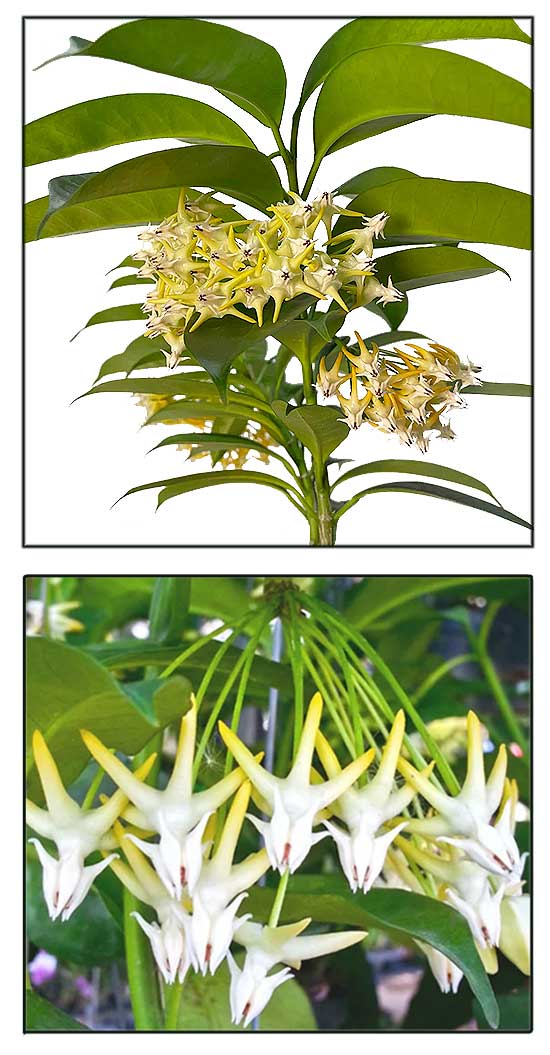
Gen info • Plants glabrous throughout except for corolla throat. Stems erect or decumbent, to 2.5 m tall, pale gray, yellowish when dry, with persistent leaf scars. Petiole 1-2 cm; leaf blade oblong-lanceolate, 8-18 × 2-6 cm, thick papery when dried, base cuneate, apex obtusely acuminate; lateral veins obscure. Inflorescences extra-axillary, subterminal, or terminal, hemispherical, many flowered; peduncle stout, 1.5-3 cm. Pedicel 3.5-7 cm. Sepals ovate, ca. 2.5 × 1.7 mm; glands many, linear. Corolla yellowish white with orange lobe apices, 1.6-1.8 cm, strongly reflexed from base; limb ca. 6 mm, throat white villous; lobes oblong-triangular, ca. 1.2 × 0.8 cm. Corona on distinct stalk; lobes yellow, narrowly lanceolate, 8-9 mm, outer angles extended into acuminate spurs, inner angles acuminate, higher than stigma head. Follicles linear-lanceolate in outline, 12-18 cm. Seeds ovate, ca. 4 × 2 mm; coma to 5 cm. Distribution - Study of dichloromethane extracts of Hoya multiflora isolated lupeol (1a), α-amyrin (1b), ß-amyrin (1c), lupeol acetate (2a), α-amyrin acetate (2b), and ß-amyrin acetate (2c) from stems; and 1b, bauerenol (3), squalene (4), lutein (5), β-sitosterol (6a), and stigmasterol (6b) from the leaves. (6) Properties Studies Availability |
 Botany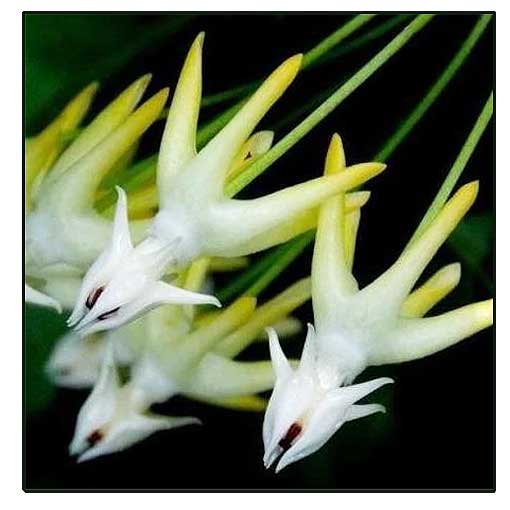
August 2026

 |
| PHOTOS / ILLUSTRATIONS |
| IMAGE SOURCE: Hoya multiflora / by Scott Zona / Some rights reserved / CC BY 4.0 International / Image modified / Click on image or link to go to source page / Wikipedia |
| OTHER IMAGE SOURCE: Hoya multiflora / HOYA MULTIFLORA CARE / Non-commercial use / Image modified / Click on image or link to go to source page / OHIO TROPICS |
| OTHER IMAGE SOURCE: Hoya multiflora / Vermont Hoyas / Non-commercial use / Image modified / Click on image or link to go to source page / VermontHoyas |
| OTHER IMAGE SOURCE: Hoya multiflora / HOYA STORE AUSTRALIA / Non-commercial use / Image modified / Click on image or link to go to source page / HoyaStoreAustralia |
Additional
Sources and Suggested Readings |
• |
DOI: It is not uncommon for links on studies/sources to change. Copying and pasting the information on the search window or using the DOI (if available) will often redirect to the new link page. (Citing and Using a (DOI) Digital Object Identifier) |
| List of Understudied Philippine Medicinal Plants |
| New plant names needed The compilation now numbers over 1,750 medicinal plants. While I believe there are hundreds more that can be added to the collection, they are becoming more difficult to find. If you have a plant to suggest for inclusion, native or introduced, please email the info: scientific name (most helpful), local plant name (if known), any known folkloric medicinal use, and, if possible, a photo. Your help will be greatly appreciated. |
• |
 |
|
