 Gen info Gen info
- Alternanthera is a genus of flowering plants in the family Amaranthaceae. It is a widespread genus with most species occurring in the tropical Americas, others in Asia, Africa and Australia. The genus contains both terrestrial and aquatic species. Estimates of species in the genus is unclear, ranging between 80 and 200. POWO lists 106 species. Many species have been reported as noxious weeds, the most important of which is alligator weed (A. philoxeroides), a South American aquatic plant that has spread to other continents. (3)
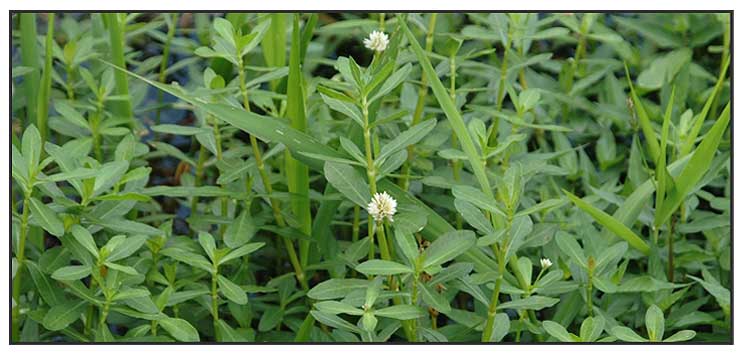
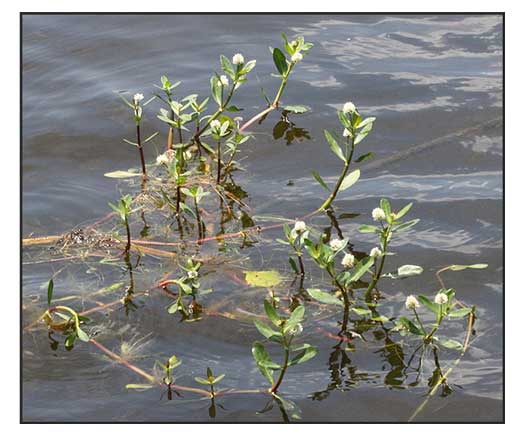
- Alternanthera philoxeroides, called alligator weed, is an invasive species, an aquatic plant found in waterways.
- Etymology: The genus name Alternanthera derives from Latin and Greek roots: alternatus and anthera, respectively, referring to its anthers with alternating fertile and sterile parts. The specific epithet "philoxeroides" combines Greek words philos (loving) and xerox (dry), referring to its adaptability - its ability to grow in both wet and dry conditions.
 Botany Botany
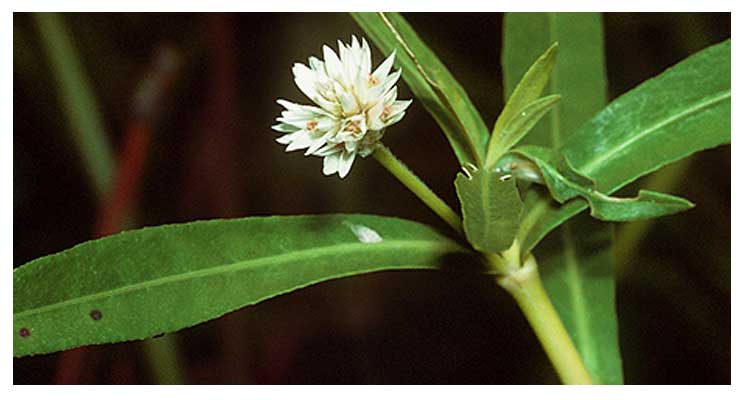
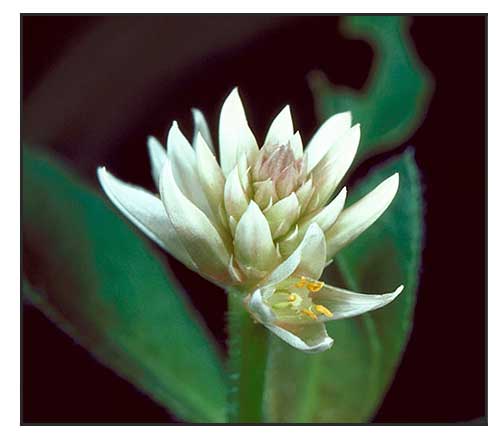
• Alternanthera philoxeroides is characterized by whitish, papery flowers along its short stalks, irregular, or sprawling hollow stems, and simple and opposite leaf pattern sprouting from its nodes. It is also considered a herbaceous plant due to its short-lived shoot system. It produces horizontal stems, otherwise known as stolons, that can sprout up to 10 meters (33 ft) in length and thanks to its hollow stems, floats easily. This results in large clusters of stem amassing and create dense mats along the surface. Flowers are bisexual, small, white, and born on dense, axillary spikes (type of raceme). Presence of a peduncle is a key trait that distinguishes the species from the sessile inflorescences of Alternanthera sessilis. While seed production has been observed in its native range, there is currently no record of viable A. philoxeroides seeds in the introduced range. The weed's intricate root system can either allow them to hang free in the water to absorb nutrients or directly penetrate the soil/sediment and pull their nutrients from below. (Wikipedia)
• Perennial herbs with prostrate, fistular, striate, stem rooting at the nodes and eventually become erect and aerial, often much branched forming dense masses. Leaves opposite, 5-10 x 0.5-2.5 cm, elliptic to obovate-lanceolate with acute base, with midrib prominent on the lower surface; petiole 1-6 mm long. Inflorescence axillary (occasionally terminal), pedunculate (1-5 mm long) white, globose heads, 10-18 mm across; bracts ovate-lanceolate, glabrous, acute, 1-veined, faintly keeled. Perianth dorsally compressed, white glabrous; tepals 5, subequal oblong-lanceolate with mucronate tip 1-5 nerved. Fertile stamens 5, pseudo-staminodes longer than the filaments and lacerate at tips. Pollen 10-12 ?m, spherical with 7 large pores, surrounded by pentagonal ridges. Ovary shortly stalked, ovoid with slender style and capitate, densely papillose stigma. (India Biodiversity Portal)
Distribution
- Naturalized.
-
Native to the
Argentina Northeast, Argentina Northwest, Bolivia, Brazil North, Brazil Northeast, Brazil South, Brazil Southeast, Brazil West-Central, Colombia, French Guiana, Guyana, Paraguay, Peru, Suriname, Trinidad-Tobago, Uruguay, Venezuela. (1)
 Constituents Constituents
- Studies of aerial parts have isolated at least 9 alkaloids, belonging to the classes of ß-carboline, indole, phaeophytin and tyramine alkaloids, among themn: phaeophytin A and phaeophytin A'; N-trans-feruloyl-3,5-dimethoxytyramine, N-trans-feruloyl-3-methyldopamine, N-trans-feruloyl-tyramine, N-cis-feruloyl-tyramine, indole-3-carboxaldehyde, indole-3-carbosylic acid. (5)
- At least 60 compounds have been isolated, mainly from aerial parts, of which flavonoids and saponins form the two major classes.
(5)
- Preliminary phytochemical screening of leaves yielded carbohydrates, proteins, amino acids, steroids, cardiac glycosides, flavonoids, alkaloids, tannins and phenolic compounds. (8)
- Study of aerial parts isolated two new compounds, alternanthin B (1) and N-trans-feruloyl-3,5-dimethoxytyramine (2), along with 4 known compounds (3-6). The compounds were evaluated for antitumor activity (results not available online). (13)
- Preliminary phytochemical screening of leaves yielded carbohydrates, proteins, amino acids, steroids, cardiac glycosides, flavonoids, alkaloids, tannins and phenolic acids. (14)
- GC-MS analysis of extracts from dry powder of
leaf, stem and root revealed presence of acetic acid, 2-(2-methoxycarbonylamino-5-nitrophenylthio)-, methyl ester, at the highest concentration (31.9 %), followed by 1, 4-benzenediol, 2, 5-bis (1,1-dimethylethyl)- (15.06 %). (see study below) (15)
Properties
- Alternanthera philoxeroides thrives in both dry and aquatic environments. (4)
- Studies have suggested antibacterial, antioxidant, anticoagulant, estrogenic, anti-anxiety, anti-dengue, fodder nutritive properties.
Invasiveness / Hazards
- It is an invasive species, a major threat to ecosystems because of adverse effects it poses on both aquatic and terrestrial environments. It is in the
list of invasive alien species of Union Concern since 2017, meaning import and trade of the species is forbidden in the whole of the European Union. Its cluster of stems produces dense mats that disrupts the natural flow of water, out-competing native vegetation for space and solar energy, and altering the regular exchange of gases that occurs underneath the surface, directly influencing aerobic processes, such as photosynthesis.
- The thick dense mats that disrupt water flow can also provide habitats for mosquitoes.
Parts used
Leaves, roots, stems.
 Uses Uses
Edibility
- Edible; eaten as vegetable in parts of Asia.
- Young leaves, eaten raw. Young tops, raw or cooked.
Folkloric
- No reported folkloric medicinal use in the Philippines.
- In China,
widely used as traditional medicine for various viral illnesses: measles, influenza, and hemorrhagic fever. (5)
- In Bangladesh, used for treatment of diarrhea and dysentery; in India, as remedy for anemia; in Thailand, for treatment of blood conditions, fever, post-natal depression, wounds, and to stimulate milk secretion. (5)
- In Bangladesh, used for treatment of pain and diabetes.
(19)
Others
- Agroforestry: Plant can be used as a tertiary filtration system for domestic sewage. (10)
- Compost: Plant sometimes cultivated as source of biomass for compost-making. (10)
- Fodder weed: Studies have suggested potential as fodder species. (see study below) (17)
Studies
• Antibacterial / Leaves: Various studies have evaluated A. philoxeroides for antibacterial activity. of Aqueous and chloroform-methanol (MeOH) (1:1) extracts of leaves showed antibacterial activity against B. subtilis, E. coli, P. aeruginosa and S. aureus with zones of inhibition of 13.6, 14.1, 17.13 and 13.33 mm for the aqueous extract, and 18.27, 14.8, 19.23, and 16.2 mm for the chloroform-methanol extract. MICs for both were in the range of 35.25 and 80.0 µg/mL. Activity was attributed to alkaloids, saponins, and sterols present in the extracts. (5)
• Antioxidant / Anticoagulant / Leaves, Roots, Stems: Study evaluated the phytochemicals, antioxidant and anticoagulant activities of methanol extract of whole plant (leaves, roots, stems) on female Swiss albino mice. Total phenol, flavonoid, and tannin contents were 181.75, 101.5 and 68.58 mg/g, respectively. HPLC study confirmed presence of four phenolic compounds: catechin, tannic acid, gallic acid, and vanillic acid. The ME showed considerable antioxidant activity in all four assays: DPPH, NO, CUPRAC, and reducing power assays. On anticoagulant activity of the bioactive compounds, vanillic acid showed strongest anticoagulant effect on PT, followed by gallic acid, tannic acid, and catechin. In aPTT, tannic acid was most prominent, followed by catechin, galic acid, and vanillic acid. Toxicity testing showed three doses of ME (250, 500, and 1000 mg/kg) are non toxic to internal organs with no discernible effects on daily administration on organ weights (heart, liver, kidny, lung, stomach, and brain). Hematological evaluation showed therapeutic dosages have a large margin of safety. (6)
• Edible Paper Sheets: Various edible paper sheets (EPS) are crafted from seaweeds, known commer-cially as nori in Japan and China, gim in Korea, and gamet in the Philippines. They are used plain or seasoned for soups or as wrappers for rice balls. Study evaluated the proximate composition, amino acid profile, and color values of edible sheets from Alternanthera philoxeroides incorporating different levels of Hypophthalmichthys molitris flesh. Protein content in EPSs varied based on fish flesh incorporation, peaking at 52.66%. Protein and carbohydrate contents showed an inverse correlation across EPSs. Lipid content correlated with H. molitrix flesh content. In amino acid analysis, methionine was most prevalent. GC-MS analysis revealed 51 bioactive compounds, including carbonic acid, hentriacontane, and various fatty acids. Elemental composition showed abundance of Ca, N, K, O, C, Mg, Na, P, Cl, Mn, and Fe. Results showed EPS prepared from A. philoxeroides and H. molitrix have potential for utilization of aquatic biomass and providing both plant and animal nutrients to consumers. (7)
• Anti-Anxiety via Estrogenic Activity: Ovariectomy (OVX) causes estrogen deprivation and oxidative stress which leads to hippocampus cell death and cause mood disorders such as anxiety. Study evaluated the anti-anxiety effect of A. philoxeroides extract (AP) on OVX-induced estrogen deprivation in mice model. AP and E2 (1 µg/kg/day) were used, and anxiety-like behavior was assessed by EPM (elevated plus maze) and LD (light/dark exploration) test. Results showed E2 and AP 250 and 500 significantly diminished anxiety behavior. The antianxiety activity was attributed to AP via estrogenic activity through rutin, quercetin, and kaempferol. (9)
• Health Risks as Vegetable / Heavy Metals in Roots: In India alligator weed grows in abundance in polluted Peri-urban Greater Hyderabad and is sold in markets as leaf vegetable. The plant accumulates iron (Fe), manganese (Mn), cadmium (Cd), lead (Pb), and zinc (Zn) in roots and leaves. Soil samples showed significant metal concentrations of Pb, Mn, and Zn. The metal accumulation order in plants is root > leaf > stem in all studied sites. Although the plants are rich in nutraceuticals like phenolics and antioxidants, the massive roots are effective in bioconcentrating Fe, Mn, Zn, Pb, and Cd. In low income communities that consume it as vegetable, the leafy vegetable can cause health risks. (11)
• Alligator Weed as Feed Supplement: Study evaluated the effects of incorporating AW as a dietary supplement on production performance, immune responses, and antioxidant levels in Vanaraja chicks. Results showed chickens fed a diet with 1% AW had noticeably better body weight, weight gain and feed intake, The 1% AW supplementation mitigates the effects of cold stress, enhances productivity and boosts immunity. (12)
• Antibacterial Against Phytopathogens / Stem, Leaves, Roots: Study evaluated the antibacterial activity of alligator weed organic extracts against three bacterial phytopathogens (Erwinia carotovora, Ralstonia solanacearum and Xanthomonas axonopodis), using disc diffusion method at 100 mg/Ml extract concentration. The n-hexane extract of leaves showed maximum inhibition zone diameter (28.1mm) against R. solanacearum, with positive control Penicillin at 48 mm IZD. Activity was attributed to compounds revealed by GC-MS. (see constituents above) (15)
• Anti-Dengue Virus: Study evaluated the effects of A. philoxeroides extracts against dengue virus in vitro. MTT assay and observation of cytopathic effect (CPE) was used to determine cytotoxicity on C6/36 cells lines and effects on dengue virus. The extracts showed not obvious cytotoxicity except for concentrations over 320 µg/ml. All extracts showed inhibitory effects on dengue virus. Extracts from petroleum ether showed strongest inhibi8tory effect with ED50 of 47.43. (16)
• Potential Fodder Weed: Study evaluated the nutritive value of quickly spreading invasive weed Alternanthera philoxeroides at different harvest times including days after emergence (DAE): 28, 42, 56, 70 and 120 DAE. The best time for harvest in measures of nutritive quality, digestibility, and fodder yield was 70 DAE. Crude protein contents ranged from 10.2 to 14.2%. Total phenolic content range was 52.--87 µg/b. The plant possesses nutritive value comparable to that of alfalfa, sorghum and maize. The potential for multi-cutting, positive response to climate, vigorous growth under stress and all type of habitats ensure its potential as new fodder species. (17)
• Antihyperglycemic / Antinociceptive / Whole Plant: Study evaluated the methanolic extract of shade-dried and powdered leaves for antinociceptive and antihyperglycemic activities in Swiss albino mice. Antinociceptive activity evaluated by attenuation of number of constrictions in acetic acid-induced gastric pain showed dose dependent and significant inhibitions in number of constrictions using doses of 50, 100, 200 and 400 mg/kbw. Extract also exhibited dose-dependent and significant antihyperglycemic activity with reduction of of serum glucose concentrations by 36.3, 58.6, 65.0 and 65.6% at four doses administered, with results favorably comparable with standard glibenclamide at 42.7% at dose of 10 mg/kbw. Results validate the folk medicinal use of the plant in Bangladesh for pain and diabetes. (19)
Availability
- Wild-crafted.
|