Gen info
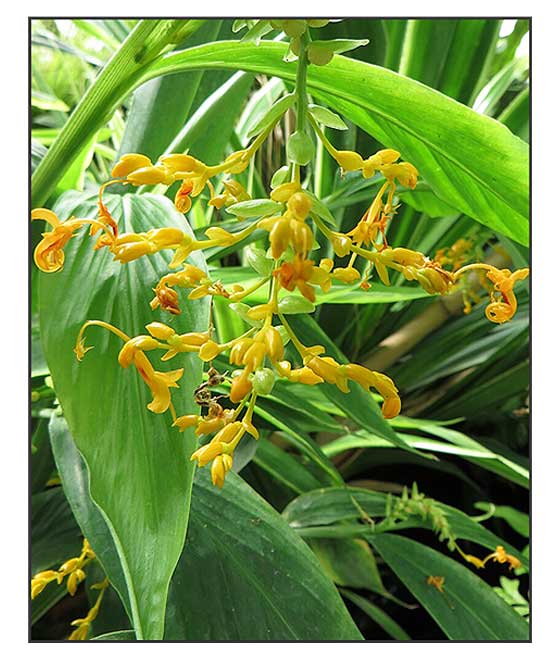
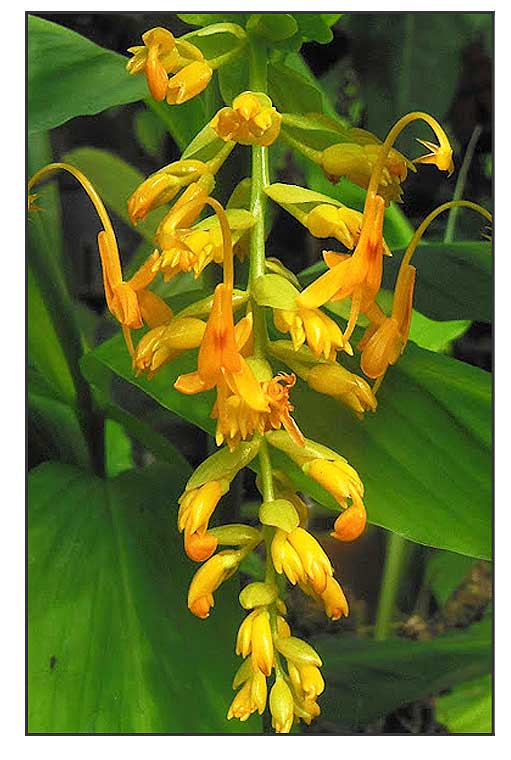
- Globba is a genus of plants in the ginger family, with delicate flowers, sometimes called "dancing ladies" or "dancing girls ginger".
- POWO lists 138 species.
Globba marantina is the type species.
- A total of 8 species are currently known in the Philippines, all of which are endemic except for Globba marantina, which is naturalized in tropical regions around the world.
- Etymolgy: The genus name Globba derives from the Ternate language word galoba, referring to plants within the ginger genus. The specific epithet marantina honors Venetian physician and botanist Bartolomeo Maranti (1500-1571), a 16th century Italian botanist.
 Botany Botany
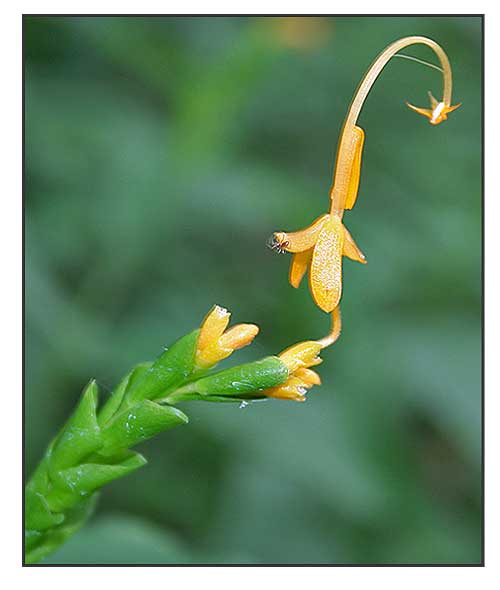
• Herb 20–45 cm tall. Leaf sheaths purplish green, pubescent; ligule truncate, 2 mm long, ciliate; blades 2–7, elliptic to somewhat ovate, 9–20 by 2–6 cm, sparsely so above, pubescent below, rarely glabrous, base cuneate, apex acuminate; petiole to 1 cm on upper leaves. Inflorescence horizontal, compact, cylindrical, 2–8 cm long; peduncle hardly exserted beyond leaf sheaths, most bracts sterile; rachis pubescent; bracts persistent, elliptic, ca 1 by 1 cm, diminishing gradually towards apex, green, densely pubescent; cincinni short, flowers 1–3 per cincinnus, sessile; bracteoles persistent, elliptic, ca 5 mm long, shallowly hooded, pubescent, yellow. Flower: ovary ellipsoid, ca 2 by 1 mm; calyx funnel-shaped, ca 3 mm long, trilobed, lobes acute to acuminate, yellow; floral tube 1.2 cm long, yellow, dorsal corolla lobe elliptic, ca 6 by 2 mm, hooded, yellow, lateral corolla lobes elliptic, ca 5 by 2 mm long, shallowly hooded, yellow; lateral staminodes oblong, 0.8–1 by 0.3 cm, twice as longer as corolla lobes, yellow; labellum obtriangular, ca 8 by 4 mm, bilobed, lobes acute, yellow with red spot; stamen: filament ca 2 cm long, yellow; anther elliptic, 2 mm long, connective tissue yellow, appendages 4, triangular, ca 3 mm long, yellow. Fruit globose, 5–8 mm diam., verrucose, orange. Bulbils numerous, in axils of bracts, narrowly ovoid to conical with irregularly verrucose surface, ca 1 cm long. (eFlora of Thailand)
Distribution
- Listed as native to the Philippines by POWO. (1)
-
Listed as "Naturalized" at Leonardo Co's database. (2)
-
In Luzon: Bataan, Bulacan, Cavite, La Union, Nueva Ecija, Pampanga, Pangasinan, Rizal, Zambales; Mindoro, Negros, Palawan, Panay. (2)
- In lowland and medium elevation thickets near human settlements. Often common. (2)
- Native to Andaman Is., Assam, Bangladesh, Bismarck Archipelago, Borneo, Cambodia, China South-Central, East Himalaya, India, Jawa, Laos, Lesser Sunda Is., Malaya, Maluku, Myanmar, Nepal, New Guinea, Nicobar Is., Philippines, Queensland, Sri Lanka, Sulawesi, Sumatera, Thailand, Vietnam. (1)
 Constituents Constituents
- Phytochemical screening of methanolic extract of leaves revealed presence of alkaloids, cardiac glycosides, steroids, with absence of saponins and anthraquinones. (see study below) (5)
- Methanolic extract of leaves yielded total phenolic content of 129.44 mg GAE/g DW, total flavonoid of 97.958 mg QE/g DW, and total flavonol content of 120.639 mg QE/g DW. (see study below) (5)
- Quantitative analysis of aqueous extracts of leaves and roots
showed total phenolic content (mg GAE/g extract) of 54.82 and 49.37; total flavonoid content (mg QE/g extract) 38.52 and 34.16; and total tannin content (mg TAE/g extract) of 26.47 and 24.84. Alcoholic extracts of leaves and roots showed TPC of 82.46, 76.19; TFC of 6t4.93 and 58.74; and TTC of 41.28 and 38.92. (see study below) (6)
- Secondary metabolite constituents of EA extracts two endophytic actinomycetes included bactobolin, actinobolin, 5-(2-aminoethyl)-1 H imidazole-2-carbaldehyde, isovaleric acid, fulvic acid, phenol, 4-[2-(methylamino) ethyl]-, eicosanoic acid, heptadecanoic acid, etc.
(see study below) (7)
- GC/MS study of methanoll extract
of rhizome yielded: Heptadecane, pinocarvone, L-linalool, alloaromadendrene, ß-caryophyllene, α-humulene, terpineol, lavandulol, 2,6-dimethyl-1,5,7-octatrien-3-ol. (9)
- GC-FID and GC/MS study for essential oil showed ß-caryophyllene
as major compound, followed by
α-humulene, (Z)-nerolidol, and (Z,Z)-farnesol.
 Properties Properties
- Studies have suggest antioxidant, antidiabetic, α-amylase and α-gucosidase inhibitory properties.
Parts used
Bulbs, leaves, roots.
Uses
Edibility
- Small bulbil are edible; eaten fresh or dried. Also used as flavoring.
- In Malaya, used as spice.
Folkloric
- In the Philippines, (2)
- Used for treatment of earaches and as eye drops for conjunctivitis.
- Small bulbils used to stimulate the appetite.
- In India, roots and leaves used for treatment of asthma, rheumatoid arthritis, cough, cold, snakebites, among other. Also used by Orissa practitioners for treatment of conjunctivitis and leukoderma.
(4)
- In India, rhizomes used in post-natal care of mother and child:
Paste of fresh rhizome is mixed with equal aunt of rhizome of Dioscorea tomentosa. Aqueous extract of leaves used as eye drops for conjunctivitis and eye abrasions. For leukoderma, crushed fresh rhizome is mixed with Pongamia seed oil and the paste applied on white spots. (8)
Studies
• Antioxidant / Leaves: Study evaluated methanolic extract of leaves for antioxidant activity and compared with ascorbic acid and BHT.
IC50 in DPPH radical scavenging assay showed 145.80, 100.27 and 113.89 µg/ml, respectively. EC50 in reducing power assay (µg/ml) showed 142.85, 68.67, and 60.76, respectively; EC50 in ferric reducing assay (µg/ml) showed 34.95, 32.90, and 20.49, respectively. Antioxidant properties were attributed to high content of phenolic compounds. (see constituents above) (5)
• Antidiabetic / Leaves: Study evaluated the in-vitro antidiabetic activity of G. marantina using
α-glucosidase and α-amylase inhibitory assays, glucose uptake studies, and cytoprotective evaluation on pancreatic ß-cells under glucotoxic conditions. Extracts showed significant, concentration-dependent inhibition of carbohydrate-digesting enzymes, enhanced glucose uptake, and protective effects against glucose-induced ß-cell damage. Results suggest promising antidiabetic properties and a potential source of bioactive compounds for diabetes treatment. (see constituents above) (6)
• Broad Spectrum Bioactivities of Endophytes: Endophytic actinomycetes are potential sources of novel pharmaceutically active metabolites. Study of secondary metabolites from two endophytic actinomycetes, Streptomyces parvulus GloL3 and Streptomyces lienomycini SK5, isolated from Globba marantina and Selaginella kraussiana, exhibited broad-spectrum bioactivity. EA extract of SK5 showed antibacterial activity against nine human pathogens,, including MRSA, Candida tropicalis and C. alibicans. GloL3 showed antioxidative potentialities against DPPH, ABTS, FRAP, and H2O2 free radical generators. It improved enzymatic antioxidatiive parameters in treated peritoneal macrophage cells of Swiss albino mice. Results suggest metabolites from endophytes possess potent pharmaceutical utilities. (see constituents above) (7)
Availability
- Wild-crafted.
- Seeds in the cybermarket. |


_in_Talakona_forest,_AP_W_IMG_8155.jpg)