HOME      •      SEARCH      •      EMAIL    •     ABOUT


Family Apocynaceae
Devil pepper
Rauvolfia verticillata (Lour.) Baillon
COMMON DEVIL PEPPER
Luo fu mu

Scientific names Common names
Cerbera chinensis Spreng. Common devil pepper (Engl.)
Dissolena verticillata Lour. Devil pepper (Engl.)
Ervatamia ophiorhizoides (Kurz) Lace  
Ervatamia ventii Ly  
Hunteria sundana Miq.  
Hunteria sundana var. minor Miq.  
Ophioxylon belgaumense Wight  
Ophioxylon chinense Hance  
Ophioxylon densiflorum (Wall.) Thwaites  
Ophioxylon macrocarpum Wight  
Ophioxylon majus Hassk.  
Ophioxylon neilgheerense Wight  
Ophioxylon zeylanicum Wight  
Rauvolfia altodiscifera R.H.Miao  
Rauvolfia brevistyla Tsiang  
Rauvolfia chinensis (Hance) Hemsl.  
Rauvolfia densiflora (Wall.) Benth. ex Hook.f.  
Rauvolfia densiflora var. macrophylla Hook.f.  
Rauvolfia latifrons Tsiang  
Rauvolfia loheri Merr.  
Rauvolfia major (Hassk.) G.Nicholson  
Rauvolfia membranacea Merr.  
Rauvolfia obversa Koord.  
Rauvolfia ophiorrhizoides (Kurz) Merr.  
Rauvolfia peguana Hook.f.  
Rauvolfia perakensis King & Gamble  
Rauvolfia serpentina var. gracilis Staph  
Rauvolfia superaxillaris P.T.Li & S.Z.Huang  
Rauvolfia taiwanensis Tsiang  
Rauvolfia verticillata (Lour.) Baill. . . .  
Rauvolfia yunnanensis Tsiang  
Tabernaemontana cylindrica Steud.  
Tabernaemontana densiflora Wall.  
Tabernaemontana microcarpa Wall.  
Tabernaemontana ophiorrhizoides Kurz  
Tabernaemontana parviflora B.Heyne ex Wall.  
Tabernaemontana subcapitata Hook.f. & Thomson  
Tabernaemontana wallichiana Steud.  
Rauvolfiais verticillata is an accepted species. KEW: Plants of the World Online

Other vernacular names
CHINA: Sha bao an luo, Luo fu mu, Ji yan zi.
INDIA: Amalpori, Vanduvara (Malayalam).
INDONESIA: Salung-salung
MALAYSIA: Pokok batu pelir kambing.
THAILAND: Cheepuk, Chaek, Yaa kae haak.
VIETNAM; Ba g[aj]c v[of]ng, T[is]ch ti[ee]n, Sam t[oo], Ba gac la to, Ba gac Campuchia, Ho rac, Ka day, Ba gac cam bot, Cay nhanh.

Gen info
- Rauvolfia (sometimes spelled as Rauwolfia) is a genus of evergreen tree and shrubs, commonly known as devil peppers, in the family Apocynaceae.
- Rauvolfia verticillata, the common devil pepper, is a plant in the family Apocynaceae.
- Etymology: The genus Rauvolfia honors Leonhard Rauwolf. The genus name was established by Carl Linnaeus in his 1763 book Species Plantarum, which states in Botanical Latin that the name is dedicated to Leonhard Rauwolf: "Leon  Rauvolfio". Subsequent authors hypercorrected the Classical Latin letter "v" to a modern "w", which is not accepted by the code of nomenclature. The specific epithet verticillata derives from Latin, meaning "whorled", referring to the plant leaves. (4) (5)

Botany
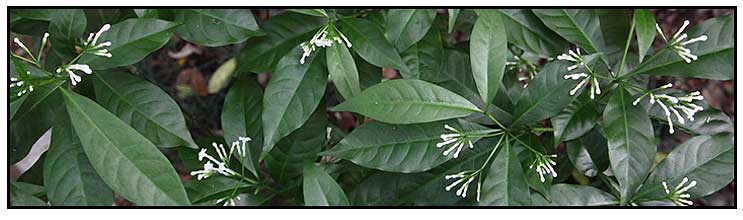
A shrub up to 3 m tall; leaves (2-)3-verticillate, elliptical, (8-)10-20 cm x (2-)4-6 cm, petiole up to 1.5 cm long; flowers with narrow cylindrical corolla tube much longer than calyx; fruit consisting of 1-2 elliptical drupelets. (3)

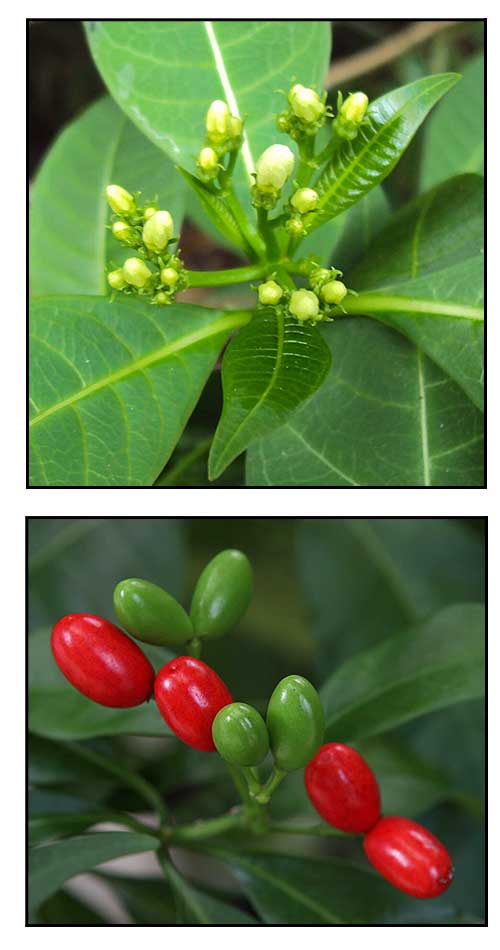
• Shrubs to 3 m tall, erect, glabrous. Branchlets pale gray, lenticellate. Lower leaves opposite, terminal leaves in whorls of 3 or 4; petiole 0.5-1.5 cm; leaf blade narrowly to broadly ovate or oblong, 3.5-25 X 5-13 cm, nearly papery to membranous; lateral veins 6 or 7 pairs. Cymes rather lax, 3-9 together; peduncle 2-15 cm. Pedicel 3-6 mm. Corolla white, tube cylindric, 1-1.8 cm, inflated and villous from middle to throat; lobes broadly elliptic or ovate, 1-4.5 mm. Stamens inserted at middle of corolla tube. Ovaries distinct. Drupes ellipsoid or ovoid, distinct, ca. 10 X 5 mm. Seed 1. (Flora of China)

Distribution
- Native to the Philippines. (1) (2)
- In Luzon: Bataan, Benguet, Camarines Norte, Ilocos Norte, Rizal. In open areas, rainforests, 30-2000 m.   (2)
- Also native to Assam, Bangladesh, Borneo, Cambodia, China South-Central, China Southeast, East Himalaya, Hainan, India, Jawa, Laos, Lesser Sunda Is., Malaya, Myanmar, Sri Lanka, Sulawesi, Sumatera, Taiwan, Thailand, Vietnam. (1)
- In lowland to montane rain forest and monsoon forest, up to 1700 m altitude, often in open places in hills and mountains, e.g. along rivers, near villages and rice fields. (3)
- Threatened by deforestation and urban development.

Constituents
- Study of stems of Rauvolfia verticillata isolated five new hexacyclic monoterpenoid indole alkaloids, rauvovertine A (1), 17-epi-rauvovertine A (2), rauvovertine B (3), 17-epi-rauvovertine B (4), and rauvovertine C (5), along with 17 known analogues. (see study below) (6)
- Study of chloroform layer extract isolated 3 indole alkaloids and one acridone alkaloids and identified as: ajmalicine B (1), sandwicine (2), raunescine (3) and 7-hydroxynoracronycine (4). (9)
- R. verticillata contains reserpine and yohimbine. (see study below) (10)
- HPLC (hihg-performance liquid chromatography) assay identified five bioactive indole alkaloids: sarpagine, yohimbine, ajmaline, ajmalicine, and reserpine. (11)

Properties
- Studies have anti-inflammatory, anticancer, antiproliferative, smooth muscle relaxant, ulcerative colitis-ameliorative properties.

Parts used
Leaves, roots, branches, stems.

Uses

Edibility
- No info found on edibility.
Folkloric
- No reported folkloric medicinal use in the Philippines.
- In Indo-Chinese and Chinese medicine, used as sedative and for hypertension. Fresh leaves are applied to snake bites, wounds, and inflamed eyes. (3)
- In Chinese medicine, also used for malaria and typhus. (4)
- In traditional Chinese medicine (TCM), roots used to dispel wind and heat, reduce liver heat, disperse swelling and remove toxin, tranquilise the mind; branches and leaves used to clear heat and remove toxin, activate blood and disperse swelling. (9)
Others
- Adulterant: Roots used as adulterant for R. serpentina.

Studies
Alkaloids / Cytotoxicity / Stems:
Study of stems of Rauvolfia verticillata isolated five new hexacyclic monoterpenoid indole alkaloids, rauvovertine A (1), 17-epi-rauvovertine A (2), rauvovertine B (3), 17-epi-rauvovertine B (4), and rauvovertine C (5), along with 17 known analogues. The new alkaloids were evaluated for in vitro cytotoxicity against human tumor HL-60, SMMC-7721, A-549, MCF-7, and SW-480 cell lines. (Results not accessible at present) (6)
Alleviation of Inflammation-driven Colorectal Cancer and Modulation of Gut microbiota / Pectic Polysaccharides: Study evaluated the effects of pectic polysaccharides (PPs) from R. verticillata in inflammation-associated CRC (colorectal cancer) via modulation of gut microbiota and NF-kB/IL-6/STAT3 signaling pathways. Results showed PP intervention significantly mitigated AOM/DSS-induced weight loss, intestinal lesions, and disease activity index (DAI) scores while suppressing NF-kB and STAT3 activation. PP restored gut microbiota diversity, especially hexanoic and isohexanoic acids. PP alleviates CRC and is associated with modulation of gut microbiota, SCFA metabolism, and NF-kB/IL-6/STATE3 signaling, suggesting potential for a strategic strategy for inflammation driven CRC. (7)
Antiproliferative / Smooth Muscle Relaxation / Alkaloids / Roots and Rhizomes: Study of roots and rhizomes isolated a new acridone alkaloids, 9-hydroxynoracronycine (1) along with four known compounds, including coumarins, lignan, and indole alkaloid. Compound 1 was tested against human breast cancer cell line MCF-7 and human promyelocytic leukemia HL-60. Results showed decreased MCF-7 cell proliferation with statistically significant IC50 at 102.8 µmol/L, along with moderate small intestine smooth muscle relaxation. (8)
Toxicity Profile: R. verticillata contains reserpine and yohimbine. Reserpine inhibits vesicular mono-amine transporter resulting in reduced action of catecholamines in tissue. Yohimbine is an antagonist of α-2 adrenergic receptors. There are no reported cases of poisoning in humans. (10)
Ameliorative Effect on Ulcerative Colitis / Pectic Polysaccharides: Study evaluated the effects and mechanisms of pectic polysaccharides (PP) from R. verticillata var. hainanensis on dextran-sulphate sodium (DSS)-induced ulcerative colitis (UC) in female BALB/c mice. TNF-α and interleukin 6 (IL-6) were significantly reduced while expression of IkBα was up-regulated, and ERK, JNK, and p38 were activated. PP inhibited activation of MAPKs and NF-kB pathways in bone marrow-derived DCs. Results suggests PP significantly ameliorated murine DSS-induced UC model, via regulation of MAPKs and NF-kB pathways in DCs. (13)

Availability
- Wild-crafted.

January 2026

                                                 PHOTOS / ILLUSTRATIONS
IMAGE SOURCE: Rauvolfia verticillata / by Vinayaraj / CC BY-SA 3.0 / Click on image or link to go to source page / Wikipedia
OTHER IMAGE SOURCE: Rauvolfia verticillata: leaves and flower buds / by Vinayaraj / CC BY-SA 3.0 / Click on image or link to go to source page / Wikipedia
OTHER IMAGE SOURCE: Rauvolfia verticillata: (2 images) / © Atlas of Poisonous Plants / Non-commercial use / Click on image or link to go to source page / Atlas of Poisonous Plants

Additional Sources and Suggested Readings
(1)

Rauvolfia verticillata / KEW: Plants of the World Online
(2)
Apocynaceae: / Rauvolfia verticillata / Co's Digital Flora Database
(3)
Rauvolfia verticillata / Tran Dinh Ly, Pham Duy Mai / PROSEA
(4)
Rauvolfia verticillata / Wikipedia
(5)
Rauvolfia / Wikipedia
(6)
Phytochemical and Pharmacological Profile of Rauvolfia verticillata (Lour.) Baill. / Sunil Kumar, Bikarma Singh / Book: Bioactives and Pharmacology of Medicinal Plants, Volume 2, Chapter 55 /
DOI: 10.1201/9781003281702-23
(7)
Rauvolfia Verticillata Pectic Polysaccharides Alleviate Inflammation-Associated Colorectal Cancer and Correlate with Modulation of Gut Microbiota, Short-Chain Fatty Acid Metabolism, and NF-κB/IL-6/STAT3 Signaling Pathways / Yi-fan Guo, Yujie Wang, Haidong Wu, Liudan Wang, Xinpu Miao / Nutrition and Cancer, 2025; 77(10): pp 1183-1199 / DOI: 10.1080/01635581.2025.2551294
(8)
Chemical constituents from rauvolfia verticillata and bioactivities research
/ Hong Bo, Jin Gao, Jian Wu, Chunjie Zhao / Chemistry of Natural Compounds, 2012; 48(2): pp 276-280 /
DOI: 10.1007/s10600-012-0220-6
(9)
Chemical constituents of Rauvolfia verticillata / Bo Hong, Wen-Jing Li, Chun-Jie Zhao / Acta Pharmaceutica, 2012; 47(6): pp 764-768
(10)
Rauvolfia verticillata / Atlas of Poisonous Plants in Hongkong - Clinical Toxicology Perspective
(11)
Determination of indole alkaloids and highly volatile compounds in Rauvolfia verticillata by HPLC-UV and GC-MS / Bo Hong, Wenjing Li, Aihua Song, Chunjie Zhao / J Chromatogr Sci., 2013; 51(10): pp 926-930 / DOI: 10.1093/chromsci/bms191. 
(12)
1H-NMR metabonomics study of the therapeutic mechanism of total alkaloids and ajmalicine from Rauvolfia verticillata in spontaneously hypertensive rats / Min Feng, Shiyi Xu, Min Zhao, Chunjie Zhao, Yinan Wang / Anal.Methods, 2014 / DOI: 10.1039/c4ay00851k
(13)
Pectic polysaccharides extracted from Rauvolfia verticillata (Lour.) Baill. var. hainanensis Tsiang ameliorate ulcerative colitis via regulating the MAPKs and NF-κB pathways in dendritic cells / Xin-Pu Miao, Xiao-Ning Sun, Qiong-Si Li, Lu-Jia Cui et al / Clin Exp Pharmacol Physiol., 2019; 46(1): pp 48-55 /
DOI: 10.1111/1440-1681.13026

DOI: It is not uncommon for links on studies/sources to change. Copying and pasting the information on the search window or using the DOI (if available) will often redirect to the new link page. (Citing and Using a (DOI) Digital Object Identifier)

                                                            List of Understudied Philippine Medicinal Plants
                                          New plant names needed
The compilation now numbers over 1,730 medicinal plants. While I believe there are hundreds more that can be added to the collection, they are becoming more difficult to find. If you have a plant to suggest for inclusion, native or introduced, please email the info: scientific name (most helpful), local plant name (if known), any known folkloric medicinal use, and, if possible, a photo. Your help will be greatly appreciated.

HOME      •      SEARCH      •      EMAIL    •     ABOUT