Gen info
• Asteraceae is a large family of flowering plants consisting of over 32,000 known species in over 1,900 genera within the order Asterales. The number is rivaled only by Orchidaceae. The family was first described in 1740 under the name Compositae. It is an economically important family, which provides food staples, garden plants, and herbal medicines.
(31)
• Sonchus is a genus of flowering plants in the tribe Cichorieae within the family Asteraceae, and commonly known as sow thistles.
• Etymology: The common name 'sow thistle' derives from its attractiveness to swine and the similarity of its leaf to the pig's ear. The scientific name's Latin roots. The genus name Sonchus derives from Greek words sonkhos or sogos, an old classical name used by Theophrastus and Dioscorides for a type of thistle. Alternatively, it may refer to the hollow stems or its attractiveness to swine. The specific epithet oleraceus derives from Latin olus or holus, meaning "resembling garden herbs," "edible," or "pertaining to vegetables used in cooking," alluding to the its young leaves long use for human consumption.
• Sow thistles exude a milky latex when any part of the plant is cut or damaged, which was fed to lactating sows in the belief it will increase milk production; hence, the name "milk thistle."
- As of 2023, POWO lists 106 species.
(32)
- Mythological snippet: In Greek mythology, Theseus is said to have eaten sow-thistle to gain power before journeying to
slay the Minotaur in its Cretan labyrinth, where it dines on human bodies, bull's heads, and young Atheneans. (40)
 Botany
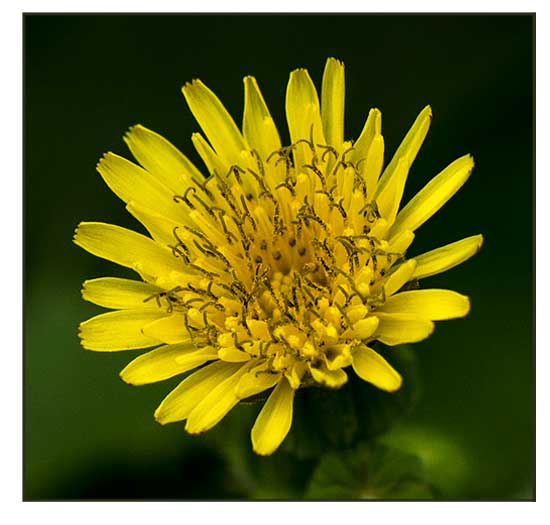
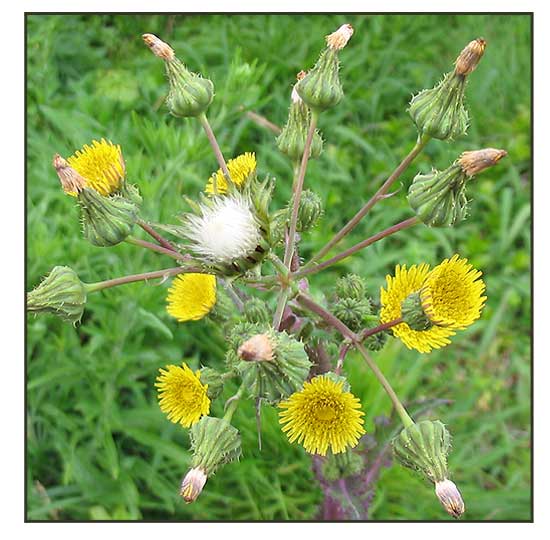
• Gagatang is an erect, annual, milky, hairy or slightly glandular herb, growing 40 to 80 centimeters high. Leaves are oblong to lanceolate, 10 to 20 centimeters long, coarsely and lyrately lobed; the lobes somewhat reflexed and toothed, the terminal ones large, the lateral one pointing downwards, and those of the stem clasping at the base. Heads are peduncled, about 1 centimeter long. Bracts are smooth, thin and green. Flowers are numerous and yellow. Achenes are nearly 3 millimeters long, compressed, ribbed and rough.
• Annuals or biennials, 10–140(–200) cm. Stem bases soft to hard, herbaceous, often hollow. Leaves: blades of mid cauline spatulate or oblong to obovate or lanceolate, 6–35 × 1–15 cm, bases auriculate, auricles deltate to lanceolate, ± straight, acute, margins usually pinnately (often runcinately) lobed, lobes ± deltate to lanceolate, not constricted at bases, terminals usually larger than laterals, entire or dentate. Peduncles usually glabrous, sometimes stipitate-glandular. Involucres 9–13+ mm. Phyllaries usually glabrous, sometimes tomentose and/or stipitate-glandular. Corollas: ligules ± equaling tubes. Cypselae dark brown, mostly oblanceoloid, 2.5–3.5+ mm, ribs 2–4 on each face, faces transversely rugulose or tuberculate across and between ribs; pappi 5–8 mm. (Flora of North America)
• Annual herb, 30–110 cm high, with taproot and fibrous roots. Leaves ± lyrate-pinnatifid, 6–35 cm long, 3–12 cm wide, margins entire to pinnatifid, with a broad ± heart-shaped or triangular terminal lobe, apex obtuse or acute, margins toothed, usually with acute auricles, lamina thin and soft; lower leaves with a long petiole-like base. Heads 5–6 mm diam., few to many in cymose or umbellate inflorescence; involucral bracts glabrous or with glandular hairs along midline. Achenes compressed-obovoid, 2.5–4 mm long, 3-ribbed on each face, wrinkled, with narrow margins; pappus 5–8 mm long. (PlantNET)
 Distribution
- Introduced.
- Naturalized.
(8)
-
Found only in the Benguet subprovinces, Rizal and Laguna provinces in Luzon.
- In waste places, along trails, old gardens, on talus slopes at altitudes of 1,200 to 2,000 meters.
- Considered an invasive species.
- Occurs in all warm countries.
- Native to Albania, Algeria, Austria, Azores, Baleares, Baltic States, Belarus, Belgium, Bulgaria, Burkina, Canary Is., Cape Verde, Central European Russia, Chad, Corse, Cyprus, Czechia-Slovakia, Denmark, Djibouti, East Aegean Is., East European Russia, Egypt, Eritrea, Ethiopia, Finland, France, Germany, Great Britain, Greece, Gulf States, Hungary, Iran, Iraq, Ireland, Italy, Ivory Coast, Kriti, Krym, Lebanon-Syria, Libya, Madeira, Mali, Mauritania, Morocco, Netherlands, North Caucasus, North European Russia, Northwest European Russia, Norway, NW. Balkan Pen., Oman, Palestine, Poland, Portugal, Romania, Sardegna, Saudi Arabia, Selvagens, Sicilia, Sinai, Socotra, Somalia, South European Russia, Spain, Sudan-South Sudan, Sweden, Switzerland, Transcaucasus, Tunisia, Türkiye, Türkiye-in-Europe, Ukraine, Yemen.
(22)
Constituents
- Reported to contain the same constituents as S. arvensis.
-
Contains fixed oil with stearic and palmitic acids, ceryl-alcohol, invert sugar, choline, tartaric acid.
- Milky juice contains oxydase, coautchoue, mannite, l-inosite, etc.
- Phytochemicals of aqueous extracts yielded sugar reducers, phenolic compounds, tannins, flavonoids and coumarins.
- Study yielded four sesquiterpene glycosides - sonchusides A, B, C and D together with five known glycosides - glucozaluzanin C, macrocliniside A, crepidiaside A and picrisides B and C. (7)
- Study for chemical constituents yielded four compounds: p-methoxyphenylacetic acid (1), luteolin (2), apigenin (3), quercetin-3-O-glucoside (4). (26)
- Preliminary screening of various extracts of crude powdered drug yielded cardiac glycosides, steroid, tannins, phenolic compound, flavonoid, and carbohydrate. (see study below)
(28)
 Properties
Studies have suggested antidepressant, antinociceptive, anxiolytic, anti-inflammatory, cytotoxicity, anti-quorum sensing, cytotoxicity, antimicrobial, antioxidant, anti-HIV, protease inhibitory, anticancer, prebiotic, antioxidant, anticancer, wound healing, anti-aging, genotoxicity, anti-mutagenic, antidiabetic, antiglycation, pigmentary (snti-vitiligo), phytoremediation properties.
Parts used
Stem, leaves, gum, juice.
 Uses
Edibility
- Entirely edible; the flavor and texture significantly varies as the plant matures, turning bitter as they age.
- Best harvested when young (4-12 inches tall). Young leaves are soft, mild, with taste akin to lettuce or spinach.
- Eaten raw in salads, steamed, sautéed, or added to soups and stews.
- Young roots are cooked; juicy, but not very palatable.
- Milky sap used as chewing gum by the Maoris of New Zealand.
Folkloric
- Brownish gum formed by the evaporation of the common sow thistle, when taken internally in a dose of two to four grains, acts as a "powerful hydragogue cathartic" with strong effects on the liver, duodenum and colon. Its effects resemble elaterium, producing large and watery discharges, thus an effective agent in ascites and hydrothorax. However, it may cause griping like senna and produce tenesmus like aloes. To counteract that effect, the gum is administered with manna, aniseed, and carbonate of magnesia, or with stimulants and aromatics
- Natives of Bengal use an infusion of leaves and roots as tonic and febrifuge.
- In Indochina, stems used as sedative and tonic.
- In Italy, used as a laxative and diuretic.
- Juice of the plant used for cleaning and healing ulcers.
- In Brazilian folk medicine, used as a general tonic. Also used in the treatment of headaches, general pain, hepatitis, infections, inflammation and rheumatism. (18)
- In India juice of fresh leaves taken orally every morning for hepatotropic / hepatoprotective. (30)
- Latex sap used in treatment of opium addiction, warts, and cancer. Stem juice considered hydrogogue and cathartic, but used with caution as it may cause colic and tenesmus. Leaves used as stomachic and sedative; for treatment of gastritis and eye problems. Leaves applied as poultice to inflammatory swellings. Leaf sap used for treatment of earaches and deafness caused by earwax. Infusion of leaves and roots used as tonic and febrifuge. Roots are abortifacient, purgative, and vermifuge. (38)
Others
- Agroforestry: While primarily considered as an agricultural weed, it provides functional roles in agroforestry, intercroppin, and soil management systems. It is a compatible companion for major crops such as onions, tomatoes, corn, cucumbers, and squashes. Its deep taproot helps breakdown compacted sub-layers and improves soil aeration and water filtration.
- Pollinator Attraction: The small flowers attract beneficial insects and pollinators like bees and butterflies into the agricultural plot.
- Phytoremediation: Studies have shown SO has potential to accumulate potential toxic elements (PTEs) like cadmium (Cd), and zinc (Zn) in contaminated soils, and provides a low-cost alternative for phytoremediation of degraded or mining impacted land. (see study below) (38)
Studies
• Antidepressant: Study of S. oleraceus extracts in mice showed evidence of an antidepressant-like effect comparable to that of amitriptyline (10mg/K p.o.). (2)
• Antinociceptive: Extracts of SO markedly demonstrated antinociceptive action in mice, supporting previous claims of traditional use. At 300 mg/kg, it had a stronger antinociceptive effect than indomethacin (5 mg/kg) and morphine (10 mg/kg). (3)
• Anxiolytic: Study of extract of aerial parts showed anxiolytic effects in mice similar to clonazepam (0.5 mg/kg). (4)
• Phytochemicals / Low Toxicity: Study of aqueous extracts showed phenolic compounds, tannins, flavonoids and coumarins. Toxicity test on Artemia salina indicated low toxicity.
• Antioxidant / Cytotoxicity: Study of SO extracts showed concentration-dependent antioxidant activity. The methanol extracts yielded the greatest the most phenolic and flavonoid contents. Cytotoxicity activity showed the ethanol extract had the best activity against the growth of stomach cancer cell. (5)
• Anti-Quorum Sensing / Antimicrobial: A study of 14 ethanolic extracts of different parts of 8 plants for antimicrobial and antiquorum sensing activity showed Sonchus oleraceus and Laurus nobilis to have superior activity against Chromobacterium violaceum. Quorum sensing is involved in microbial pathogenesis, and its inhibition may be a way of controlling bacterial infections with the advantage of reducing risks of resistance development. (6)
• Phytochemicals: Study yielded alkaloids anthraquinones, flavonoids, terpenes, tannins, steroids, and cardiac glycosides in leaves and roots. (10)
• Antitumor: Study evaluated three types of extracts on AM-3 (Murine mammary adenocarcinoma). In the group treated with cold aqueous extract for a month, necrotic changes in cancer mass was noted. Results showed antitumor effects and, possibly, activation of the immune system. (11)
• Antioxidant: Study showed strong antioxidant activity as measured in the 2,2-diphenylpicrylhydrazyl (DPPH) assay. Data suggest a potential as a nutraceutical supplement for human health. (12) Crude extracts of whole plant of S. oleraceus showed in vitro antioxidant activity on DPPH, H2O2 and OH-scavenging assays. (see constituents above) (28)
• Wound Healing: A 10% extract of Sonchus oleraceus was studied in repair of skin tissues in 36 male Wistar rats. Results showed less necrotic tissue, lower slough and more granulation tissue, increased fibroplasia, less neovascularization. Results showed tissue repair conforming with normal physiological patterns. (13)
• Antimalarial: Nine crude extracts of three Sudanese medicinal plants were evaluated for antimalarial activity in their ability to inhibit growth of Plasmodium falciparum. Ethanolic and chloroform extracts of S. oleraceus were inactive; however a petroleum extract showed moderate activity against P. falciparum. (14)
• Cytotoxic Variations / Anticancer: Study evaluated ethanolic, cold aqueous, and hot aqueous extracts against three cancer cell lines in vitro. The three extracts showed concentration and time dependent growth inhibitory effects, the highest obtained from the ethanol extract. Results suggest cytotoxic concentrations showed variation in values among cell lines according to cell types in vitro. (15)
• Effects of Stressors, Cooking and Digestion on Antioxidant Activities: Study showed caftaric, chlorogenic, and chicoric acids to account for 92% of phenolic compounds in S. oleraceus leaves. Study identified factors that caused significant variation in antioxidant properties, namely: maturation, genetic heredity, abiotic stressors, propagation method, and cooking. Human cells were more protected from oxidative damage if leaves had stressor-augmented antioxidant activities. Results suggest the potential of S. oleraceus as a functional food crop. (16)
• Loliolide / Roots / Cytotoxic: Phytochemical study of roots of Sonchus oleraceus yielded loliolide (1) together with 15-O-β-glucopyranosyl- 11β,13-dihydrourospermal A (2), ursolic acid (3), lupeol (4), and β- sitosterol-3-O-β-glucopyranoside (5). Compounds 1 and 2 showed cytotoxic activity against L5187Y cell line. (17)
• Anti-inflammatory: Study evaluated the anti-inflammatory activity of S. oleraceus in in vivo inflammatory models. A hydroalcoholic extract demonstrated marked anti-inflammatory activity in a carrageenan-induced paw edema model in rats. (18)
• Antinociceptive: Study evaluated hydroethanolic and dichlormethane extracts of aerial parts in chemical and thermal models markedly demonstrated antinociceptive action in mice. (19)
• Anti-HIV / Inhibition of Protease Activity / Coumarins: Study evaluated coumarin compounds extracted from S. oleraceus for inhibitory action against enzymes involved in the replication of HIV. Methanol extracts showed significant inhibition of protease activity as compared to standard, lopinavir. (20)
• Modulation of Human Colonic Microbiota through Plant-Derived Prebiotics: Prebiotics are naturally occurring carbohydrates classified as non-digestible oligosaccharides present in edible plants, eliciting systemic physiological functions, acting as fermentable substrates for colonic-microflora. Study evaluated prebiotic compounds, especially inulin, in non-commercialized leafy plants. Of 22 plants studied, Sonchus oleraceus exhibited the best prebiotic effect, and was the only plant to stimulate all the probiotics. (21)
• Anticancer Effects: In vivo study evaluated the anticancer effects of three types of extracts (ethanolic, cold aqueous and hot aqueous) on AM-3 (Murine mammary adenocarcinoma). Results suggest antitumor effects. Results showed severe necrosis of cancer mass, delay in growth of transplanted tumor and prevention of growth. Histopathological study sowed no toxic abnormalities in most organs of treated animals. Besides an antitumor effect, results suggest activation of the immune system. (23) In vitro study evaluated the anticancer effects of three extracts (EE, CAE, and HAE) of SO on three cancer cell lines (murine mammary adenocarcinoma, AMN-3 cell line, laryngeal carcinoma Hep-2 cell line). The three extracts showed concentration and time dependent growth inhibitory effects. Cytotoxic concentrations of the extracts showed variation among the cell lines. (24)
• Prebiotic Effect: In contrast to probiotics, prebiotics are naturally occurring carbohydrates classified as non-digestible oligosaccharides present in edible plants. Study studied prebiotic compounds, especially inulin, from the aqueous extracts of 22 locally growing non-commercialized leafy plants. Sonchus oleraceus showed the best prebiotic effect and was the only plant to stimulate all the probiotics including B. longum. (25)
• Anti-Ageing Effects on H2O2-Induced Cell Senescence / Leaves: Study hypothesized that S. oleraceus extracts protect cells against H2O2-induced senescence by mediating oxidative stress. SO extracts suppressed H2O2 stress-induced premature senescence in a concentration dependent manner. better or equivalent to corresponding ascorbic acid treatments. Results suggest a potential for formulation as an anti-ageing agent. (27)
• Wound Healing / Repair of Tissue Injuries: Study evaluated a 10% extract of S. oleraceus in the repair of skin lesions of 36 male wistar rats subjected to punch injury. Results showed tissue repair with increased fibroplasia, greater changes in shrinkage of lesion, less necrotic tissue, lower slough and more granulation. (29)
• Anti-Inflammatory Effect on Lipopolysaccharide Stimulated RAW 264.7 Cells in Mice: Study evaluated an aqueous extract of SO for anti-inflammatory activity on lipopolyysaccharide stimulated RAW 264.7 cells. SO extract significantly inhibited production of pro-inflammatory cytokines and mediators at gene and protein levels with concentration of 31.3 µg/ml, and suppressed expression of TLR-4, COX-2, NF-kB, pSTAT in RAW 264.7 cells. (33)
• Antidiabetic / Antiglycation / Antioxidant: Study evaluated the antidiabetic and antioxidant potential of methanolic extracts of S. oleraceus leaves. Extract exhibited significant antioxidant activity, with high flavonoid and polyphenol levels, underscoring potential as natural antioxidant. It also demonstrated notable α-glucosidase and α-amylase inhibition, along with antiglycation effects evidenced by prevention of advanced glycation end products and protein damage. Results suggest antioxidant, antidiabetic and anti-inflammatory properties and potential for application in management of diabetes and oxidative stress. (34)
 • Mitigation of Sodium Benzoate-Induced Cytotoxicity and Genotoxicity / Antimutagenic: Sodium benzoate (SB) is a versatile food preservative used in packaged food and drink industries, which has been found to cause genotoxicity and DNA damage. Study evaluated of S. oleraceus leaf extract for potential mitigating activity against SB by using the Allium cepa in vivo bioassay and molecular analysis. Results demonstrated aqueous extracts of SO exert a concentration-dependent genotoxic effect on A. cepa cells, particularly at high concentration. SB treatments along significantly disrupted mitotic activity, increased chromosomal aberrations, and induced genomic instability. Co-treatment with SO extract partially ameliorated these effects, indicating moderate antimutagenic activity. At high concentrations, SO exhibited genotoxicity, underscoring the need for precise dosage determination in traditional and clinical applications. (35)
• Treatment for Vitiligo / Leaves: Study reports on the use of S. oleraceus leaf infusion for the treatment of vitiligo in 11 patients with depigmentation in various regions of the body. Infusion of leaves was used for 3 to 13 months (average of 9 months). The tea was prepared with 5 leaves in a litter of water, consumed at an average of 700 mL a day. The infusion of S. oleraceus caused pigmentation of the white spots in the patients with vitiligo. (36)
• Antimicrobial: Study evaluated S. oleraceus for bioactive compounds, antimicrobial activity, and its molecular characterization using RAPD. Phytochemical screening of various extracts revealed alkaloids, flavonoids, proteins, carbohydrates, tannins, phenols, terpenoids, and saponins. By agar well diffusion method, at concentrations of 150, 200, 250, and 300 mg/ml, extracts showed concentration dependent antimicrobial activity against K. pneumonia, S. aureus, P. aeruginosa, E. coli and S. typhi. (37)
• Phytoremediation / Biostimulant Efficacy in Contaminated Mining Soil: Study evaluated the mitigation capacity of various biostimulant formulations (Trichoderma sp, Phosbactin, Bacillus sp., Azospir and humic substances) in Sonchus oleraceus grown in severely contaminated soil with potential toxic elements (PTEs) from mining. Findings demonstrated complex interactions among biostimulants, soil, plant responses, and PTE concentrations, highlighti8ng the importance of choosing suitable bio-
stimulants for sustainable management of PTE-contaminated soils. Further studies are suggested to identify biostimulant mechanisms mitigating PTE negative effects. (38)
Availability
Wild-crafted.
Seeds, extracts and supplements in the cybermarket.
|