 Gen info Gen info
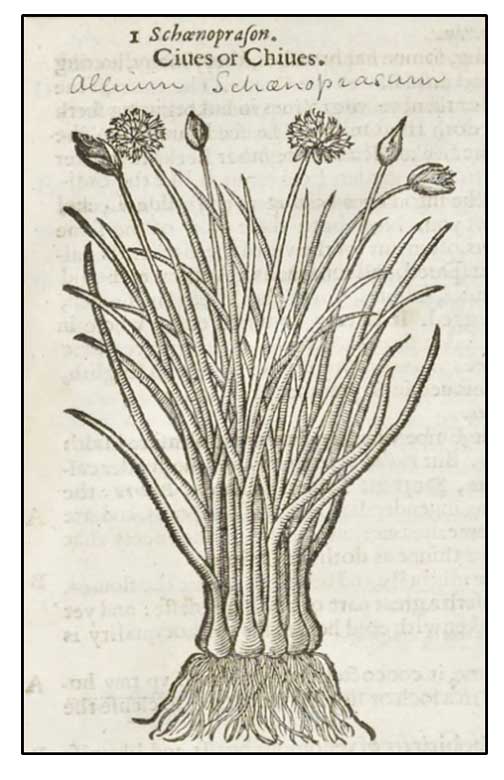
- Chives, Allium schoenoprasum, is a species of flowering plant in the family Amaryllidaceae. It is the only species of Allium native to both the New World and Old World. (2)
- Close relatives of chives include common onions, garlic, shallot, leek, scallion, and Chinese onion. (2)
- It has been in cultivation in Europe since the Middle Ages, for culinary and medicinal use; and as long as 4,000 years ago by the Chinese.
- Taxonomy: It was first described in 1753 by the Swedish botanist Carl Linnaeus in his seminal publication Species Plantarum.
- Etymology: The species name schoenoprasum derives from Greek words skhoinos (sedge or rush) and prason (leek). The English name, chives, derives from the French word cive, from cepa, the Latin word for onion. (2)
- Historical chive snippets: Used since 3000 BC. Brought by Marco Polo to Europe from China in the late 13th century. Once thought to be a poison antidote. An old British tradition suggests chives to border gardens or hang over doorways to prevent evil spirits from entering. Dutch settlers in America planted chives in their pastures to give a different taste and chive-scented milk. (3)
Botany
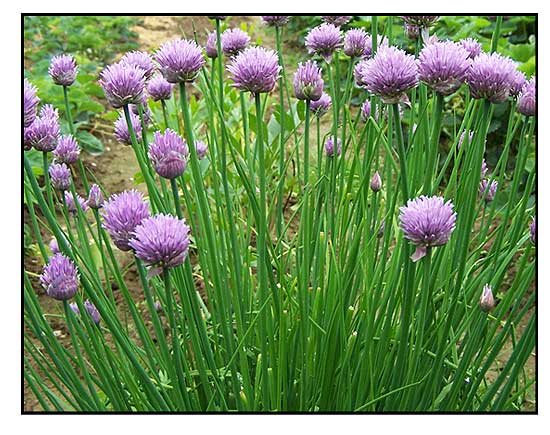
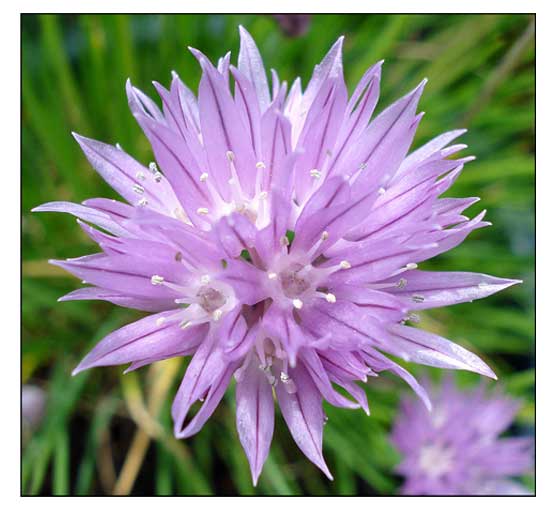
• Chives are a bulb-forming herbaceous perennial plant, growing to 25 centimeters (10 in) tall. Bulbs are slender, conical, 2–3 cm (3⁄4–1+1⁄4 in) long and 1 cm (1⁄2 in) broad, and grow in dense clusters from the roots. Scapes (or stems) are hollow and tubular, up to 50 cm (20 in) long and 2–3 mm (1⁄16–1⁄8 in) across, with a soft texture, although, prior to the emergence of a flower, they may appear stiffer than usual. Grass-like leaves, which are shorter than the scapes, are also hollow and tubular, or terete (round in cross-section). Flowers are pale purple, and star-shaped with six petals, 1–2 cm (1⁄2–3⁄4 in) wide, and produced in a dense inflorescence of 10–30 together; before opening, the inflorescence is surrounded by a papery bract. Seeds are produced in a small, three-valved capsule, maturing in summer. Plant flowers from April to May in the southern parts of its habitat zones and in June in the northern parts. (2)
 Distribution Distribution
- Introduced; not naturalized.
- Native to Afghanistan, Alaska, Albania, Alberta, Altay, Austria, Baltic States, Belarus, British Columbia, Bulgaria, Buryatiya, Central European Russia, Chita, Colorado, Connecticut, Corse, Czechia-Slovakia, Denmark, East European Russia, Finland, France, Germany, Great Britain, Greece, Idaho, Inner Mongolia, Iran, Iraq, Irkutsk, Italy, Japan, Kamchatka, Kazakhstan, Khabarovsk, Korea, Krasnoyarsk, Kuril Is., Labrador, Magadan, Maine, Manitoba, Massachusetts, Michigan, Minnesota, Mongolia, Montana, Netherlands, New Brunswick, New Hampshire, New Jersey, New York, North Caucasus, North European Russia, Northwest European Russia, Northwest Territories, Norway, Nova Scotia, Nunavut, NW. Balkan Pen., Ohio, Ontario, Oregon, Pakistan, Pennsylvania, Poland, Portugal, Primorye, Prince Edward I., Québec, Rhode I., Romania, Sakhalin, Saskatchewan, South European Russia, Spain, Sweden, Switzerland, Tadzhikistan, Transcaucasus, Tuva, Türkiye, Ukraine, Vermont, Washington, West Himalaya, West Siberia, Wisconsin, Wyoming, Xinjiang, Yakutiya, Yukon. (1)
 Constituents Constituents
- Nutrient analysis on 1 tbsp of chopped chives: Energy 0.9 calories, vitamin K 6.38 mcg (5% dail]y value DV), vitamin C 1.74 mg (2% DV), folate 3.15 mg (2% DV), vitamin A 6.43 mcg (1%DV), calcium 2.76 mg (<1%DV), potassium 8.88 mg (<1%DV)
(USDA). (12)
- Phytochemical screening of chive leaves yielded alkaloids, flavonoids, glycosides, steroids, tannins, and minerals, including potassium, magnesium, and sodium. (see study below)
(15)
- GC-MS analysis of both fresh and dried leaves of Chinese chives revealed 5 major bioactive compounds viz., 2-methoxy-4-vinyl phenol, dimethyl sulfone, n-hexadecanoic acid, 2-hydroxy-gamma-butyrolactone,
and furaneol.
(see study below)
- Comparative study on levels of potassium, calcium, and sodium
in fresh and boiled chives revealed: K 321.1147 NS 169.2157 mg/100 g; Ca 47.4054 and 43.842 mg/100g, and Na 10.0729 and 4.2025 mg/100 g, respectively. (see constituents below) (25)
Properties
-
Studies have suggested antioxidant, anti-inflammatory, neuroprotective, anthelmintic, antilithogenesis, antiurolithiatic, fertility-promoting, antifungal, antibacterial , antimicrobial, hypoglycemic, hypolipidemic, anti-epileptic properties.
Toxicity
- Reported toxicity to dogs, cats, and horses.
- Toxic principle: N-propyl disulfide.
- Signs: Vomiting, blood in the urine, weakness, high heart rate, panting. (22)
Parts used
Leaves, bulbs.
Uses
Edibility
- Leaves, flowers and bulbs are edible, with a mild onion flavor; used as flavoring for soups, stews, sauces, and salads, and stir-frying of meat, fish, and vegetables. (•)
- Cultivated for their scapes and leaves, and their wide variety of culinary uses. Edible flowers used for making blossom vinegars. Both scapes and
unopened, immature flower buds are diced and used as ingredient for omelets, fish, potatoes, soups, etc. Scapes are often paired weith cream cheese. In his 1806 book Attempt at a Flora (Försök
til en flora), Anders Jahan Retzius wrote of such uses. Chives are one of the fines herbes of French cuisine, along with tarragon, chervil, and parsley. (3)
Folkloric
- In Agusan del Norte, Higaonon and non-Higaonon in Sitio Lomboyan, Buenavista, embrocation of crushed leaves used for treatment of cough.(4)
- The Maranao healers administer chives during labor of a parturating woman to lessen labor pain and to thwart bad spirits that might cause harm to both mother and child. Healer also prepare the chive by squeezing and extracting juice from the leaves, to be drunk by the pregnant woman, at the same time, applying crushed leaves on the abdomen. Maranaos believe evil spirits are attracted to pregnant women and their babies. Besides birthing, chives are also used to cure headaches, the plastered leaves plaster on the forehead. (6)
- In ancient herbal medicine, Romans used chives to relieve sunburn pain or a sore throat; also for raising blood pressure or as diuretic. (3)
- Plant considered digestive, hypotensive and tonic.
Others
- Repellent: Used as insect repellent. Chives are repulsive to most insects because of their sulfur compounds. Retsius describes how farmers would plant chives between rocks making up the borders of flowerbeds, to keep plants free from pests. The plant repels unwanted insect life, its leaf juice helping in the process, as well as fighting fungal infections, mildew, and scab. (3)
- Nectar: Provides a good amount of nectar for pollinators. It was rated in the top 10 for most nectar production (nectar per unit cover per year) in the United Kingdom plant survey by Agriland project. (3)
- Apotropaic: The Romani, besides using chives in fortune telling, hung dried chives around the house to ward off disease and evil. (3)
- Agroforestry: Chives generally grow well with most plants, especially roses, carrots, beet, chamomile, but inhibit the growth of legumes. The help reduce the incidence of scab when grown under apple trees. It is a bad companion for alfalfa, negatively affecting each other. (17)
Studies
• Antioxidant: Study evaluated the biochemical diversity of chive (A. schoenoprasum) accessions from Türkiye and compared them with other Allium species. Accession A6 showed highest total phenolic content (61.2 g GAE/kg) and antioxidant capacity (139.89 mmol Trolox Eq/kg). A2 showed greatest superoxide dismutase (24.36 U g FW) and catalase (25.66 U g FW) activities. A1 and A2 showed higher rutin contents. Correlation analysis demonstrated strong positive associations between total phenolic content, antioxidant capacit5y, and individual flavonoid concentrations. Results suggest a promising natural antioxidant sources for food and pharmaceutics. (5)
• Anti-Inflammatory / Leaves: Study evaluated the anti-inflammatory effects of A. schoenoprasum leaves, using a 1:1 (w:V) extract. Total phenolic content was 68.5 g GAE/g. In vitro antioxidant activity by DPPH was 6.72 g/mg and 132.8 g trolox eq/g. Anti-inflammatory effect of extract concentrations of 25, 50 and 100% were used on in-vivo model of turpentine oil-induced inflammation in rats. Pure extract (100% concentration) showed best inhibitory activity on phagocytosis and oxidative stress. Results suggest anti-inflammatory activity by inhibition of phagocytosis via reduction of nitro-oxidative stress. (7)
• Antioxidant-Mediated Neuroprotection in Ischemia Reperfusion-Induced Cerebral Injury / Leaves: Study evaluated the effect of A. schoenoprasum leaf extract (ASLE) on functional deficit against IR-induced cerebral injury in mice. IR-injury was induced bt bilateral common carotid arter occlusion for 15 min followed by 24h reperfusion. ASLE doses of 200 and 400 mg/kg p.o. daily were used after IR injury. Oral treatment with ASLE for 7 days significant attenuated IR-mediated memory and sensorimotor function deficit in the mice. The extract also reduced cerebral infarct size and rise in brain TBARS levels, and reduced GSH levels and SOD activity. Results suggest ASLE is safe and effective in improving functional outcomes, demonstrating a neuroprotective effect via enhancement of antioxidant defence against IR injury. (10)
• Anthelmintic: Study evaluated the anthelminthic property of A. schoenoprasum (onion chives) against Ascarius suum in vitro. Mebendazole was used as reference drug. Extract concentrations of 5, 10 and 20% were used. Results showed time- and concentration-dependent anthelmintic activity in measures of motility, paralysis, and death. (11)
• Antilithogenesis / Chive Leaves Powder: Study evaluated the invitro antilithogensis activity of infused solution of chives leaves powder. For invitro antilithogenesis activity, atomic absorption spectrophotometry method was used to measure the dissolved calcium level. In vitro assay showed that 12.5% infused chives can dissolve human calcium stone by 47.7%. Study suggests potential for treatment of calcium lithogenesis. (13)
• Phenolic Content and Antioxidant Activity of Different Tissue Parts: Study evaluated the metabolim of phenolic compounds and change in antioxidant activity inn different parts of post-harvest chives. Compared to the bottom white part (BW), the round green part (RG) exhibited significantly higher contents of phenolic compounds, increased enzyme activities and enhanced antioxidant activities, indicating phenolic compounds were mainly synthesized in RG. Expression levels of genes such as phenylalanine ammonia-lyase, cinnamate 4-huydoxylase and 4-coumaroyl-CoA ligase and their enzyme activities rapidly decreased in RG, and maintained in BW, suggesting more rapid senescence in RG than in BW. Results offer consumer information on nutrition considerations. (14)
• Effect of Potassium on Calcium Oxalate Solubility: Study evaluated the effect of potassium on calcium oxalate solubility in infusion of fresh and dried chives leaves. Phytochemical screening yielded alkaloids, flavonoids, glycosides, steroids, tannins, and minerals, including potassium, magnesium, and sodium. Results showed that potassium in fresh and dried chive leaves infusion significantly affected the solubility of calcium oxalate. Levels of dissolved and solubility percent of calcium oxalate in dried chive leaves solution was higher than fresh leaves solution. One factor affecting calcium solubility is potassium, and chives' high potassium content is believed to dissolved calcium oxalate in kidney stone, (15)
• Effect of Potassium on Calcium Oxalate Solubility: Study evaluated the anti-calculi activity of fresh and dried chives leaves infusion on male albino Wistar rats using 0.75% ethylene glycol and 2% ammonium induction method. Results suggested anticalculi activity in measures of kidney weight ration, calcium level in the kidney, urinary calcium level, urinary oxalate level, and serum creatinine level. Biggest effect of calcium oxalate dissolution in the kidney was with the dried leaves infusion. Results suggest potential for dried leaves as alternative in calculi disease treatment. (16)
• 1-Methylcyclopropene (1-MCP) / Enhanced Antioxidant Capacity and Organosulfur Profile: of Potassium on Calcium Oxalate Solubility: Study evaluated the effect of 1-MCP on quality, antioxidant capabilities and organosulfur profile of chives during storage. 1-MCP treatment enhanced ascorbic acid and glutathione (GSH) content, promoted activity of antioxidant enzymes (SOD, CAT and APX) during 5-day storage at 20°C, inhibited chlorophyll degradation, alleviated cell membrane damage, and delayed senescence. Results demonstrate 1-MCP preserves the quality of chives by enhancement of antioxidant capacities and organosulfur profile during storage. (18)
• Effect on Semen Quality and Hematological Profiles of Roosters under Heat Stress Conditions / Bulb: Study evaluated the effect of chive bulb extract (CBE) as natural antioxidant on roost4rs exposed to heat stress. Treatments with CBE at 1% or higher significantly improved semen characteristics, including semen volume, sperm concentration, and motility, while reducing sperm mortality and abnormalities compared to control. Also, MDA was significantly reduced, while TAC and serum levels of LH, FSH, and testosterone were significantly increase with 2% CBE. Results suggest CBE possess fertility-promoting properties and increased reproductive hormone activity. (19)
• Antifungal Activity / Leaves: Study evaluated the antifungal activity of A. schoenoprasum leaf extract in vivo against phytopathogenic fungi: Aspergillus niger, Botrytis cinerea, B. paeoniae, Fusarium oxysporum f. sp. tulipae, Penicillium gladioli, and Sclerotiorum. Results showed antifungal activity with MICs in the range of 70-120 µl/ml. Results were compared to Fluconazole and synthetic allicin with MICs of 80-300 and 100-160 µl/ml, respectively. (20)
• Antibacterial Activity / Leaves: Study evaluated the antimicrobial activity of various chives extracts against Escherichia coli, Staphylococcus aureus, Shigella dysenteriae, and Lactobacillus acidophilus, using disc diffusion method. The chives extracts with concentrations of 20, 40, 60 and 80% showed growth inhibition against E. coli, S. aureus, S. dysenteriae, with no inhibition zone against L. acidophilus. The absence of inhibition zone against L. acidophilus supports chive extract as one of the good media for its growth, and potential for development of food products, especially those related to probiotics. (21)
• Hypoglycemic / Hypolipidemic Activity / Increase HDL / Leaves: Study evaluated the effect of A. schoenoprasum feeding on blood glucose and lipids in male streptozotocin-induced diabetic rats. Results showed oral administration of A. schoenoprasum to STZ-induced diabetic rats at food weight ratio of 6.25% has a significant hypoglycemic effect, with reduction of serum triglyceride and LDL-cholesterol level, and increase in serum HDL-cholesterol. (23)
• Antiepileptic / Leaves: Study evaluated the potential antiepileptic effects of A. schoenoprasum in rats using two epilepsy models viz., induction by intracortical injection of 500 IU penicillin and i.p. induction by PTZ (pentylenetetrazole). A.schoenoprasum did not significantly change either the spike or amplitude in the penicillin model. Although it did not change the seizure score in the PTZ model, it reduced the death rate and significantly decreased the tonic-clonic seizure duration. Results suggest A. schoenoprasum may have antiepileptic effects when applied chronically. (24)
• Comparative Study on Potassium, Calcium and Sodium / Fresh and Boiled Chives: Study (atomic absorption spectrophotometry) evaluated the differences in the amount of potassium, calcium, and sodium in fresh and boiled chives. Boiling decreased percentages after boiling for potassium by 47.30%, calcium 7.52%, and sodium 58.28%. Results suggest the contents of K, Ca, and Na in fresh chives are significantly higher than boiled chives. (see constituents above) (25)
• Antibacterial / Chives: Study evaluated the antimicrobial properties of aqueous and alcoholic extracts of Allium schoenoprasum against S. aureus, B. cereus, E. coli, and Vibrio cholera by micro broth dilution method. Erythromycin was used as standard. The MICs of alcoholic and aqueous extracts was 16-256 and 32->256 µg/ml, and MBCs of 32-256 and 64->256 µg/ml, respectively. Extracts showed higher activity against S. aureus and B. cereus strains. (26)
Availability
- Wild-crafted.
- Herbs, extracts, tinctures, supplements in the cybermarket.
|