|  Gen
info Gen
info
- Xanthostemon is a genus of plants in the myrtle family Myrtaceae.
- It was
first described in 1864 by the German-born Australian botanist Ferdinand von Mueller. as Metrosideros chrysantha. In 1867, it was reclassified in the genus Xanthostemon by George Bentham in the 3rd volume of his Flora Australiensis.(10)
-
The genus is distributed across Malesia, Papuasia, and northern Ausstralia.
- POWO lists 48 species in the genus.
- Etymology: Xanthostemon derives from the Greek word xanthos meaning yellow, and stemon meaning 'thread of stamen"; chrysanthus derives from chrysos meaning gold, and anthos, referring to the flower color. The common name Golden Penda refers to its spectacular golden flowers.
- It is the floral emblem of the city of Cairns, Queensland, Australia.
 Botany Botany
• Xanthostemon chrysanthus is a perennial small tree or shrub growing to a height of 9 to 12 meters, with
glossy green, alternate lanceolate leaves, 5 centimeters wide to 15 centimeters long, arranged in whorls along the stem.
Flowers are bright yellow, occurring in terminal
rounded clusters, five-parted with numerous
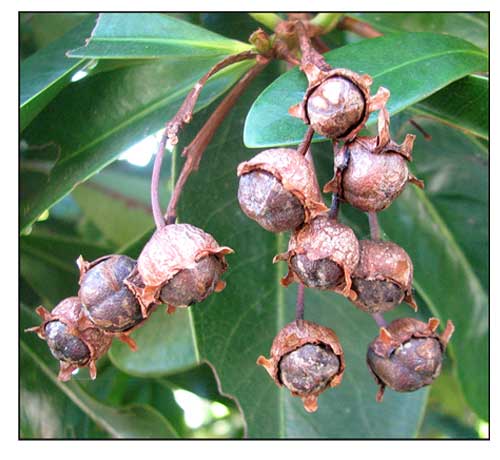
conspicuous bright yellow stamens. Fruits are inedible; a single fruit measuring 10-12 millimeters, rounded and woody, green when young, dark brown when mature. Fully ripened fruits dehisce to disperse tiny seeds.
• Tropical tree, 8 - 12 m in height under cultivation, but up to 40 m in its native environment. Lance-shaped leaves, 8 - 20 cm x 1.5 - 5 cm, arranged spirally, dark green and leathery. Young flushes appear bronze-red. Flowers bright yellow and bisexual with 5 petals attached to rim of calyx. Yellow stamens about 3 cm, surround centrally located style that is 3 - 4 cm long. Fruits are capsules, turn from green to brown upon maturation. Seeds are dispersed by explosive action. (Flora & Fauna Web)
Distribution
- Indigenous to tropical northern Australia, New Caledonia, New Guinea, Indonesia, and the Philippines. (3)
- Planted as ornamental for its unique yellow florals.
 Constituents Constituents
- GC and GC/MS analysis yielded a leaf oil in which the principal component
was the ß-triketone leptospermone (65-84 percent). (1)
- Study isolated four new cinnamoyl-phloroglucinols (1-4) from the leaves of X. chrysanthus. (see study below) (6)
- Study isolated (+)- and (-)-Xanchryones F and G (1,2) from X. chrysanthus by chiral separation. Compounds were evaluated for antibacterial and anti-inflammatory activities. (8)
- Study of leaves isolated (+)/(-)-Xanthrysol A (1), an enantiomeric pair of novel macrocyclic meroterpenoids, along with three enantiomeric pairs of biogenetically related meroterpenoids (+)/(-)-xanthrysols B-D (2-4). (see study below) (9)
- Study of leaves isolated three pairs of dimeric phenyl-propanoyl-phloroglucinol enantiomers. (see study below) (10)
Properties
• Plant attracts nectar feeding birds and insects.
• Propagated through seeds and stem cuttings. Tolerant of hard urban environments. (3)
- Studies have suggested
antibacterial, cytotoxicity, anticancer properties.
Uses
Folkloric
- No reported folkloric medicinal
use in the Philippines.
- Used for purifying the blood; for liver and pulmonary complaints.
Others
- Woodcraft: Hardened wood used by the Ngadjonji of Queensland for making spear points, swords, and digging sticks.
Studies
• Leaf Oils: Xanthostemon chrysanthus produced a leaf oil in which
the principal component was the ß-triketone leptospermone, 65-84%. (see constituents above) (1)
• Antibacterial: In a study of 60 medicinal plant extracts, X. chrysanthum ethanol extract was one of 16 bark and leaf extracts that showed inhibition activity against test bacterium Chromobacterium violaceum DMST 21761. Leaf extract showed an MIC of 2.5 mg/ml. Anti-quorum sensing activity was not detected. (4)
• Cinnamoyl-Phloroglucinols / Cytotoxicity / Breast Cancer Cell Line / Leaves: Study isolated four new cinnamoyl-phloroglucinols (1-4) from the leaves of X. chrysanthus. Compound 3 showed moderate cytotoxicity against MDA-MB-231 and SGC-7901 cells with IC50 values of 25.26 ± 0.35 µM and 31.2 ± 0.94 µM, respectively. (6)
• Xanthrysols / Antiviral Meroterpenoids / Leaves: Study of leaves isolated (+)/(-)-Xanthrysol A (1), an enantiomeric pair of novel macrocyclic meroterpenoids, along with three enantiomeric pairs of biogenetically related meroterpenoids (+)/(-)-xanthrysols B-D (2-4). Xanthrysol A (1) demonstrated potent antiviral activity against respiratory syncitial virus (RSV) and acyclovir-resistant strains of herpes simplex virus type 1 (HSV-1/106, HSV-1/blue, and HSV-1/153) with IC50s range from 4.68 to 8.10 µM. Time-of-addition assays showed compound 1 specifically acts on the early stages of virus replication process for both RSV and HSV.1. (9)
• Xanthchrysones / Antibacterial / Leaves: Study of leaves isolated three pairs of dimeric phenyl-
propanoyl-phloroglucinol enantiomers, (+)= and (-)-xanthochrysones A-C [(+)- and (-)-1-3],, along with postulated biosynthetic precursors. Both (+)-2 and (-)-2 showed moderate antibacterial activities including several multidrug resistant strains. (10)
Availability
- Cultivated.
- Seeds in the cybermarket.
|


_2.jpg)