 Gen info Gen info
- Cosmostigma is a genus of plants in the family Apocynaceae, first described as a genus in 1834, It is native to tropical and subtropical Asia.
-
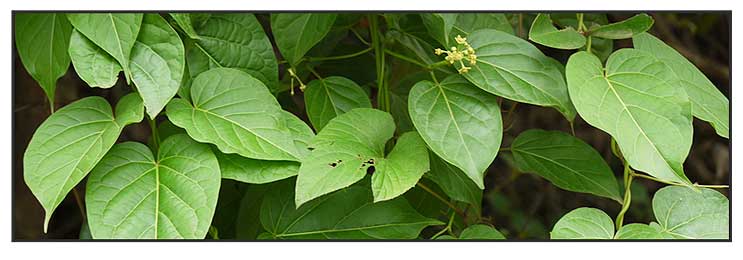
Cosmostigma cordatum, or green milkweed, is a species of flowering plant in the family Apocynaceae. It is a climbing herb growing in moist deciduous forests. (3)
- Etymology: The genus name Cosmostigma derives from Greek words kosmos (beauty) and stigma (stigma), having racemes (flower cluster). Specific epithet cordatum derives from Latin, meaning :heat-shaped", referring to the leaf base.
Botany
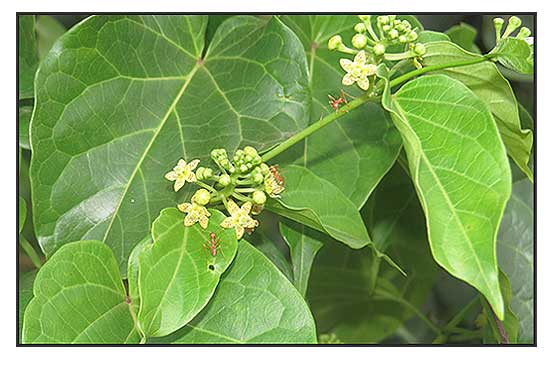
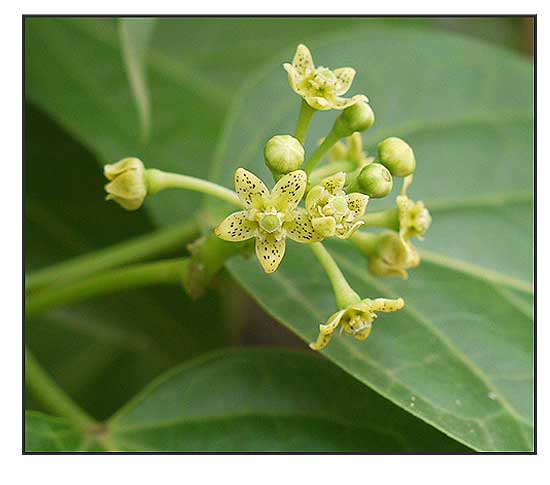
• Climbing herbs, stem glabrous. Leaves 6-10 x 3-5 cm, ovate, apex acute or acuminate, base rounded or subcordate, 5-ribbed, glabrous with a few small black glandular papillae at base, lateral nerves 3 pairs; petiole to 2.5 cm long. Racemes to 2.5 cm long. Flowers 8 mm across, many together; pedicels 1 cm long, slender, pubescent; sepals small, ovate to orbicular, ciliate; corolla greenish-yellow with brown dots, 4 mm long, lobes ovate; gynostegium 2 mm across, outer corona lobes orbicular, emarginate, membranous; inner corona similar to outer. (eFloraofIndia)
Distribution
- Naturalized.
(1)
-
Native to the
Andaman Is., Bangladesh, Cambodia, India, Myanmar, Sri Lanka, Thailand, Vietnam. (2)
 Constituents Constituents
- Preliminary phytochemical analysis of methanol and ethyl acetate extracts of leaves yielded saponins, tannins, terpenoids, phenols, steroids, quinones, glycosides, alkaloids, and flavonoids. Distilled water yielded only saponins, tannins, terpenoids, glycosides, and alkaloids. (4)
- Preliminary phytoanalysis of methanolic extract of leaf powder of C. racemosum yielded steroid +++, flavanoid +, phenol ++. alkaloids +++, tannin +++, saponin +++. Heavy metal analysis in ppm yielded chromium 1.1, copper 8.5, zinc 13.4, lead 0.43, arsenic 0.11, cadmium <detectable limit.
(4)
- GC-MS analysis of n-hexane extract of leaves identified (E,E)-7,11,15-trimethyl-3-methylene-hexadeca-1,6,10,14-tetraene, 1H-cycloprop[e]azulene, decahydro-1,1,7-trimethyl-4-methylene-, n-hexadecanoic acid, 1-naphthalenepropanol,.alpha-ethenyldecahydro-2-hydroxy-.alpha.2,5,5,8a-pentamethyl [1R[1.alpha.(R*).beta.4a.beta.8a.alpha.]]-,cis-3,14-clerodadien-13-ol, squalene and octacosane.
(6)
- Methanol extract of leaves showed higher concentration of phenols (2.29 mg GAE/g) and higher antioxidant activity compared to ethanol and aqueous extracts. Ethanol extract showed higher flavonoid content (51.94 mg QE/g).
(6)
Properties
- Studies have suggested antioxidant, anticancer properties.
Parts used
Flowers, fruit, leaves, bark.
 Uses Uses
Edibility
- No information found on edibility.
Folkloric
- No reported folkloric medicinal use in the Philippines.
- In Indian traditional medicine, leaves used for treatment of ulcerous sores. Root bark is taken internally as a cholagogue in dyspepsia caused by torpidity of the liver. Glycosides extracted from the seeds used for heart failure. Leaves or trunk bark occasionally used as purgative.
(4)
- The Tripuri people of Northeast India drink infusion or decoction of flowers and fruits for treatment of jaundice. (8)
Others
- Host plant: It is a larval host plant of blue tiger and dark blue tiger butterflies. (3)
Studies
• Antioxidant / Leaves: Study evaluated phytochemistry and antioxidant potential of distilled water, methanol, and ethanol extracts of dried leaves. Methanol extract showed higher concentration of phenols (2.29 mg GAE/g) and higher antioxidant activity compared to ethanol and aqueous extracts. Ethanol extract showed higher flavonoid content (51.94 mg QE/g). Study results suggest the leaves have potential as source of food supplements, nutraceuticals, and photo-therapeutics. (see constituents above) (6)
• Anticancer / BCL-2 Inhibitory Activity: Study selected bioactive compounds from Cosmostigma cordatum plant extract. Docked compounds were used for anticancer activity by insilico method wit BCL-2, which plays a prominent role in causing cancer. Out of 20 selected compounds, docking results showed Methyl-1-cyclohexane carboxylate (1) and 1,2-diacetoxy-5-idohexane (2) as the best docked to BCL-2. Compound 1 showed a docking energy of 22.56K cal/mol and compound 2, 20.24K cal/mol with BCL-2. The two compounds showed good BCL-2 inhibitory activity. Identifying the active site of the BCL-2 protein can provide deeper understanding of structure-function relationship and its role in various cellular processes. (7)
Availability
- Wild-crafted.
|


.jpg)