Gen info
- Luvunga is an Asian genus of plants in the family Rutaceae, distributed from India to China, and through Southeast Asia to northern Australia. As of January 2025, POWO accepts 11 species. (9)
- Luvunga scandens is a species of vine first described by William Roxbugh, and received its current name by Buch.-Ham and Wight & Arn.
- Historical snippet: The earliest documented mention of Luvunga scandens was in medieval Kerala palm leaf manuscripts, circa 15th century CE, where it was referred to as "Kambhalu" in local Sanskrit dialects.
 Botany Botany
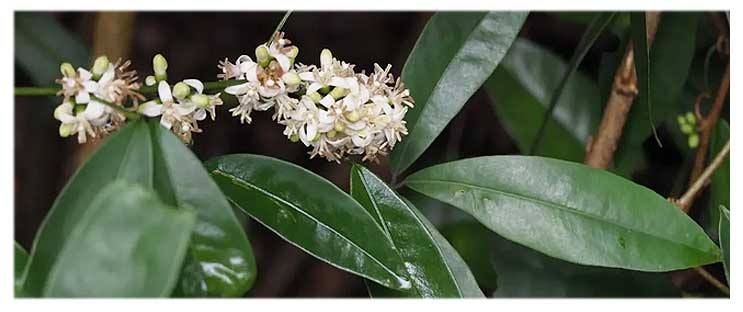
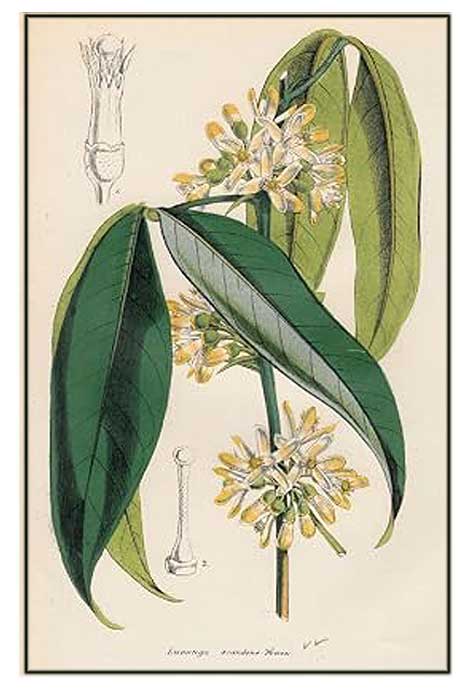
• Heavy woody climbers. Leaves digitately 3-foliolate; petiole 2-9 cm; petiolules 3-10 mm; leaflet blades elliptic to obovate, 6-20 × 3-9 cm. Flowers ellipsoid in bud. Calyx 2.5-4 mm, shallowly 4-lobed. Petals 4.6-10 mm. Stamens 8 or fewer. Fruit yellow, globose or obpyriform, 3-5 cm in diam., surface smooth, 1-4-seeded; outer part of pericarp (exocarp and mesocarp) thick. Seeds broadly ovoid, 2-3 cm.
(Flora of China)
• Heavy woody climbers; bark ash colored, rough tufted from the ground with strong axillary sharp straight or slightly recurved spines. Leaves compound, digitately 3-foliolate, alternate, spiral, simple when young; petioles ca. 3-6.5 cm long, channeled above, glabrous; lamina ca. 6.5-18 x 2.5-4 cm, variable, oblong-elliptic or oblanceolate, cuneate at base, acute or shortly acuminate at apex, entire, thick, coriaceous, glabrous; secondary nerves 15 pairs. Inflorescences in paniculate-racemes, often 4-6-flowered; peduncles ca. 7 mm long, glabrescent; calyx ca. 3.5-5 mm long, cupular; lobes 4, truncate, minute, ciliolate along margins; petals 4, ca. 12-16 x 3-4 mm, white, oblong, obtuse, glabrous, fleshy; stamens 8-10; filaments linear-subulate, connate; staminal tube ca. 12 mm long, glabrous; anthers ca. 5 mm long, linear, apiculate; ovary ca. 2.5 x 1.5 mm, long-ovoid, glabrous, 3-locular; each locule with 1 or 2 superimposed ovules; style ca. 7 mm long, continuous with ovary, cylindric, glandular, glabrous; stigma capitate ca. 2.5 mm broad, glandular. Berries ca. 20×25 mm, oblong; pericarp smooth, densely glandular or pustular, 3-locular. Seeds ovoid, green, pointed at apex; radicle superior. (eFlora of India)
Distribution
- Native to the Philippines.
(1)
- In primary lowland forests.
- In Palawan, Tawi-tawi (?). (1)
- Also native to Assam, Bangladesh, Borneo, Cambodia, China South-Central, China Southeast, Hainan, Laos, Malaya, Myanmar, Thailand, Vietnam. (2)
Constituents
- Study of dichloromethane extract of roots isolated four compounds: two xanthones (10-hydroxy-5-methoxy-2,2-dimethylpyrano[3,2-6]xanthen-6(2H)-one (LI) and 10-(2,6-dihydro-5-methoxy-2,2-dimethyl-6 oxopyrano[J,2-Z>]xanthen-10- yloxy)-5-methoxy-2,2 -dimethylpyrano [3,2-6]xanthen-6(2//)-one (L2)) and two pure compounds, a coumarin (ostruthin) and a triterpene (limonin).
(see study below) (6)
- Study of dichloromethane extract of stem isolated two tirucallane triterpenes, namely flindissol (1) and 3-oxotirucalla-7,24-dien-21-oic-acid (2). (see study below) (10)
- NMR-guided fractionation strategy of rhizome and leaves isolated 10 limonoids, including three new compounds: Luvungas B-D (3, 4, and 8). (see study below) (12)
Properties
- Studies suggested antioxidant, cytotoxicity, anticancer, anti-inflammatory, antibacterial, ferroptosis inhibitory, antimalarial, anti-malignant melanoma, neuroprotective, antifungal, aflatoxic inhibitory, food preservative properties.
Parts used
Leaves, roots, stems, bark, oil.
 Uses Uses
Edibility
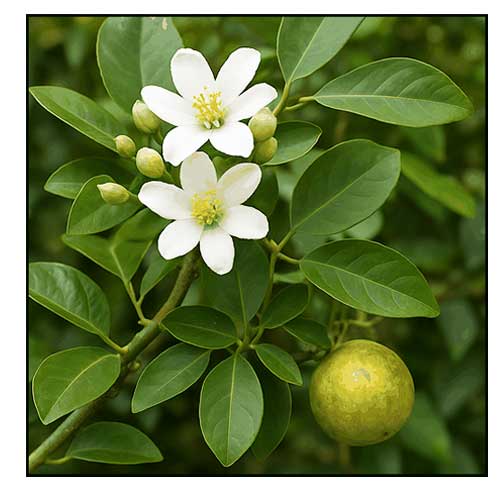
- Fruits mentioned in Ayurvedic texts as edible. Used as appetizer or cordial.
- Fruit flesh posted as edible: sweet and juicy.
Folkloric
- No reported medicinal use in the Philippines.
- In Peninsular Malaysia, root decoction is taken as post-partum medicine. (3)
- Used for treatment of cirrhosis and ascites.
- In Thailand, roots used as diuretic.
- In Thai folk medicine used for treatment of small pox, kidney disease, wasting diseases and urinary disorders. (11)
- In Ayurveda, dried leaf powder used for digestive or pitta-related issues. Decoction of coarsely powdered bark drunk after meals to support digestive health. Fresh leaves warmed in sesame or coconut oil are strained and used topically for skin conditions. (5)
- In Ayurvedic classics, such as the 18th-century compendium "Vanaushadhi Nighantu" it was noted for its specific action on pitta imbalance and for dhatu (tissue purification). (5)
- Herbalists in Tamil Nadu still harvest L. scandens in monsoon season, blending fresh leaf juice with honey to soothe sore throats. (5)
- Traditional healers along the Western
Ghats use the bark decoction for its cooling properties in managing fevers. Leaf paste used for topical inflammations. (5)
- Stem decoction used for treatment of malaria and fatigue.
Others
- Oil: In India, dried mature fruits are used to prepare a perfumed medicinal oil for use as ingredient of various formulations. (3) Essential oil of fruit has shown moderate to strong antifungal activity against a range of plant-pathogenic and keratinophilic human-pathogenic fungii. (3)
- Repellent: Oil has strong repellent effect on the pulse beetle (Callosobrucvhus chinensis). (3)
- Host plant: A critical host plant for butterflies, including the Banded Swallowtale (Papilio demolion).
- Horticulture: Cultivated in botanical collections and specialized gardens for its ornamental value and intensely fragrant flowers.
Studies
• Ostruthin / Antioxidant / Cytotoxicity / Anticancer / Roots: Four compounds were isolated from the dichloromethane extract of roots of Luvunga scandens: two xanthones (LI and L2)) and two pure compounds, a coumarin (ostruthin) and a triterpene (limonin). Ostruthin and L1 exhibited good radical scavenging activity by DPPH assay, with IC50s of 9.5 and 12.7 µg/mL. Only ostruthin showed significant cytotoxicity with IC50 (23.5 µg/mL) against human breast cancer cell line MCF-7. (see constituents above) (6)
• Anti-Inflammatory / Cytotoxicity / Essential Oil: Study extracted essential oils (EOs) from different parts of two Luvunga species (L. scandens and L. hongiaoensis). GC/MS analysis of EOs isolated a total of 69 compounds. Major constituents of leaf, fruit, and roots EOs from L. scandens were ß-caryophyllene (71.5%, 63.0, and 31.5% respectively). The EO from L. scandens fruits significantly inhibited nitric oxide production on LPS-induced RAW264.7 cells (IC50=37.95 µg/mL). The EOs from L. hongiaoensis roots and L. scandens leaves and fruits exhibited cytotoxic activity against MCF-7, SK--LU-1, and HepG2 (IC50s from 49.74 to 97.82 µg/mL). (7)
• Anti-HCC (Hepatocellular carcinoma) / Leaves: Hepatocellular carcinoma (HCC) is the most frequent type of primary liver cancer and the leading cause of cancer mortality in Vietnam. In a study of different parts of 24 Vietnamese medicinal plants traditionally used in liver cancer treatment, out of 52 crude methanol extracts, three showed notable cytotoxic effects against HCC cells: Luvunga scandens leaves, Hyptis suaveolens roots, and Solanum torvum leaves. For leaves of L. scandens and S. torvum, the ethyl acetate extract showed high TFC value and promising anti-HCC activity. (8)
• Cytotoxic Tirucallane Triterpenes Against MCF7 Cell Line / Stem: Study of dichloromethane extract of stem isolated two tirucallane triterpenes, namely flindissol (1) and 3-oxotirucalla-7,24-dien-21-oic-acid (2). MTT assay of the two compounds showed potent cytotoxicity against MCF-7 cell line with IC50s of 13.8 and 27.5 µM, respectively. Results suggest potential activity as antitumor agents. (10)
• Antibacterial / Antioxidant / Anti-Inflammatory / Stem Bark: Study evaluated dichloromethane, ethyl acetate, and methanol extracts of stem bark for antioxidative, anti-inflammatory, and antibacterial activities. The ME reduced the level of cytokine TNFα and IN-10, both known mediators of inflammation responses. All extracts exhibited promising antibacterial activities against S. aureus, B. cereus, E. coli, E. faecalis, and Methicillin-resistant S. aureus (MRSA) with MICs ranging from 3.125 to 100 mg/mL. The extracts also exhibited moderate activity as antioxidants in DPPH radical scavenging assay with IC50 of 94 (DCM), 445 (M) and 480 µg/mL (EA). (11)
• Luvungas B-D / Ferroptosis Inhibitor / Rhizomes and Leaves: NMR-guided fractionation strategy of rhizome and leaves isolated 10 limonoids, including three new compounds: Luvungas B-D (3, 4, and 8). Biological evaluated revealed compound 8 inhibits RSL-3-induced ferroptosis in HepaRG liver cells with EC50 of 16.1 µM. Compound 8 also showed to mitigate lipid peroxidation without inhibiting direct radical scavenging or iron-chelating activities. (Ferroptosis is an iron-dependent form of regulated cell death caused by unchecked accumulation of lipid peroxides in cellular membranes.) (12)
• Antimalarial against Plasmodium falciparum / Leaves and Stems: Study evaluated n-hexane, dichloromethane, and methanol extracts of stems and leaves for antimalarial activity against Plamodium falciparum 3D7. Dichloromethane extracts of leaves and stems showed most potent activities against P. falciparum with IC50s of 6.61 and 5.38 µg/mL. Both extracts were safe and effective with selectivity indices (SI) values greater than 2. Fraction 23 was the most active fraction with IC50 of 2.44 µg/mL and CC50 of 46.35. Study suggested isoflavones possibly take a role in the antimalarial activity. (13)
• Antimalarial against Plasmodium falciparum / Leaves and Stems: Study evaluated the cytotoxicity effect of L. scandens on human skin carcinoma cells along with its effect against normal cell lines (HaCaT and HDF). Results showed the extract and the compound
3-oxotirucalla-7,24-dien-21-oic acid possesses cytotoxic effect against skin cancer cells with not cytotoxicity in HaCaT and HDF cells.
Caspase 3/7 assay showed the DCM extract exhibited highest level of apoptosis against skin cancer cells. All treated cells showed high readings in the sub-G1 phase. The in vitro study showed antiproliferative effects and has potential as natural source for anticancer therapy. (14)
• Antioxidant / Low Cytotoxicity / Roots: Study isolated isobutylglucosinolate (1) from the root of L. scandens, which demonstrated antioxidant activity with IC50 of 30.1 µg/mL. Additionally, two biologically active phytosterols, ß-sitosterol (2) and stigmasterol (3) were isolated, showing low cytotoxicity against human colon adenocarcinoma cell line (HT29) with IC50s of 124 and 141 µg/mL, respectively. (15)
• Anticancer / Human Malignant Melanoma Cells: Study evaluated the antiproliferative and apoptotic effects of L. scandens plant extracts ( methanol, DCM, hexane) against human malignant melanoma cell line. The extracts showed cytotoxic effect against skin cancer cells, with no cytotoxic activity on both HaCaT and HDF cells. Scanning electron microscopy of treated cells showed overall changes in cell shape, alterationof surface morphology, absence of microvilli and appearance of blebs. Caspase 3/7 assay showed DCM extract exhibited highest level of apoptosis against malignant melanoma cells. Results showed antiproliferative effects and promising potential as anticancer therapy (16)
• Anticancer / Oral Squamous Cell Carcinoma Cells: Study evaluated the anticancer potential of two triterpenoids derived from L. scandens, namely: flindissol (1) and 3-oxotirucalla-7,24-dien-21-oic-acid (2) on human oral cancer HSC-2 cells. MTT assay showed compound 1 and 2 markedly induced cytotoxicity on HSC-3 cells with IC50 of 10.7 and 8.3 µM, respectively. Flow cytometry showed both compounds increased percentage of apoptotic cells by 18.2% and 16.6% respectively. Caspase 3/7 assay confirmed both compounds markedly induced caspase 3/7 activities in HSC-3 cells. Results suggest potential for oral cancer treatment. (17)
• Neuroprotective / Enantiomeric Coumarins / Rhizomes: LC-MS/MS study of rhizomes isolated 22 new monoterpene-coumarins, Luvunscandins A-G (1-7) and H-K (8-11). Isolates were tested for neuro- protective effects on LPS-stimulated NO production in BV2 microglia. Compounds 6a, 7a-b, 8b, 9a-b, 11a-b demonstrated more potent inhibitory effect than control. Neuroprotective effect was primarily associated with pyran-type dihydrofurancoumarins. (+)-Luvunscandin I (9a) showed more significant inhiitory activity (IC50=4.9 µg/mL) through suppression of inflammatory transcription factors p65NF-kB and iNOS. (18)
• Food Preservative Potential / Antifungal / Aflatoxin Inhibitory / Antioxidant / Essential Oil: Study reports on the efficacy of L. scandens berry essential oil (LSEO) as antifungal, aflatoxin inhibitory and as antioxidant. Antifungal activity of LSEO by food poisoning method using Aspergillus flavus LHP-PV1 as test fungus showed MIC of 3.5 µl/ml. Antiaflatoxigenic activity showed minimum aflatoxin inhibitory concentration of 1.75 µl/ml. Total phenolic content was 4.45 µg/mg. LSEO showed strong antioxidant activity by DPPH assay with IC50 of 3.61 µl/ml. The strong antifunga antiaflatoxigenic, and antioxidant potency suggest potential as plant-based preservative for food commodities during post-harvest storage. (20)
Availability
- Wild-crafted.
- Ornamental cultivation.
- Oils, seeds in the cybermarket.
|