 |

Family • Fabaceae
Kamangi
Agogo
Dalea cliffortiana Willd.
FOXTAIL / PRAIRIE CLOVER
| Scientific names | Common names |
| Amorpha glandulosa Blanco | Agogo (Tag.) |
| Dalea acutifolia Moc. & Sessé ex DC. | Chang-parang (Tag.) |
| Dalea angustifolica G.Don | Dura (Pang.) |
| Dalea annua Kuntze | Durang-parang (Tag.) |
| Dalea annua var. cliffortiana (Willd.) Kuntze | Kamañgi (Tag.) |
| Dalea annua var. ebracteata Kuntze | Sampalok-sampalokan (Tag.) |
| Dalea annua var. willdenowii Kuntze | Foxtail (Engl.) |
| Dalea cliffortiana Willd. | Prairie clover (Engl.) |
| Dalea dalea (L.) MacMill. | |
| Dalea elegans Hook. & Arn.. | |
| Dalea glandulosa (Blanco) Merr. | |
| Dalea nigra M.Martens & Galeotti | |
| Dalea pumila (Rydb.) L.Riley | |
| Dalea robusta (Rydb.) R.S.Cowan | |
| Dalea virgata Micheli | |
| Parosela acutifolia (Moc. & Sessé ex DC.) Rose | |
| Parosela cliffortiana (Willd.) Rose | |
| Parosela dalea (L.) Britton | |
| Parosela dalea var. robusta (Rydb.) J.F.Macbr. | |
| Parosela glandulosa (Blanco) Merr. | |
| Parosela nigra (M.Martens & Galeotti)Rose |
|
| Parosela pumila (Rydb.) J.F.Macbr. | |
| Parosela robusta (Rydb.) Standl. | |
| Psoralea annua Houst. ex Mill. | |
| Psoralea dalea (L.) Britton | |
| Thornbera dalea (L.) Rydb. | |
| Thornbera pumila (Rydb.) J.F.Macbr. | |
| Thornbera robusta Rydb. | |
| Parosela glandulosa (Blanco) Merr. is a synonym of Dalea cliffortiana Willd. | |
| Dalea cliffortiana Willd. is an accepted speciess. KEW: Plants of the World Online | |
| Note: -sampalokan (kamañgi, P. glandulosa) as common name has confusing similarity with Sampa-sampalukan (Phyllanthus niruri, seed-under leaf) | |
Botany
Distribution Constituents Properties Uses Studies Availability |
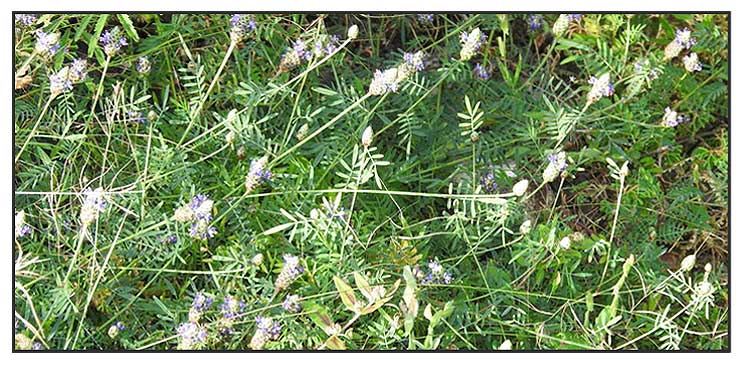
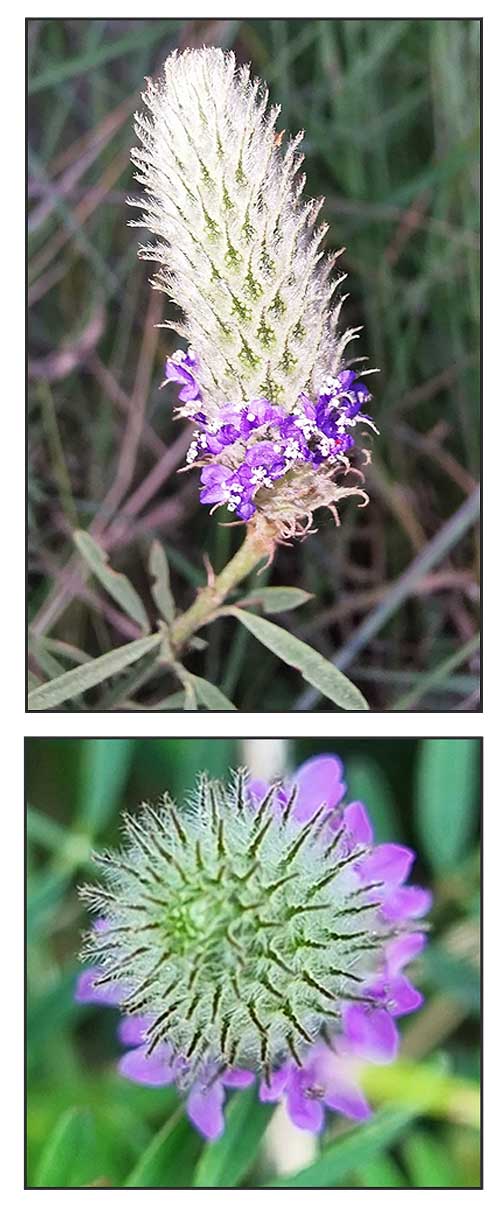 • An erect, much-branched herb up to 70 cm tall; stems reddish, glandular-dotted. Leaves alternate, imparipinnate, (1-)1.5-3(-5) cm long; rachis narrowly winged; stipules narrow; leaflets 5-15(-19), linear to narrowly elliptical, (2-)4-8(-15) mm long, entire, gland-dotted below; stipels represented by paired glands. Inflorescence a narrow, compact, terminal spike 0.8-3.5 cm long; bracts abruptly acuminate, pubescent, gland-dotted. Flowers bisexual; calyx 3-5 mm long, 5-toothed, densely pilose; corolla papilionaceous, standard 3-5 mm long, clawed, white often tinged rose, wings 2-2.5 mm long, keel 2-3.5 mm long, wings and keel blue to pink or white; stamens 9-10, all connate; ovary superior, pubescent, 1-celled. Fruit an obovoid pod 2-2.5 mm long, indehiscent, 1-seeded. Seed oblong, c. 1.5 mm long. (
 Revised April 2026
May 2015

 |
PHOTOS / ILLUSTRATIONS |
| IMAGE SOURCE: Dalea cliffortiana / by Sinaloa Silvestreayne / Public Domain / No rights reserved / Click on image or link to go to source page / iNaturalist |
| OTHER IMAGE SOURCE: Dalea cliffortiana / © Pablo Carillo-Reyes / Some rights reserved / CC BY-NC / Image modified / Click on image or link to go to source page / iNaturalist |
| OTHER IMAGE SOURCE: Dalea cliffortiana / © Jose Abelardo Sanchez / Some rights reserved / CC BY-NC 4.0 / Image modified / Click on image or link to go to source page / iNaturalist |
| Additional
Sources and Suggested Readings (1) Dalea cliffortinana Willd. / KEW: Plants of the World Online (2) Fabaceae: Dalea cliffortiana / Co's Digital Flora of the Philippines (3) Dalea cliffortiana / LJG van der Maesen / PROSEA: Plnat Resources of South-East Asia (4) Dalea / Wikipedia (5) MOLLUSCICIDAL ACTION OF SOME PHILIPPINE PLANTS ON GOLDEN SNAILS, POMACEA SPP. / BELEN MORALLO - REJESUS AND EVANGELINE G. PUNZALAN / Philipp. Ent., 1997; 11(1): pp 65-79 / ISSN: 0048-3753 (6) Chemical characterization of the compounds present in essential oil of the Dalea cliffortiana (Santander, Colombia) / Jesus A Zambrano, Jesica J Mejia, Jairo Rene, Elena E Stashenko / Brazilian Symposium on Essential Oils: International Symposium on Essential Oils, 2015 / ISBN:978-85-66836-11-0 |
• |
DOI: It is not uncommon for links on studies/sources to change. Copying and pasting the information on the search window or using the DOI (if available) will often redirect to the new link page. (Citing and Using a (DOI) Digital Object Identifier) |
| List of Understudied Philippine Medicinal Plants |
| New plant names needed The compilation now numbers over 1,750 medicinal plants. While I believe there are hundreds more that can be added to the collection, they are becoming more difficult to find. If you have a plant to suggest for inclusion, native or introduced, please email the info: scientific name (most helpful), local plant name (if known), any known folkloric medicinal use, and, if possible, a photo. Your help will be greatly appreciated. |
 |
• |
|
