Gen info
- Apocynaceae is a family of flowering plants that includes trees, shrubs, herbs, stem succulents, and vines, usually known as the dogbane family, because some taxa were used as dog poison. Notable members include oleander, dogbanes, milkweeds, wax plants, and periwinkles.
-
Cynanchum is a genus of about 300 species including some swallowworts, belonging to the family Apocynaceae.
-
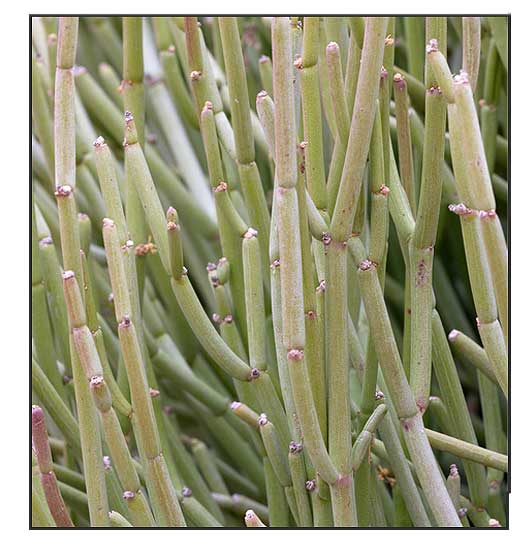
Cynanchum viminales is a leafless succulent plant in the family Apocynaceae.
- Taxonomic journey: Cynanchum viminale was first described as Euphorbia viminale by Carl Linnaeus in 1753, until it was moved to the genus Cynanchum in 1771. The taxonomic status of the species is controversial. The genus Sarcostemma has been nested with Cynanchum. In 2002, Sarcostemma was put into synonymy with Cynanchum, and the species was known as Cynanchum viminale. However, the change is not accepted by all taxonomists, and despite the genetic evidence, Sarcostemma remains in use, albeit in a minority. (3)
- Etymology: The scientific name Cynanchum viminales derives from Greek and Latin roots meaning
"dog-strangling" and "pliant twig," descriptive of the plant's toxic reputation and long, flexible, leafless green stems.
Alternatively, Cynanchum from Greek words kyon (dog) and anchein (to choke). It further draws from the historical belief that certain European species within the genus were poisonous to dogs. The specific epithet viminale derives from Latin vimina meaning broom, or alternatively, an osier, pliant twig, or long flexible shoot like a willow.
Botany
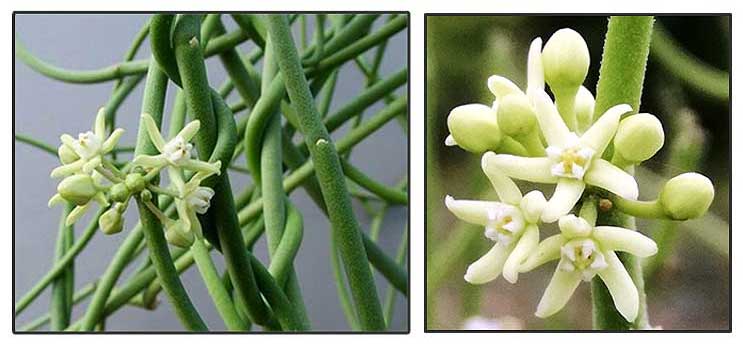
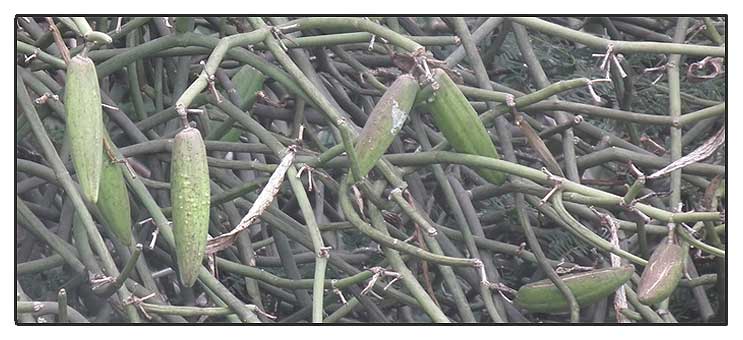
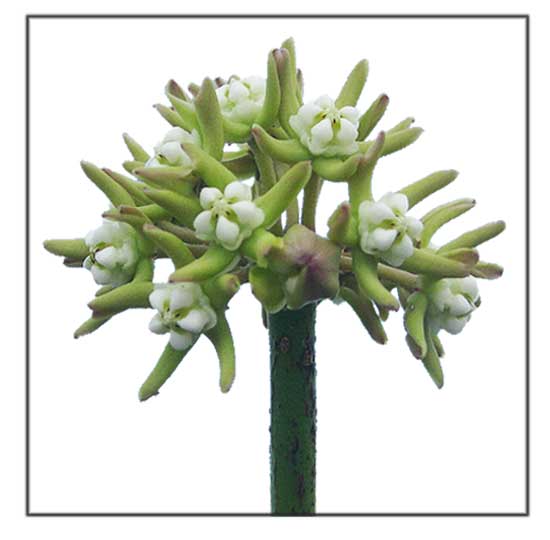
• Cynanchum viminale is a leafless succulent plant with cylindrical, green photosynthetic stems. The plant may grow as a shrub or a scandent vine. The stems produce copious amounts of milky exudate when broken. This exudate is caustic in nature and can cause burns if it contacts human skin. The plant produces small white flowers in clusters. Flowers are followed by long pods which produce numerous seeds with silky plumes that aid in wind dispersal. The environmental range of the species is very broad, extending from rainforest margins and monsoon forests to arid deserts.
• Succulent woody liane or erect or sprawling subshrub. Stems to 6 mm diam., with brachysclereids in cortical tissue; flower-bearing stems 2–5 mm diam. Leaves vestigial, caducous. Inflorescence a racemose cyme; peduncle obsolete. Flowers 2.5–3 mm long, 9–10 mm diam.; pedicels 4–10 mm long. Corolla rotate, cream to cream-green; lobes lanceolate-ovate to ovate, 4–6 mm long, 1.9–3.6 mm wide, l: w ratio 1.7–2.8, glabrous. Annular corona absent; staminal corona cream to cream-green; lobes 1.3–1.5 mm long, 0.8–1 mm wide. Follicles fusiform, 5–8 cm long. (Flora of Australia)
 Distribution Distribution
- Native to the Philippines. (1) (2)
- In Bacuit Is., Coron; in Luzon: Bataan, Batangas, Benguet, Quezon; Mindoro, Palawan, Panay.
0-1200 m. (1)
- Aldabra, Angola, Bangladesh, Benin, Botswana, Burkina, Burundi, Cape Provinces, China Southeast, Comoros, Djibouti, DR Congo, Equatorial Guinea, Eritrea, Eswatini, Ethiopia, Free State, Ghana, Hainan, India, Kenya, KwaZulu-Natal, Lesotho, Madagascar, Malawi, Malaya, Mali, Mozambique, Myanmar, Namibia, Nepal, New Caledonia, New South Wales, Nigeria, Northern Provinces, Northern Territory, Oman, Pakistan, Queensland, Rodrigues, Rwanda, Réunion, Saudi Arabia, Seychelles, Socotra, Somalia, South Australia, Sri Lanka, Sudan-South Sudan, Tanzania, Thailand, Uganda, Vietnam, Western Australia, Yemen, Zambia, Zimbabwe. (2)
Constituents
- Phytochemical analysis of ethyl acetate and water extracts of C.. viminale stems yielded tannins, saponins, phlobatannins, flavonoids, cardiac glycosides, alkaloids, terpenoids, and steroids. (see study below) (4)
- HRLC-MS analysis of stem for bioactive constituents revealed presence of Ancistrocladine, Piperolein B, 1, 1'-Bis (2-hydroxy-3- methylcarbazole), Retinyl beta-glucuronide, Chrysophanol 1-triglucoside, Gentamicin A, Cerberin, Nystatin A1, 2, 3-Dihydrowithanolide E, Irinotecan, Grossamide, Kaempferol 3-O-beta-D-galactoside, Ellagic acid, Gingerglycolipid A, Agavasaponin C and Fistuloside. (5)
- Study reports on isolation of novel seco-pregnane aglycones cynavimigenin A (5) and cynaviminoside A (6), together with new pregnane glycosides cynaviminoside B (7) and cynavimigenin B (8). (see study below)
Properties
- Toxicity: Variable toxicity. The milky white latex sap is caustic and mildly toxic. Plant is also known to cause poisoning and death in livestock.
Ingestion has been reported to cause internal distress and poisoning in humans.
- Studies have suggested antibacterial, antifungal, analgesic, anti-inflammatory, cytotoxicity, genotoxicity, antipyretic, anticancer, apoptotic properties.
Parts used
Stems, latex.
 Uses Uses
Edibility
- In Somalia and South Africa, stems are eaten, raw or cooked. (3)
- Chopped stems used in making a bitter tea.
Folkloric
- No reported medicinal use in the Philippines.
- Used in traditional medicines for its potential anticancer activity.
- Wide range of use in traditional medicine, including sores and wounds, small pox, eye infections, diarrhea, intestinal and skin parasites, and insufficient milk production. (Caution advised because of caustic nature of the sap. (3)
- In Ayurvedic practice, latex and dried stems are used for topical and internal applications. In Sri Lanka, local vedic practitioners recommend decoction of stems for treatment of chronic diarrhea. (7)
- A 1st-century CE Sanskrit reference in a palm-leaf manuscript describes the use of the bitter vine to treat skin lesions. Medieval Chola dynasty (9th-13th century) trade logs hint at the use of the vine for tough wounds and zombie-like gangrene. (7)
- Other tribal uses include application of sap to areas of affliction or placing patients onto bedding made from the plant. (3)
Others
- Forage: In Kenya, considered quality forage. (3)
- Veterinary: In tribal regions of Eastern Cape (South Africa), indigenous healers carve the vine bark and apply fresh latex to infected cattle wounds.
Studies
• Antibacterial / Stems: Study evaluated stem extracts for antimicrobial activity by agar well diffusion method against five bacterial and three Candida species. Streptomycin sulphate and Fungicon were used as positive control. The ethyl acetate extract showed highest activity against Escherichia coli (ATCC25922( with inhibition zone of 26.9 mm. Extract also showed anti-candida activity against all tested Candida species, with highest activity (19.03) against C. krusei. (see constituents above) (4)
• Analgesic / Anti-Inflammatory / Antipyretic / Stems: Study of aqueous extracts of C. viminale in albino mice showed analgesic activity using formalin-induced writhing test, antipyretic activity using Brewer's yeast induced pyrexia, and anti-inflammatory activity using formalin-induced inflammation test using dose of 150 mg/kbw. (6)
• Seco-Pregnane Glycosides / Mild Cytotoxicity / Low Anticholinesterase Activity: Study reports on the isolation of novel seco-pregnane aglycones, along with new pregnane glycosides. The isolates exhibited only limited cytotoxicity in cancer and normal human cell lines, low activity against acetylcholinesterase, and Sarcoptes bioassays suggesting 5-8 not being associated with the reported toxicity of this plant species. (see constituents above) (8)
• Anticancer / Antioxidant / Antimicrobial: Study reports on an integrated in vitro and in silico analysis of methanolic extracts of C. viminale and Pergularia daemia for antimicrobial screening against six pathogens, antioxidant activity using five antioxidant assays, and cytotoxicity against a panel of six human cancer cell lines (HepG2, MCF-7, HCT116, A-549, PC-3, and A-431). While P daemia exhibited superior antioxidant and broader-spectrum antibacterial activity, C. viminale demonstrated dramatically superior cytotoxic potency against all tested cancer cell lines, with IC50 as low as 24.37 µg/mL against HepG2 liver cancer. Potency of C. viminale was attributed to principal alkaloids, Protopine and Berberine, which showed high binding to ATP-binding site of EGFR, a key driver of cancer prliferation. (9)
• Genotoxic / Cytotoxic Effects via Apoptotic Signs on Allium cepa Root: Study evaluated the cytotoxic efficacy of methanolic extract of C. viminale on A. cepa root meristematic cells. Various apoptotic signs such as apoptotic body formation, nuclear budding, micronucleus, nuclear disintegration, nuclear breakage, etc. were observed in meristematic cells of A. cepa. Results suggest cytotoxic, preferably genotoxic effect of ME of C. viminale evidenced by various apoptotic symptoms on A. cepa root cells. (10)
Availability
- Wild-crafted. |