HOME    •    SEARCH      •      EMAIL    •     ABOUT  •     DONATE


Family • Hydrocharitaceae
Lusay
Paddle grass
Halophila decipiens Ostenf.
CARIBBEAN SEAGRASS / HAIRY SPOON SEAGRASS
Mao ye xi yan cao

Scientific names Common names
Halophila decipiens Ostenf. Lusay (Tagalog)
Halophila decipiens var. pubescens Hartog Caribbean seagrass (Engl.)
  Clover grass (Engl.)
  Hairy spoon seagrass (Engl.)
  Paddle grass (Engl.)
Halophila decipiens is an accepted species. KEW: Plants of the World Online
Note: Common name Lusay is shared broadly with other native seagrass species like Halophila ovalis and Enhalus acoroides.

Other vernacular names
CHINA: Mao ye xi yan cao.

Gen info
- Halophila is a genus of seagrasses in the family Hydrocharitaceae, the tape-grasses. It was described as a genus in 1806.
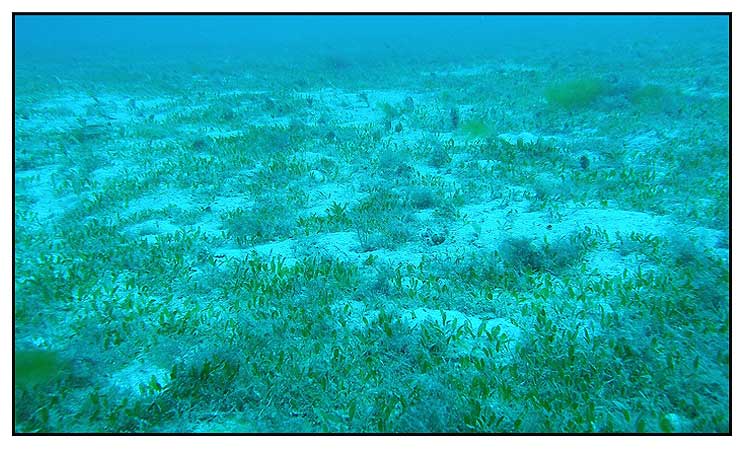
- Halophila decipiens, commonly known as paddle grass, is a seagrass species found in the tropical waters of the Atlantic Ocean, Indo-Pacific, and other parts of the world. It has oval shaped leaves and grows in short patches on the seafloor that contain extensive root systems underneath. (5)
- Etymology: The genus name Halophila derives from Greek words hals (salt) and phile (loving), literally meaning "salt-loving" or "sea-loving." The specific epithet decipiens derives from Latin decipere, meaning "to deceive," "deceiving" or "deceptive." The deceptive reference probably refers to its close resemblance to the small seagrasses in the Halophila genus.
- Philippine seagrass flora: There are 13 species found in the Phlippines: Cymodocea rotundata, Cymodocea serrulata, Enhalus acoroides, Halodule pinifolia, Halodule uninervis, Halophila beccarii, Halophila decipiens, Halophila minor/ovata, Halophila ovalis, Halophila spinulosa, Syringodium isoetifolium, Thalassodendron ciliatum and Thalassia hemprichii. Species have contrasting growth forms and growth capacities, which confer different capacities to survive disturbance. (3) FIELD GUIDE ON SEAGRASS lists 18 species in the Philippines. While many species live in depths of 3 to 9 feet (1-3 meters), H. decipiens is reported deepest growing, found at depths of 190 feet (58 meters). (4)

Botany
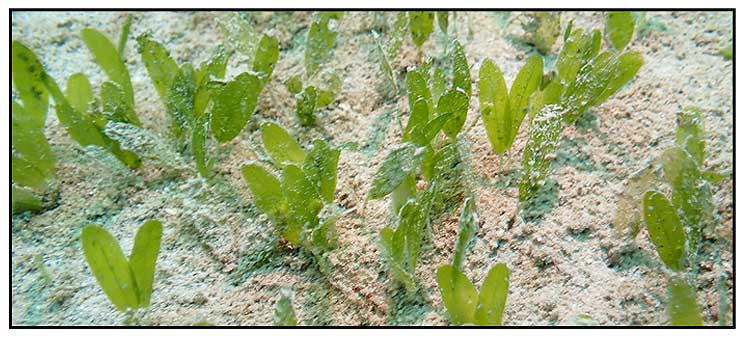
• Halophila decipiens have oval-shaped leaves lined with serrated edges that typically grow to a length of 1-2.5cm. L eaves are covered in minute hair and stem from rhizomes that create branching networks of these plants on the seafloor. Rhizomes are thin, white, and slightly thicker than the roots of the plant. Unlike other seagrass genera, Halophila species lack basal sheaths, which are casings that wrap around the base of the seagrass stem. (5)

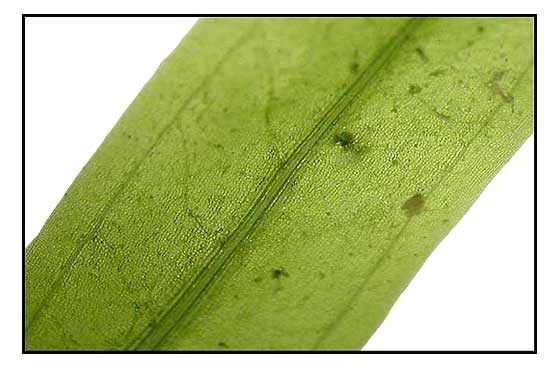
• On the leaf stems of Halophila, basal sheaths are absent. Its elongated, smooth, branching rhizome has internodes. Two short scales encircle a single root and two petiolate leaves at each node. The paddle-shaped leaves have light green, transparent, elliptic to oblong leaf blades that are cuneate at the base and obtuse at the apex. The tiny unicellular hair on the leaves’ surfaces is heavily covered in hair.
(Marine Biodiversity)

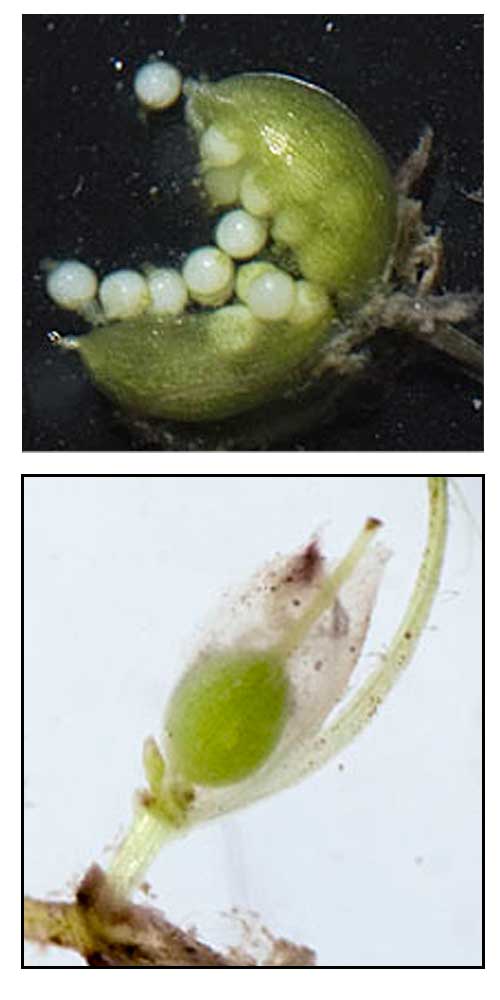
• Marine to estuarine, submerged, monoecious, annual or perennial herb. Rhizome fleshy, c. 1 mm diam.; scales usually hairy. Leaves with petiole distinctly shorter than blade; blade oblong-elliptic, 10–25 mm long, 2.5–6.5 mm wide, finely serrulate, obtuse to acute, membranous, hairy or sometimes glabrous; cross veins in 5–9 pairs, unforked. Spathal bracts hairy, enclosing a male and a female flower. Male flowers with pedicel to 25 mm long; tepals ovate to elliptic, 2 mm long; anthers linear-oblong, 1.5–2 mm long. Female flowers sessile on rhizome nodes; hypanthium 1–2 mm long; tepals minute; ovary ovoid, 1 mm long; styles 3, 1.5–2.5 mm long. Fruit ellipsoid, 2–5 mm diam. Seeds c. 30, ovoid, 0.2–0.5 mm diam.; testa reticulate. (Flora of Australia)

Distribution
- Native to the Philippines. (1)
- Also native to
Bangladesh, Belize, Canary Is., Chagos Archipelago, Colombia, Comoros, Costa Rica, Cuba, Florida, India, Jamaica, Jawa, Leeward Is., Maluku, Mauritius, Mexico Gulf, Myanmar, Nansei-shoto, Netherlands Antilles, New Caledonia, New South Wales, Nicaragua, Panamá, Puerto Rico, Queensland, Seychelles, Society Is., Sri Lanka, Taiwan, Tanzania, Thailand, Trinidad-Tobago, Venezuela, Vietnam, Windward Is. (2)
- Halophila decipiens is one of the only species of seagrass with a true global distribution, i.e., found in shallow waters all over the world. It is unknown how it as successfully dispersed on a global scale; perhaps, via the small seed size that become trapped in large drifts of algae or other vegetations as a form of travel. (5)
- Invasiveness: It is classified as an invasive species in Hawaii, discovered in 2000 and considered a threat to the local Halophila hawaiiana seagrass. Despite its global distribution, it is not classified as invasive elsewhere, but with its easy dispersion and reproduction, it has the potential to out-compete and harm others seagrass species and populations. (5)

Constituents
- Phytochemical screening of various solvent extracts of H. decipiens revealed methanolic, ethanolic, and aqueous extracts to be rich in t3erpenoids, phenols, flavonoids, alkaloids, saponins, and carbohydrates. Non-polar solvents (diichloromethane, hexane, petroleum ether) were predominantly rich in phytosterols and steroids. (see study below) (6)

Properties
- Studies have suggested antioxidant, antibacterial properties.

Parts used
Whole plant, leaves.

Uses

Edibility
- While it is a vital ecological food source for marine gazers, it is not traditionally consumed by humans. Another seagrass, Halophila ovalis, is traditionally gathered in the Ilocos regions and pickled or prepared as salad vegetable.
Folkloric
- No reported folkloric medicinal use in the Philippines.
Others

- Ecology: Seagrass beds act as habitat and breeding ground for various organisms. They are an important food source for sea urchins sea turtles, parrotfish, and surgeonfish. (5)

Studies
• Antioxidant / Antimicrobial / Leaves:
Study evaluated H. decipiens for phytochemical profile, antioxidant capacity, and antimicrobial potential. In DPPH radical assay, the ethanolic extract showed pronounced activity (68.42% at 100 µg/mL; IC50 of 23 µg/mL) followed by methanolic and aqueous extracts approaching potency of ascorbic acid with IC50 of 15.5 µg/mL. ABTS revealed maximal inhibition for aqueous extract (72.3% at 100 µg/mL). Total antioxidant capacity (31.94 µg ascorbic acid equivalent (AAE)/g) substantiated the contribution of polyphenolic and flavonoid constituents. Antimicrobial study showed distinct inhibitory zones against S. aureus (13.0 mm), Listeria monocyto-genes (20.0 mm) and Pseudomonas aeruginosa (14.0 mm). Results suggest a promising marine botanical with substantial antioxidant and antibacterial potential for natural therapeutic development. (see constituents above) (6)
• Silver Nanoparticles / Antioxidant: Study reports on the green, environmentally friendly synthesis of silver nanoparticles (AgNPs) utilizing extracts from seagrass Halophila decipiens. The antioxidant study of synthesized AgNPs showed significant DPPH scavenging activity, ranging from 71.2 at 25 µg/mL to 37.5% at 100 µg/ml. Nitric oxide scavenging and hydrogen peroxide assay also showed concentration-
dependent increase in scavenging activity. Results suggest sustainable approach and potential for biomedical applications. (7)

Availability
- Sea-crafted.


October 2026

                                                 PHOTOS / ILLUSTRATIONS
IMAGE SOURCE: Caribbean Seagrass (Halophila decipiends) / © Robin White / Some rights reserved / CC BY 4.0 International / Image modified / Click on image or link to go to source page / iNaturalist
OTHER IMAGE SOURCE: Caribbean Seagrass (Halophila decipiends) - Close-up of leaf / © Invasive Marine Algae of Hawai'i / Click on image or link to go to source page / Hawaii.edu
OTHER IMAGE SOURCE: Caribbean Seagrass (Halophila decipiends) (2 images) - Fruit and Seeds / © WILD FACT sheets / Images modified / Click on image or link to go to source page / wildsingapore
OTHER IMAGE SOURCE: Halophila decipiends / National Oceanic and Atmospheric Administration CCMA Biogeography Team / PUBLIC DOMAIN / Click on image or link to go to source page / Wikipedia

Additional Sources and Suggested Readings
(1)

Hydrocharitaceae: Halophiila decipiens / Edited by Pieter B Pelser 20-24 / Co's Digital Flora Database
(2)
Hydrocharitaceae: Halophila decipiens / KEW: Plants of the World Online
(3)
Seagrass-Watdh in the Philippines / SeagrassWatch
(4)
FIELD GUIDE ON SEAGRASS / FishCORAL Porject: Region V
(5)
Halophila decipiens / Wikipedia
(6)
Exploration of Halophila Decipiens Extracts for their Phytoconstituents, Radical Scavenging Capacity and Antibacterial Properties / T Radhamani, A Nirmala / Thalassas: An International Journal of Marine Sciences, 2026; 42(1) / DOI: 10.1007/s41208-026-01060-0
(7)
Exploring the Biological Properties and Characterization of Silver Nanoparticles Synthesized from Halophila decipiens Seagrass
/ Pauline Christupaul Roseline, Hareesh Abesheak, Pavithra Thiraviuam, Kamala Kannan, Pitchiah Sivaperumal et al / Thalassas: An International Journal of Marien Sciences, 2025; 41(66) / DOI: 10.1007/s41208-025-00820-8

•

DOI: It is not uncommon for links on studies/sources to change. Copying and pasting the information on the search window or using the DOI (if available) will often redirect to the new link page. (Citing and Using a (DOI) Digital Object Identifier)

                                                            List of Understudied Philippine Medicinal Plants
                                          New plant names needed
The compilation now numbers over 1,830 medicinal plants. While I believe there are hundreds more that can be added to the collection, they are becoming more difficult to find. If you have a plant to suggest for inclusion, native or introduced, please email the info: scientific name (most helpful), local plant name (if known), any known folkloric medicinal use, and, if possible, a photo. Your help will be greatly appreciated.
•

•
HOME      •      SEARCH      •      EMAIL    •     ABOUT