 |

Family • Fabaceea
Makapilit
Pericopsis mooniana (Thwaites) Thwaites
NANDU WOOD / NEDUN TREE
| Scientific names | Common names |
| Dalbergia lanceolaria Moon | Makapilit (Bis.) |
| Dalbergia mooniana Thwaites | Nandu wood (Engl.) |
| Derris ponapensis Hosok. | Nendu tree (Engl.) |
| Ormosia villamilii Merr. | |
| Pericopsis mooniana (Thwaites) Thwaites | |
| Pericopsis ponapensis (Hosok.) Hosok. | |
| Pericopsis mooniana is an accepted species. KEW: Plants of the World Online | |
| Other vernacular names |
| INDONESIA: Kayu kuku (general), Kayu besi papus (Sulawesi), Nani laut (Irian Jaya). |
| MALAYSIA: Kaui laut (Peninsular, Sabah), Merbau laut (Peninsular). |
| PALAUAN: Kamanois. |
| SRI LANKA: Nedun (Sinhala). |
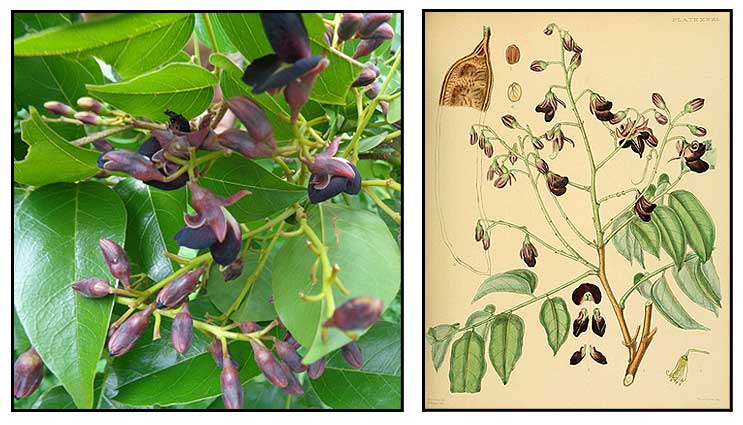 |
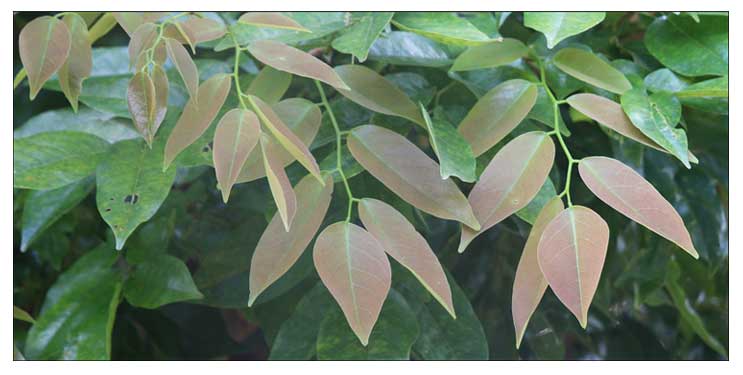
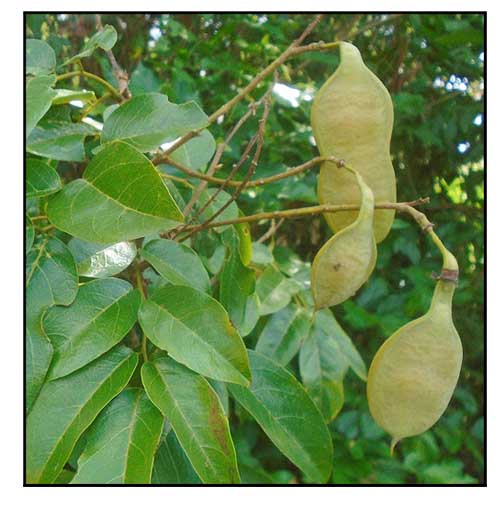
Gen info • Tall tree; young stems pubescent; leaves imparipinnate, 5-8-foliate, the axis glabrous, about 10-16 cm long; leaflets about 4-9 cm long and 2.5-5 cm broad. Inflorescences racemose or paniculate, about 6-10 cm long. Flowers about 2 cm long; petals blackish-purple. Fruit 1-6 seeded, 6-15 cm long; seeds reddish-brown, compressed, about 15 mm long, 7-8 mm wide and 4 mm thick, hilum orbicular, about 1 mm in diameter. Distribution 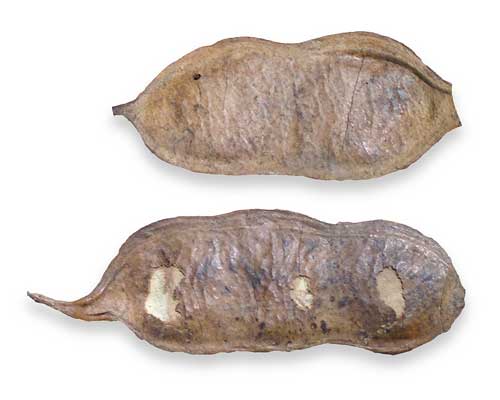 Constituents - Unlike volatile essential oils, oil extract from P. mooniana seeds is a non-volatile fixed oil with yield approximating 36.7%. As an oleic-linoleic type oil, fatty acid composition is dominated by oleic acid (41.02%), and linoleic acid (38.12%), along with palmitic acid (11.70%) and stearic acid (3.55%). - The unsaponifiable fraction contains beneficial skin condition compounds: squalene (4.01 mg/g), ß-sitosterol (2.63 mg/g), phytol (1.45 mg/g), stigmasterol (1.23 mg.g) and geranylgeraniol (1.03 mg/g). (University of Sri Jayeward. . .) Parts used Bark, leaves. Uses Edibility - No information on edibility. Folkloric - No reported folkloric medicinal use in the Philippines. - In Sri Lankan ayurveda, used for its anti-inflammatory and astringent properties. Formulations from bark and heartwood used for fevers, skin conditions, and rheumatic complants. (3) - Bark and leaves used for treatment of wounds and abscesses. (5) Others - Wood: Moderately heavy to heavy and hard. Heartwood is yellowish-brown when fresh; golden-brown to dark-brown on exposure, with irregular darker streaks. Sapwood is light yellowish-brown. Rated slightly susceptible to powder-post beetles, but moderately resistant top dry-wood termites.(3) - Timber uses: A valuable decorative wood of very limited supply. Timber described as handsome. Used as substitute for teak for cabinet work, furniture, turnery, high quality joinery, parquet flooring, paneling and veneer. Also used for heavy construction needs, ship building (especially rails and decks), bridges, door and window frames, vehicle bodies and in freshwater engineering. Wood is probably usable for saltwater harbor works. (3) Studies • No medicinal studies found. Availability |
 |
November 2026

 |
| PHOTOS / ILLUSTRATIONS |
| IMAGE SOURCE: Illustration: Pericopsis mooniana / AHG Alston, JD Hooker, Henry Trimen / Public Domain / Click on image or link to go to source page / Wikipedia |
| OTHER IMAGE SOURCE: Pericopsis mooniana / © Chalitha Madhuwantha / Noncommercial use / Image modified / Click on image or link to go to source page / Facebook |
| OTHER IMAGE SOURCE: Pericopsis mooniana pods / © Ayurvedic Medicinal Plants of Sri Lanka / Noncommercial use / Image modified / Click on image or link to go to source page / InstituteOfAyurveda |
| OTHER IMAGE SOURCE: Pericopsis mooniana twigs / © Ayurvedic Medicinal Plants of Sri Lanka / Noncommercial use / Image modified / Click on image or link to go to source page / InstituteOfAyurveda |
| OTHER IMAGE SOURCE: Pericopsis mooniana / © Sanjeewa Rupasinghe - Flora of Sri Lanka / Noncommercial use / Image modified / Click on image or link to go to source page / FloraOfSriLanka |
| OTHER IMAGE SOURCE: Pericopsis mooniana / © Aruna Yasapalitha - Flora of Sri Lanka / Noncommercial use / Image modified / Click on image or link to go to source page / FloraOfSriLanka |
Additional
Sources and Suggested Readings |
• |
DOI: It is not uncommon for links on studies/sources to change. Copying and pasting the information on the search window or using the DOI (if available) will often redirect to the new link page. (Citing and Using a (DOI) Digital Object Identifier) |
| List of Understudied Philippine Medicinal Plants |
| New plant names needed The compilation now numbers over 1,830 medicinal plants. While I believe there are hundreds more that can be added to the collection, they are becoming more difficult to find. If you have a plant to suggest for inclusion, native or introduced, please email the info: scientific name (most helpful), local plant name (if known), any known folkloric medicinal use, and, if possible, a photo. Your help will be greatly appreciated. |
• |
 |
• |
|

