General Info
• The family Convolvulaceae comprises about 59 genera and 1880 species. The genus Ipomoea is one of the largest in the family with approximately 700 species, mainly distributed in the tropical and warm temperate regions of the world and known as morning glories. most of which are twining climbing plants , including annual and perennial herbs, lianas, shrubs, and small trees. (Stevens 2020), (25)
• Etymology: The species name cairica mean "from Caira", the city where the species was first collected.
 Botany Botany
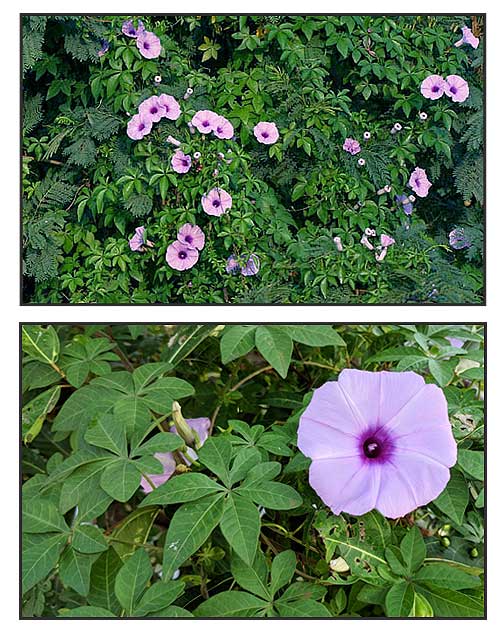
• Ipomoea cairica is a vining perennial, twining and herbaceous, up to 4 meters long, smooth or muricate. Leaf blades are 3 to 10 centimeters long, palmately divided in 5 to 7 lobes. Flowers are showy, white to lavender, peduncles 5 to 80 millimeters long. Corolla is purple, bluish purple or white with a purple center, funnelform, 4.5 to 6 centimeters long.
• A hairless, slim climber with bulbous roots and lignescented base, its leaves are stalked with 2 to 6 cm long petioles. Leaf blade is ovate to circular in outline, 3 to 10 cm long and 6 to 9 cm wide. It is divided into five to seven segments, these are lanceolate, ovate or elliptic, entire and pointed at the tip and base. Often pseudo side-leaves are formed. Lavender-colored inflorescences are one to a cyme. Flower stalks are 12 to 20 mm long, sepals are 6 to 8 mm long, ovate and sting-pointed. Crown is funnel-shaped, 4 to 6 cm long and violet colored. Stamens and the stylus do not protrude beyond the crown. The ovary is hairless. Fruits are spherical capsules approximately 1 cm in diameter containing one or two hairy seeds. Each fruit matures at about 1 cm across and contains hairy seeds.
Distribution
- Introduced; naturalized.
-
Widely distributed in the Philippines
- Widely cultivated and commercialized as a garden ornamental.
(25)
- Once naturalized, it has the potential to out-compete native plants.
- In some places it has become invasive and seriously harmful to the environment in China, Japan, Australia, Singapore, and many other islands in the Pacific region.
(25)
- Native to Angola, Bangladesh, Botswana, Burkina, Burundi, Cameroon, Cape Provinces, China South-Central, China Southeast, Congo, DR Congo, Equatorial Guinea, Eritrea, Eswatini, Ethiopia, Gabon, Gambia, Ghana, Guinea, Guinea-Bissau, Gulf of Guinea Is., Hainan, India, Ivory Coast, Kenya, KwaZulu-Natal, Laos, Liberia, Madagascar, Malawi, Mauritius, Mozambique, Myanmar, Nansei-shoto, Nepal, Nigeria, Northern Provinces, Ogasawara-shoto, Oman, Palestine, Rodrigues, Rwanda, Réunion, Saudi Arabia, Senegal, Sierra Leone, Somalia, South China Sea, Sri Lanka, Sudan-South Sudan, Taiwan, Tanzania, Thailand, Togo, Uganda, Vietnam, West Himalaya, Yemen, Zambia, Zimbabwe. (4)
 Constituents Constituents
- Phytochemical analysis of methanol extracts of leaves and flowers yielded alkaloids, carbohydrates, tannins, phenolic compounds, proteins and amino acids, terpenoids, sterols, and saponins. (see study below) (7)
- Phytochemical screening of various extracts of flowers and leaves yielded the presence of alkaloids, sterols, flavonoids, reducing sugars, tannins, saponins, terpenoids, anthraquinones, glycosides, and phenols.
(17)
- Phytochemical screening of various extracts (petroleum ether, CHCl2, Ch3OH) of leaves and flowers
yielded alkaloids, sterols, flavonoids, reducing sugars, tannins, saponins, terpenoids, anthraquinones, glycosides, and phenols. (9)
- An ethanolic extract yielded compounds, 3,5-Di-O-caffeoylquinic acid and 4,5-Di-O-caffeoylquinic acid. (10)
- Study of aerial parts isolated six pentasaccharide resin glycosides, four new acylated pentasaccharide resin glycosides, namely cairicoside I-IV and two known compounds, cairicoside A and cairicoside C, (see study below)
(12)
- Study of aerial parts isolated the coumarins umbelliferone and scopoletin, and the dibenzyl-γ-butyrolactone lignans arctigenin, matairesinol and trachelogenin, along with β-sitosterol and fatty acids. (13)
- Study of methanol extract yielded 14 compounds viz., (+)-(8R,8′S)-thujaplicatin methyl ether (1), arctigenin (2), matairesinol (3), trans-2,3-dibenzylbutyrolactone (4), vanillic acid (5), p-hydroxybenzoic acid (6), methoxybenzoic acid (7), methylparaben (8), stearic acid (9), palmitic acid (10), olenic acid (11), friedelinol (12), and a mixture of β-sitosterol (13) and stigmasterol (14). (see study below) (15)
- Study of aerial parts yielded six pentasaccharide resin glycosides: four new acylated pentasaccharide resin glycosides, cairicoside I-IV (1-4), along with two known compounds, cairicoside A (5) and cairicoside B (6).
(see study below) (18)
- Phytochemical screening of various extracts (PE, CHCl, and CH3OH) alkaloids, sterols, flavonoids, reducing sugars, tannins, saponins, terpenoids, anthraquinones, glycosides and phenols.
(25)
- GC-MS study of aerial parts for essential oil identified 96 components representing 96.80% of the oil. Major components were bioactive terpenoids trans-caryophyllene (19.70%) and germacrene D (18.09%) followed by
α-muurolene (5.12%) and 2,4-diisopropenyl-1-methyl-1-vinyl-cyclohexane (4.67%). (see study below) (34)
- Phytochemical analysis of methanolic extract of leaves isolated five flavonoids, including two rare flavonoid sulphates, ombuin-3-sulphate [1] and rhamnetin-3-sulphate [2] and three flavonoid glycosides, kaempferol 7-O-α-L-rhamnopyranoside [3], kaempferol 3,7-di-O-α-L-rhamnopyranoside [4] and quercetin 3-O-α-L-arabinopyranoside [5]. (see study below) (35)
Properties
- Studies suggest antioxidant, anti-diabetic, antinociceptive, antimicrobial, mosquito larvicidal,
α-glucosidase inhibitory, antioxidant, anticancer, cytotoxicity, ACE-inhibitory, antidiabetic properties.
 Uses Uses
Folkloric
• No reported folkloric medicinal use in the Philippines.
• In Brazilian folk medicine, used for rheumatism and inflammation.
• Traditionally used for diabetes, hypertension, liver disease, cancer, and heart disease. Seeds used for diuretic and laxative effects; also to alleviate edema, oliguria, ascariasis, and constipation. (31)
Studies
• Larvicidal / Essential Oil:
A study of the essential oil for its larvicidal effect against four vector species of mosquitoes showed remarkable larvicidal properties, inducing 100% mortality in the larvae of Culex tritaeniorhynchus, A aegypti, A stephensi and Culex quinquefasciatus. (2)
• Antinociceptive / Essential Oil:
Study yielded 3,5-di-O-caffeoylquinic acid and 4,5-di-O-caffeoylquinic acid which have been reported to have analgesic and antioxidative effects. The results show antinociceptive effects probably through release of pro-nociceptive mediators. The isolated caffeoylquinic acids can partly explain the antinociceptive effect of Ipomoea cairica polar extract. (3)
• Residual Bio-Efficacy Against Culex quinquefasciatus:
Study evaluated crude acethonilic extract of Ipomoea cairica leaves for residual and persistence effects against Culex quinquiefasciatus larvae. Results showed a short period of residual effectiveness of crude acethonilic extract of leaves with high percentage of larval mortality on the first few days that endorses less concerns of excess environmental residues, insecticide resistance and environmental pollution. (5)
• Biolarvicidal Against Key Dengue Vectors:
Study evaluated the efficacy of I. cairica extract against two different mosquito larvae: Ae. albopictus and Ae. aegypti. Results showed remarkable larvicidal properties and suggests exploration of alternatives to chemical larvicides such as Abate, Temephos for mosquito control program. (6) Study evaluated the larvicidal efficacy of different plant parts of Ipomoea cairica against third-stage larvae of Aedes albopictus and Aedes aegypti. Both acetone and methanol extracts showed 100% mortality at highest concentration (450 ppm) after 24h exposure. The larvae of Ae. aegypti appeared to be more susceptible to I. cairica extract with lower LC50 value compared with Ae. albopictus. Results suggest a potential for a more eco-friendly Aedes mosquito control program. (23)
• Antimicrobial / Antioxidant / Leaves and Flowers:
Study investigated methanol extracts of leaves and flowers of I. cairica for antimicrobial and antioxidant effects. Results showed very good activity against all bacterial and fungal strains tested. The extract also showed remarkable antioxidant activity, with DPPH scavenging activities correlating with its reductive potential. (7)
• Antinociceptive / Antioxidant / Leaves and Flowers:
Study of Ipomoea cairica extract showed dose dependent reduction of response in the formalin test inflammatory phase in mice. A possible explanation for the antinociceptive activity is the release of pro-nociceptive mediators unrelated to carrageenan-induced edema. The isolated caffeoylquinic acids could explain, in part, the antinociceptive effect. (8)
• Oviposition Deterring and Oviciding Potential Against Dengue Vectors:
Study of Ipomoea cairica demonstrated oviposition deterring and oviciding potentials against dengue vectors, Ae. aegypti and Ae. albopictus. Results suggest a potential alternative source for the development of novel plant based insecticides. (11)
• Pentasaccharide Resin Glycosides / α-Glucosidase Inhibitory Activity / Anti-Diabetic / Aerial Parts: Study of aerial parts yielded six pentasaccharide resin glycosides. Compounds 1-4, four new acylated resin glycosides, cairicoside 1-IV, all showed anti-diabetes or inhibitory activity against α-glucosidase. (see constituents above) (12)
• Mosquito-Larvicidal / Dibutyl Phthalate / Stems: Study for larvicidal activities of I. cairica stem extracts, fractions isolated a secondary metabolite,dibutyl phthalate. Findings demonstrated that the crude extracts and pure compound of stem showed potent larvicidal activity against C. quinquefasciatus and A. aegypti. Results suggest an ecofriendly and cost-effective larvicide for mosquito control. (14)
• Cytotoxicity Against Cancer Cell Lines: Study isolated 14 compounds from a methanolic extract. Compounds 2 (arctigenin) and 4 (trans-2,3-dibenzylbutyrolactone) exhibited significant cytotoxic activity against LNCaP cell line. Compound 4 also showed significant activity against A549 cell line. (see constituents above) (15)
• α-Glucosidase Inhibitory Activity / Pentasaccharide Resin Glycosides: Study of aerial parts of Ipomoea cairica yielded four new acylated pentasaccharide resin glycosides. Compounds 1-4 (cairicoside I-IV) showed strong inhibitory activity against α-glucosidase. (see constituents above) (18)
• α-Glucosidase Inhibitory Activity / Cairicoside A and B: Study isolated two new compounds from Ipomoea cairica. Evaluation for α-glucosidase inhibitory activity showed an IC50 of 25.3 ± 1.6 and 28.5 ± 3.3 µmol-L, respectively. (19)
• Antioxidant /
Leaves and Flowers: Study evaluated the in-vitro antioxidant activities of methanolic extracts of leaves and flowers by DPPH radical inhibition. The methanolic extract of I. cairica leaves showed maximum antioxidant activity (83.52%) while the methanolic extract of flowers showed maximum antioxidant activity at 81.85% at 500 µg/ml concentrations. (20)
• Insecticidal Potential on Dengue Vectors: Study evaluated the sublethal activities of I. cairica acethonilic extract against the life history trait of dengue vectors, Aedes albopictus and Ae. aegypti on late third instar larvae. Results showed significantly lower egg production (fecundity) and eggs hatchability (fertility) in Ae. albopictus There was also significant reduction of width of larval head capsule and wing length in both sexes of Aedes species. The reduced reproductive capacity suggests a potential as plant based insecticide to control dengue vectors. (21)
• Cytotoxicity Against HepG2 Cell Lines / Leaves: Study evaluated the anticancer activity of leaf extracts of ten Ipomoea Jacq. species on A 549 cell line and HepG2 cell line by SRB assay. Crude extract of leaves of Ipomoea species showed significant cytotoxic effect on HepG2 cell line and significant inhibitory effect on A549 cell line. Ipomoea cairica was the best growth inhibitor for HepG2 cell line. (22)
• Pinoresinol / Antioxidant / Calcium Antagonist Property: Cell cultures of Ipomoea produced a tetrahydrofuran lignan; (+)-pinoresinol, identified by UV, IR, MS, and NMR. The pinoresinol was found to have antioxidant and Ca+ antagonist propertied. (24)
• Antibacterial: A methanolic foliar extract exhibited inhibitory activity against Bacillus subtilis, Enterococcus faecalis, Escherichia coli, Klebsiella aeruginosa, Micrococcus luteus, Salmonella typhi and Streptococcus faecalis. An ethyl acetate soluble foliar extract inhibited all the selected bacteria. (26)
• Larvicidal against Aedes aegypti / Stems: Bioguided study evaluated the nonvolatile components of ethanolic extract of Ipomoea cairica stems as potential natural larvicide. Coumarins such as 7-hydroxy-g-methoxychromen-2-one (scopoletin) and 7-hydroxychromen-2-one (umbelliferone) were identified as major compounds. The coumarins were not directly responsible for the larvicidal activity, but may be attributed to a synergistic effect of compounds present in the most active secondary fraction, EDCM, with LC50 of 30.608 mg/L. (27)
• Larvicidal / Synergism with Metarhizium anisopliae Fungi / Leaves: Ipomoea cairica leaf extracts, Metarhizium anisopliae strain Meta-G4 demonstrated synergistic effects against Aedes albopictus and Aedes aegypti using larvicidal assays. The combination of M. anisopliae with I cairica leaf extracts (350 ppm) resulted in lowest LT50 and LT95 against Ae. aegypti. Study indicates synergistic combination of both agents exhibited significant larvicidal efficacy, and has potential as biologic cpmtrp; strategy targeting Aedes populations. (28)
• Antibacterial / Aerial Parts: In African traditional medicine, aerial parts of I. cairica are used for treatment of microbial infections. Chromatographic fractionation yielded friedelin. Friedelin exhibited a MIC of 125 µg/mL against Escherichia coli and 250 µg/mL against Pseudomonas aeruginosa, Staphylococcus aureus and Salmonella typhi. (29)
• Anti-Candida / Herbal Cream: Study evaluated the anticandidal herbal cream of aqueous and ethanollic extracts of Ipomoea cairica. The prepared herbal cream exhibited optimum and significant anti-candidal activity. Clinical trials were suggested to evaluate for more effective antifungal therapy for vaginal candidiasis. (31)
• Neuroprotective / Cadmium-Induced Biochemical Brain Changes: Study evaluated the neuro-
protective activity of I. cairica extract against cadmium-induced biochemical changes in the brain of male Wistar Rats. CdCl2 treatment caused significant increase in acetylcholinesterase activity, lipid peroxidation, ß-amyloid aggregation, caspase 3 and 9, p53, and glutamate concentration, along with significant decrease in catalase activity, SOD, glutathione-S-transferase, Na+/K+ ATPase, and glutamate dehydrogenase. The extract was able to reduce neuronal damaging effect of CdCl2 by antioxidant, antiapoptotic, anticholinesterase, and anti-excitotoxicity mechanisms. Results suggest potential as natural product for prevention of neurodegenerative diseases. (32)
• Nephrooprotective / Antioxidant / Anti-Inflammatory / Leaves: Study evaluated the nephro-protective effect of I. cairica methanol leaf extract against acetominophen-induced nephrotoxicity in rats. The MEIC at doses of 100 and 250 mg/kg caused significant decrease (p<0.05) in the concentration of creatinine, urea, and uric acid, along with an insignificant increase (p>0.05) in sodium, potassium, and chloride ions. Results showed MEIC significantly improv3d renal functionn to clear uremia. (33)
• Antioxidant / Cytotoxicity / ACE Inhibitory / Essential Oil of Aerial Parts: Study evaluated chemical contents, antioxidant, cyttotoxicity, and ACE inhibitory effects of I. cairica aerial parts essential oil. GC-MS study identified 96 components representing 96.80% of oil. The essential oil demonstrated notable antioxidant potential, with IC50s of 19.23 µg/mL for DPPH and 1.52 µg/mL for OH-radical scavenging activities, along with reductive ability absorbance of 0.79 at 100 µg/mL, indicating moderte efficacy compared to ascorbic acid and BHT. Tested against 8 cancer cell lines, the EO showed selective cytotoxicity against PA1 (IC5012.82 to 4.42 µg/ml) and MDA-MB-231 (IC50 15.56 to 12.19 µg/mL) cell lines. The EO also showed modest ACE inhibitory activity with IC50 of 94.19 µg/mL. Results suggest potential for the EO of I. cairica as alternative infusion for clinically used water insoluble cytotoxic drugs. (see constituents above. (34)
• Antidiabetic / Leaves: Study evaluated the antidiabetic activity of methanolic extract and various fractions of I. cairica leaves in-vitro using α--glucosidase and α--amylase inhibition methods. Phyto- chemical analysis isolated five flavonoids, including two rare flavonoid sulphates (1-5). Compounds 1-4 showed concentration-dependent in-vitro inhibitory activity against α--glucosidase and α--amylase. In silico study predicted that compounds 1-5 showed good interactions with α--glucosidase and α--amylase and protein tyrosine phosphatase 1b. (see constituents above) (35)
• Nephroprotective / Cadmium-Induced Renal Damage / Leaves: Study evaluated the nephro-protective effect of I. cairica 80% methanolic leaf extract against cadmium-induced renal damage in male Wistar rats. Cadmium caused significant increase in serum concentrations of urea, creatinine, and uric acid, with evident oxidative-stress in kidney tissue with significant increase in MDA, decrease in glutathione, catalase, SOD, and glutathione transferase activity. Results showed nephroprotective effect and maintenance of renal function against oxidative stress-induced toxicants. (36)
• Sublethal Effects on Life History Traits of Dengue Vectors / Reduced Reproductive Capacity: Study evaluated the sublethal activities of I. cairica acethonilic extract against life history trait of dengue vectors, Aedes albopictus and Ae. aegypti, with 3rd instar larvae exposed to sublethal dose. Results showed significantly lower egg production (fecundity) and eggs hatchability (fertility) in Ae. albopictus. Sublethal dose of crude extracts significantly reduced with width of larval head capsue and wing length of both sexes of both Aedes species. The reduced reproductive capacity along with morphological and physiological anomalies made I. cairica a potential candidate as a new plant-based insecticide to control dengue vectors. (37)
Availability
Wild-crafted. |