HOME    •    SEARCH      •      EMAIL    •     ABOUT  •     DONATE


Family Rutaceae
Philippine box-orange
Maclurodendron porteri (Hook.f.) T.G.Hartley
HAIRY PODDED MEZONEURON / KATIAK

Scientific names Common names
Acronychia porteri Hook.f. Katiak (Malaysia)
Jambolifera porteri (Hook.f.) Kuntze Philippine box-orange (Engl.)
Maclurodendron porteri (Hook.f.) T.G.Hartley  
Melicope helferi Hook.f.  
Melicope unifoliolata Merr.  
Maclurodendron porteri is an accepted species. KEW: Plants of the World Online

Other vernacular names
INDONESIA: Pauh.
MALAYSIA: Ketiak, Limau hutan (Peninsular), Rawang (Malay, Sarawak), Api tujuh longgok.
SINGAPORE: Katiak, Bunan hutan, Melaman.

Gen info
- Rutaceae is a family, commonly known as the rue or citrus family, of flowering plants, usually placed in the order Sapindales. The family contains about 160 genera. It was first described by French botanist Antoine Laurent de Jussieu in his 1789 book Genera Plantarum. (3)
- Maclurodendron is a plant genus in the family Rutaceae, first described in 1982 by Thomas Gordon Hartley. It consists of six evergreen tree species native to China and Southeast Asia/ (4)
- Taxonomy: Maclurodendron porteri is a tree in the family Rutaceae. It was first described in 1875 as Acronychia porteri by Joseph Dalton Hooker. In 1982, it was assigned to the genus Maclurodendron by Thomas Gordon Hartley. (5)
- Etymology: The genus name Maclurodendron is a compound word: a surname and a Greek botanical root. Macluro honors Floyd A. McClure (1897-1970), known for his extensive studies of the bamboos, and for his plant exploration in Southeast Asia. -dendron derives from Ancient Greek world dendron, meaning "tree." The specific epithet porteri honors George Porter, a British plant collector who served as overseer of the Penang Botanic Gardens in Malaysia during the early 19th century.
(6)

Botany
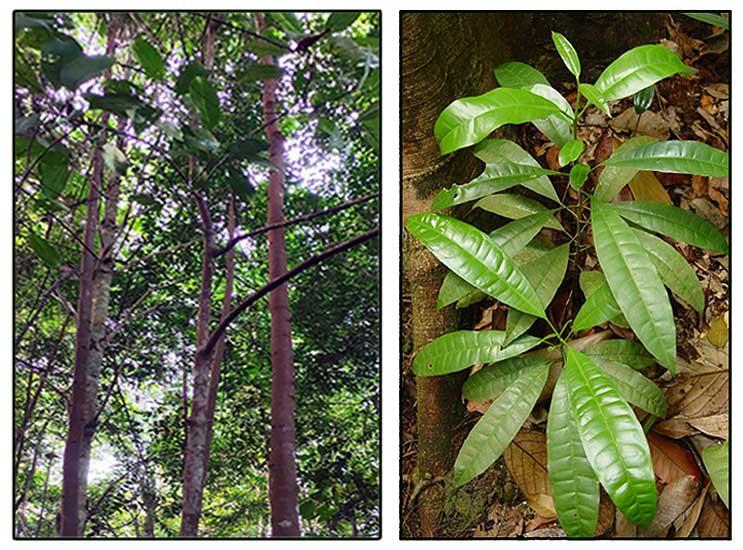
 A tree growing to a height of 25 m tall, leaves are slightly leathery to stiff papery, obovate, oblanceo-late to elliptic shaped with faintly visible veinlets. Flowers are dioecious, 4-petalled, green, yellow or white colored, held on an inflorescence found along the axils. The fruit is an oval to round drupe, shallowly 4-lobed, consist of 4 cavities.

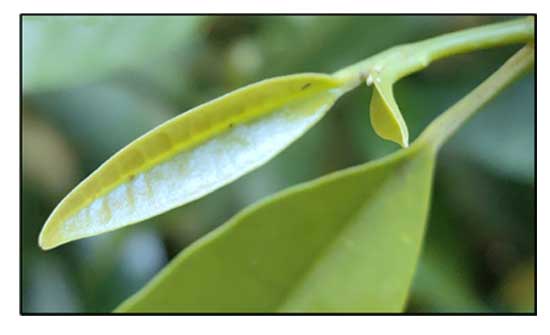
Growth form: A medium sized tree that grows to 25 m tall. Foliage: Leaves are slightly leathery to stiff-papery, spoon-shaped, inversely lance-shaped to elliptic measuring 5.5 - 24 cm long, 1.8 - 10 cm wide. There are 6=11 pairs of lateral veins, faintly visible veinlets and pellucid oil dots are present within the blade. The petiole is 0.7 - 5 cm long, swollen at the tip - near the base of the blade. Flowers: Dioecious where the female and male flowers are held on separate individuals. The flowers are on an inflorescence of 2-15 cm long found along the axils. They are 4-petalled, green to yellow to white colored, hairy on the inside. Fruit: Oval to round drupe, dark green, shallowly 4-lobed, consist of 4 cavities measuring 6-11 mm wide. Each cavity usually hold 2 seeds. (Flora & Fauna Web)

Distribution
- Native to the Philippines. (1) (2)
- Also native to Borneo, Malaya, Myanmar, Philippines, Sumatera, Thailand. (2)

- Occurs in primary rain forest, occasionally within secondary forest from sea level to 1500 m in altitude.

Constituents
- LC-MS/QTOF analysis of leaf extract found 430 compounds, and identified major compounds of amino acids, polyphenols, steroids, terpenoids and heterocyclic compounds which probably act as reducing agents. (see study below) (7)
- Study of leaves isolated two furanoquinoline alkaloids, skimmianine an kokusagin.
- Study isolated and characterized an alkaloid from M. porteri: Haplophytin B. (see study below) (8)

Properties
- Studies have suggested antimicrobial properties.

Parts used
Leaves.

Uses

Edibility
- No information found on edibility or culinary use of fruit or leaves.
Folkloric
- No reported medicinal use in the Philippines.
- In Malaysia, used for treatment of hypertension. (9)
Others

- Wood: Used in construction. (3)

Studies
Silver Nanoparticles / Antibacterial / Leaves:
Study reports on the synthesis and characterization of silver nanoparticles (AgNPs) using M. porteri extract and evaluated its antimicrobial and cytotoxic activities. The MP-AgNPs showed antibacterial activity against B. subtilis, S. aureus, E. Coli, and P. aeruginosa with inhibition zones of 8.0, 8.5, 7.5, 9.0 mm respectively. The AgNPs showed no cytotoxicity against Caco-2 and MCF-7 cells.(see constituents above) (7)
Alkaloid Haplophytin B: Study isolated an alkaloid from M. porteri, Haplophytin B. The compound showed no inhibition against S. aureus and P. aeruginosa, B. cereus, and E. coli, and not cytotoxicity against H199 and A549 cells. (8)

Availability
- Wild-crafted.

Seeptember 2026

                                                 PHOTOS / ILLUSTRATIONS
IMAGE SOURCE: Maclurodendron porteri trees / Internationa Islamic University Malaysia { Gancw1 / CC BY 4.0 / Image modified / Click on image or link to go to source page / Forest-ilm / Garden of Knowledge & Virtue
OTHER IMAGE SOURCE: Merlimau/Rawang Maclurodendron porteri / by / gancw1 / CC BY 4.0 / Image modified / Click on image or link to go to source page / Wikipedia
OTHER IMAGE SOURCE: Merlimau/Rawang Maclurodendron porteri / © / HP Lim / CC BY NC / Image modified / Click on image or link to go to source page / iNaturalist

Additional Sources and Suggested Readings
(1)
Rutaceae: Maclurodendron porteri  / Co's Digital Flora of the Philippines
(2)
Maclurodendron porteri / KEW: Plants of the World Online

(3)
Rutaceae / Wikipedia
(4)
Maclurodendron / Wikipedia
(5)
Maclurodendron porteri / Wikipedia
(6)
Maclurodendron porteri / NATIONAL PARKS: Flora & Fauna Web
(7)
Silver nanoparticles biogenically synthesised using Maclurodendron porteri extract and their bioactivities
/ Nadhirah Badrillah, Deny Susanti, Muhammad Taher et al / Heliyon, 2024; 10(4): e25454 / PMCID: PMC10877187 /   PMID: 38379964 / DOI: 10.1016/j.heliyon. 2024.e25454
(8)
Haplophytin B from Maclurodendron porteri / Muhammad Taher, Deny Susanti, Mohamad Fazlin Rezali et al / Pak. J. Pharm. Sci., 2014; 27(1): pp 179-181
(9)
Medicinal Plant Diversity and Vegetation Analysis of Logged over Hill Forest of Tekai Tembeling Forest Reserve, Jerantut, Pahang / Norhajar Eswani, AG Awang Noor et al / Journal of Agricultural Science, 2010; 2(3)

DOI: It is not uncommon for links on studies/sources to change. Copying and pasting the information on the search window or using the DOI (if available) will often redirect to the new link page. (Citing and Using a (DOI) Digital Object Identifier)

                                                            List of Understudied Philippine Medicinal Plants
                                          New plant names needed
The compilation now numbers over 1,750 medicinal plants. While I believe there are hundreds more that can be added to the collection, they are becoming more difficult to find. If you have a plant to suggest for inclusion, native or introduced, please email the info: scientific name (most helpful), local plant name (if known), any known folkloric medicinal use, and, if possible, a photo. Your help will be greatly appreciated.

HOME      •      SEARCH      •      EMAIL    •     ABOUT