 |

Family • Apocynaceae
Secamone
Secamone elliptica R.Br.
CORKY MILK VINE
Ji yu teng
| Scientific names | Common names |
| Secamone elliptica R.Br. | Corky milk (Engl.) |
| Accepted infraspecifics (2) | Corky milk vine (Engl.) |
| Secamone elliptica subsp. elliptica | Cork vine (Engl.) |
| Cynanchum dishasiale O.Schwarz | Milk vine (Engl.) |
| Secamone attenuata Decne. | Secamone (Engl.) |
| Secamone bonii Constantin | |
| Secamone caudata Pierre ex Costantin. | |
| Secamone ferruginea Pierre ex Costantin. | |
| Secamone finlaysonii Wight | |
| Secamone flavida Schltr. | |
| Secamone insularis Schltr. | |
| Secamone insularis var. angusta Schltr. | |
| Secamone lanceolata Blume | |
| Secamone likiangensis Tsiang | |
| Secamone micrantha (Decne.) Decne. | |
| Secamone multiflora Decne. | |
| Secamone neocaledonica Bullock | |
| Secamone neocaledonica Schltr. | |
| Secamone ovata R.Br. | |
| Secamone papuana Warb. | |
| Secamone sinica Hand.-Mazz. | |
| Tylophora micrantha Decne.. | |
| Secamone elliptica subsp. siamica (Kerr) Klack. | |
| Secamone siamica Kerr | |
| Tadehagi triquetrum is an accepted species. KEW: Plants of the World Online | |
| Other vernacular names |
| CHINA: Ji yu teng. |
| NIGERIA: Arilu (Yoruba); Ewuonkwonegie (Bini); Utunta (Ibo). |
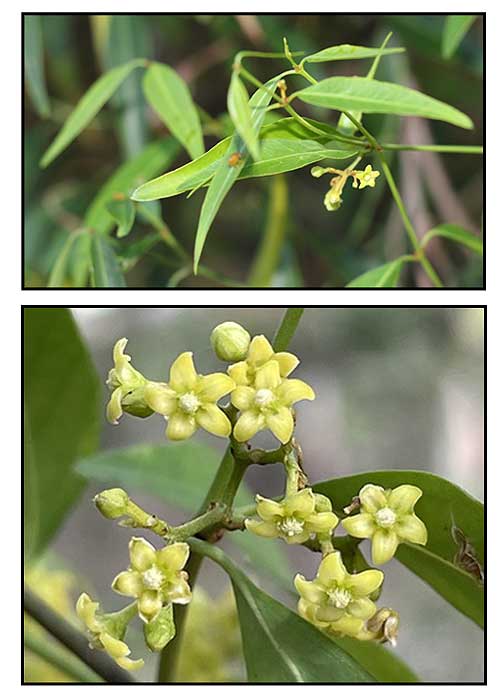
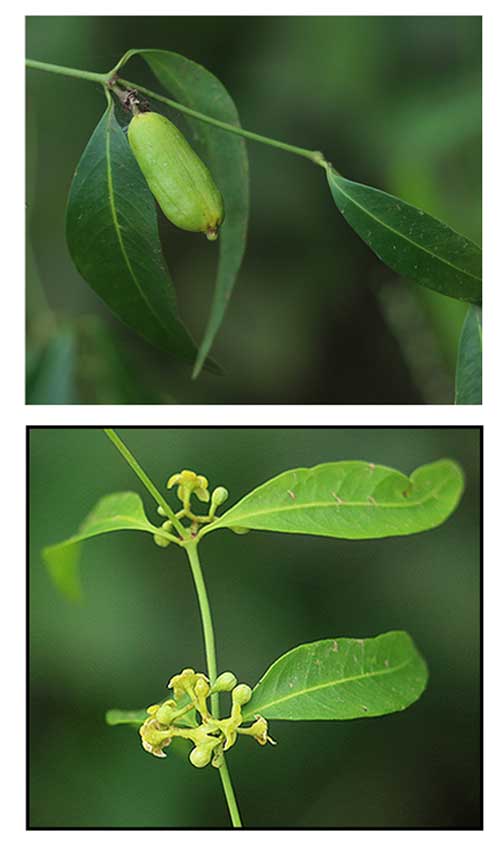
• Stem: Vine stem diameters to 5 cm recorded. Twigs, petioles and leaves produce a milky exudate. Leaf blades about 25-55 x 8-28 mm, petioles about 2-9 mm long. Small reddish glands visible on the twigs close to the point of attachment of the petioles. Sepals about 1.25-1.5 x 1 mm. Petals about 2.5 x 1.5 mm. Stamens fused together to form a corona and column. Anthers about 1 x 0.75 mm. Pollinia two per locule. Fruits usually paired, each fruiting carpel oblanceolate to fusiform, about 60-70 x 5-9 mm, flat on one side. Seeds numerous, each seed flat, about 7 x 2 mm. Plume about 25-30 mm long, attached to one end of the seed. Embryo about 5-6 mm long. Cotyledons elliptic, longer and wider than the radicle. (Australian Tropical Rainforest Plants)
Properties Availability |
 Gen info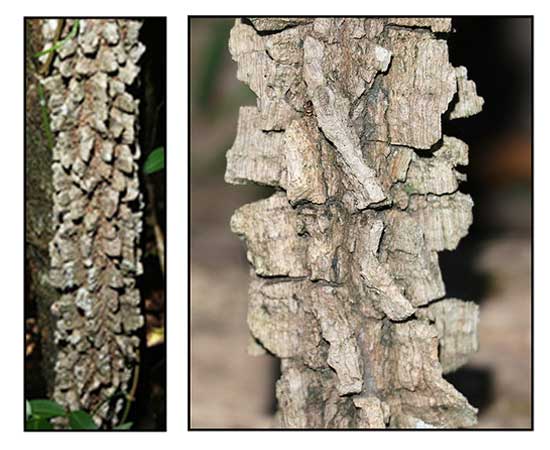
 Uses
UsesJanuary 2026

 |
| PHOTOS / ILLUSTRATIONS |
| IMAGE SOURCE: Secamone elliptica / © Greg Tasney / CC BY-SA 4.0 International / Image modified / Click on image or link to go to source page / iNaturalist |
| OTHER IMAGE SOURCE: Secamone elliptica leaves / © Greg Tasney / CC BY-SA 4.0 International / Image modified / Click on image or link to go to source page / iNaturalist |
| OTHER IMAGE SOURCE: Secamone elliptica fruit / © Greg Tasney / CC BY-SA 4.0 International / Image modified / Click on image or link to go to source page / iNaturalist |
| OTHER IMAGE SOURCE: Secamone elliptica: Corky milk vine / © Greg Tasney / CC BY-SA 4.0 International / Image modified / Click on image or link to go to source page / iNaturalist |
| OTHER IMAGE SOURCE: Secamone elliptica: Corky milk vine / © Greg Tasney / CC BY-SA 4.0 International / Image modified / Click on image or link to go to source page / iNaturalist |
| OTHER IMAGE SOURCE: Secamone elliptica: Corky milk vine / © Greg Tasney / CC BY-SA 4.0 International / Image modified / Click on image or link to go to source page / iNaturalist |
| OTHER IMAGE SOURCE: Secamone elliptica flowers / © Tim Albers / CC BY 4.0 International / Image modified / Click on image or link to go to source page / iNaturalist |
Additional
Sources and Suggested Readings |
• |
DOI: It is not uncommon for links on studies/sources to change. Copying and pasting the information on the search window or using the DOI (if available) will often redirect to the new link page. (Citing and Using a (DOI) Digital Object Identifier) |
| List of Understudied Philippine Medicinal Plants |
| New plant names needed The compilation now numbers over 1,730 medicinal plants. While I believe there are hundreds more that can be added to the collection, they are becoming more difficult to find. If you have a plant to suggest for inclusion, native or introduced, please email the info: scientific name (most helpful), local plant name (if known), any known folkloric medicinal use, and, if possible, a photo. Your help will be greatly appreciated. |
• |
 |
|
