Gen info Gen info
- Fabaceae or Leguminosae, commonly known as the legume pea, or bean family, is a large and agriculturally important family of flowering plants that includes trees, shrubs, and perennial or annual herbaceous plants, which are easily recognized by their fruit (legume) and their compound, stipulate leaves. It is widely distributed and is the third largest land plant family with about 765 genera and nearly 20,000 known species, behind only Orchidaceae and Asteraceae, (18)
- Albizia is a genus of more than 160 species of mostly fast growing subtropical and tropical trees and shrubs
in the subfamily Mimosoideae of the family Fabaceae, native to tropical and subtropical regions of Asia and Africa. (5)They are commonly called silk plants, silk trees, or sirises. (19)
-
Albizia julibrissin was first introduced in Europe (particularly Florence, Italy) in 1745 from Constantinople (Istanbul, Turkey) by Filippo Degli Albizzi. It was first described by Antonio Durazzini, who dedicated the genus name to Albizzi.
- Highly valued in traditional Chinese medicine
as a "calming spirit" herb and used for treatment of insomina, anxiety, and depression, and earning distinction as the "happiness Tree."
- Etymology: The genus name Albizia honors the Italian nobleman Filippo degli Albizzi, a Florentine nobleman who introduced the plant into cultivation in Europe from Constantinople in the mid-1700. The species name "julibrissin" is a corruption of the Persian word gul-i abrisham, which means "silk flower", from gul (flower) and abrisham (silk).
 Botany Botany
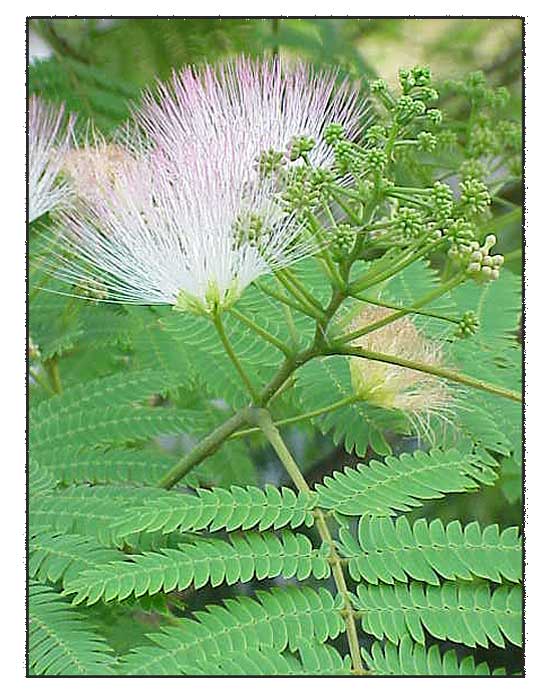
• Mimosa is a medium-sized deciduous tree that can grow to a height of 6 meters, usually multi-stemmed, a with a flat spreading crown, and a fast growth rate of about 25-50 centimeters per year. Bark is dark, greening gray, striped vertically as it gets older. Leaves are bi-pinnate, 20-45 centimeters long and 12 to 25 centimeters wide, divided into 6 to 12 pairs of pinnae, each with 20 to 30 pairs of leaflets. Leaflets are oblong, 1 to 1.5 centimeters long and 2 to 4 centimeters wide. Flowers are pink, showy, fragrant, and borne in dense fluffy clusters, grouped at the end of branches, resembling fluffy pin-cushions. Fruits are flat, straw-colored pods, about 15 centimeters in length, containing several brown oval-shaped seeds. (3)(5)
• A deciduous tree 30 to 40 ft high, with angular glabrous branchlets. Leaves doubly pinnate, with from six to twelve pairs of main divisions (pinnae), each of which consists of twenty to thirty pairs of leaflets, the entire leaf being 9 to 18 in. long, half as wide. Each leaflet is 1⁄3 to 1⁄2 in. long, 1⁄8 in. wide, oblong, oblique due to the blade developing only on the side of the midrib towards the base of the pinna. Flowers in a terminal cluster of dense heads each terminating a stalk of 1 to 2 in. long, the chief feature of the flower being the numerous thread-like pink stamens, 1 in. or more long, which give the flower-head the appearance of a brush. Pod about 5 in. wide, constricted between the seeds. (Trees & Shrubs)
Distribution
- Introduced.
- Ornamental cultivation. Grown for its leaf texture and flowers.
-
In some places, considered a nuisance because of its invasive nature. It is highly invasive and can colonize areas in a short period of time.
 Constituents Constituents
- Flowers yield a total of 25 types of aromatic components, with main aromatic constituents of Julibroside, trans-linalool oxide, linalool, isopentanol, α-ocimene, 2,2,4-tirmethylpentane, cyanidin-3-glucoside, among others. Foliage yielded an unknown quercetin derivative, hyperoside (quercetin-3-O-galactoside) and quercetin (quercetin-3-O-rhamnoside). (5)
- Bark has yielded
triterpenoid saponins (julibroside J29, julibroside J30, julibroside J31, and two phenolic glycosides (albibrissinosides A and B). (5)
- Leaves yielded a total flavonoid content of 35.14 mg/g.
(5)
- Study of stem bark yielded three new triterpenoid saponins, julibrosides A5-A7 (1-3), along with five known saponins (4-8). (10)
- Study of seeds yielded
an oil content and moisture of 10.50% and 1.56%, respectively. Free fatty acid, peroxide value, p-anisidine vale, saponification value, iodine value were 2.54%, 6.61 mequiv.O2/kg of oil, 1.98, 190.63 mg KOH/g and 111.33 g/100 g of oil, respectively. Dominant fatty acids in the oil were linoleic acid 58.58%, palmitic acid 13.86%, and oleic acid 10.47%. (see study below) (1)
 Toxicity concerns Toxicity concerns
- Reported toxicity from green or mature pods; seeds and wood.
- Alkaloids that are structural analogs of vitamin 6 (pyridoxine) are present in all plant parts that can antagonize the effects of pyridoxine. Pyridoxine is essential for formation of neurotransmitters such as GABA, and Albizia poisoning in animals can manifest as exaggerated responses to stimuli, muscle tremors, abnormal neck posture, convulsions, among others. Toxin effects can be reversed by injecting pyridoxine.
- Toxin: Legume yields a neurotoxic alkaloid that can cause neurological effects. It is thought to as as a pyridoxine antagonist. The toxicity is seasonal, when green or mature pods are available to sheep, goats, dogs, or cattle. Toxicity becomes a greater concern when trees are present in parks and gardens where children play. (11)
- Signs of intoxication can occur within hours of ingestion: seizures, tremors, staggering and labored breathing. Toxic dose range is 10-15 g/kg; LD was ≥ 15g/kg.
(11)
- There was a report of A. julibrissin poisoning involving 3 children presenting with decrease levels of consciousness at the Nashhad Medical Toxicology Research Center. They progressed to coma, but eventually recovered without residual deficits.
(11)
Properties
- Requires irrigation once established.
- The tree drips with nectar, and is attractive to hummingbirds, honeybees and butterflies.
- Downsides: Yes, pretty and fragrant, but the flowers last but two weeks, replaced by scads of ugly green pods that hang around quite a while.
And, besides toxicity concerns above: Seeds have an impermeable coat and can remain dormant for years. (3) It is moderately invasive, able to grow rapidly; sprouts can grove over 1 meter in a season, re-sprout after damage and seed prolifically. (4) Pollen can be a source of hay fever. (11)
- Studies have suggested sedative, antidepressant, anti-inflammatory, memory enhancing, antitumor, antiangiogenesis, antibacterial, anti-acetylcholinesterase, anti-lipase, immunomodulatory, anti-glycation, anti-obesity, wound healing, hepatoprotective properties.
Parts used
Flowers, leaves, stems, oil.
Uses
Edibility
- Young leaves are cooked; used as potherb. (16)
- Dried leaves used as tea substitute.(16)
- Flowers are cooked, eaten as vegetable.(16)
Folkloric
- A valued Chinese botanical for relieving anxiety, stress, and depression. Referred to by some Chinese herbalists as the "herbal prozac."
- Its extract and essential oil are widely used for dysphoria-induced wakefulness, depression, forgetfulness, and dreaminess. (5)
- It is a constituent in the well known Chinese medicine for insomnia, together with Suan-zao-reng-tang and P. multiforme. (5)
- In Taiwan, it is the most prescribed herbal medicine for insomnia. (6)
- In Korean medicine, the cortex of A. julibrissin is traditionally used to treat dermatitis, depression, and insomnia.
Others
- Fodder: Seeds are used as food for livestock and by wildlife.
- Agrofrestry: Used as reclamation plant.
Studies
• Sedative / Antidepressant: Study on mice drenched with decoction significantly showed reduction in spontaneous activity and passive activity. Effects have included tranquilization, regulating qi to whet appetite, dispersing wind to improve eyesight and promoting blood circulation. (5)
• Anti-Inflammatory / Leaves: Study of ethanol and hydroalcoholic extracts of leaves of Albizia julibrissin showed significant anti-inflammatory activity in HRBC membrane stabilization method. Percentage inhibition of membrane lysis by ethanol extract was 60.87% (1000 µg/ml) compared to standard diclofenac sodium at 69.56% (50 µg/ml). (6)
• Amelioration of Memory Loss Induced by Insomnia: Study evaluated the effect of A. julibrissin on sleep deprivation-induced memory loss in a Drosophilia model. Results showed A. julibrissin ameliorated a 3-hour memory loss but not 1-hour memory or instant learning. Findings might have application in anticipated short-term sleep disturbance. (7)
• Learning and Memory Enhancing Activity / Essential Oil: Study evaluated the learning and memory enhancing activity of A. julibrissin against amnesia induced by scopolamine in young mice. Piracetam was used as standard. Anticholinesterase activity was evaluated. Administration of essential oil prevented scopolamine induced experimental amnesia and may have great potential in memory deficits. (8)
• Ultrasonic-Surfactant Extraction of Flavonoids / Flowers: Study reports on the methodology for extraction of total flavonoids from Albizia julibrissin flowers by combing surfactant with ultrasonic technology. (9)
• Effect on Growth and Brain Monoamine Neurotransmitters: Study investigated the effects of A. julibrissin on growth and brain neurotransmitters in chronic stressed rats. Brain tissue was analyzed for content of homovanillic acid (HVA), norepinephrine (NE), dopamine (DA) and 5-hydroxytryptamine (5-HT) .Results suggest A. julibrissin alleviates growth inhibition cause by stress and regulates the levels of brain monoamine neurotransmitters in stressed rats. (12)
• Inhibition of Tumor Growth / Antiangiogenesis: Study investigated the in-vivo and in-vitro anti-angiogenesis effect of of A. julibrissin extract. The extract remarkably suppressed basic fibroblast growth factor-induced proliferation and migration and tube formation of HMEC-1. In -vivo, extract significantly inhibited tumor-induced angiogenesis and tumor growth in an intradermal inoculation mouse model. Results suggest potential as a potent anti-tumor drug, which exerts an anti-tumor effect through anti-angiogenic mechanism. (13)
• Seed Oil: Analytical study of seed of Albizia julibrissin showed it is a promising oilseed crop, which can be used for making soap, hair shampoo, and UV protectors. Its high level of unsaturated fatty acids adds to a desirable nutritional profile. (see constituents above) (14)
• Effect on Low-Density Lipoprotein Oxidation: Study reports on the extraction of flavonoids from A. julibrissin biomass. Foliage, flower, and whole plant extracts were tested for potential to inhibit LDL oxidization Highest inhibition was obtained with foliage water extracts, which were standardized at 2.5 µM of flavonoids. Water extracts were not toxic to Vero 76 cells. (15)
• Total Saponins / Inhibition of Vascular endothelial Growth Factor Medicate Angiogenesis: Study evaluated the anti-tumor and anti-angiogenic effects of total saponins from A. julibrissin. Results suggest the total saponins from A. julibrissin has potential an antiangiogenic agent that targets the VEGF/VEGER2 signaling pathway, and inhibits tumor-induced angiogenesis. (17)
• Antidepressant / Search for Molecular Basis and Mechanism of Action / Review: A. julibrissin is empirically used as an antidepressant. Studies have indicated bioactive constituents exerting antidepressant-like responses in animal models, providing molecular basis underlying its mechanism of action. Identification of bioactive constituents and their interactions with pharmacological targets will offer molecular basis for understanding the antidepressant effects of A. julibrissin. (20)
• Inflammation Modulating in Atopic Dermatitis Model / Cortex: Study evaluated the potential of A. julibrissin for treating atopic dermatitis. Study investigated the anti-inflammatory properties of Aj cortex extract in cell and animal models, in vitro by inflammatory response induced in human mast cells (HMC-1) and in human keratinocytes (HaCaT) using TNF-α, IFN-γ and cytokine analysis by ELISA. Results showed the extract reduces cytokine production in mast cells and keratinocytes in vitro. In vivo, extract improved atopic dermatitis scores, reduced scratching behavior, dermal thickness, and serum IL-6 levels, and inhibited infiltration of eosinophils and mast cells. High-dose group showed enhanced efficacy and reduced p38 mitogen activated phosphorylation. Results suggest Aj cortex extract exhibited anti-inflammatory effects and potential for management of atopic dermatitis. (21)
• Antibacterial / Stem, Flowers, Leaves: Study evaluated the antibacterial efficacy of leaf, stem, and flowers extracts of Aj against bacterial pathogens using disc diffusion method and tube dilution method. A methanol extract of leaves showed highest extractive value of 5.14g/100g and total flavonoid content of 35.14 mg/g. Leaf extracts showed maximum zone of inhibition towards Proteus vulgaris (10.1 mm) and least against Salmonella typhi (3.5 mm). Stem and flower extracts inhibited bacterial growth only at higher concentrations (MIC 160-215 and 65-180 µg/ml respectively). (22)
• Immunomodulatory / Saponins / Stem Bark: Total saponins extracted from stem bark of Aj have been shown to enhance both antigen-specific cellular and humoral immune responses. A purified saponin fraction, AJSAF, has shown ability to amplify immune responses, triggering Th1/Th2 and Tcl/Tc2 responses to various vaccines, including those for porcine reproductive and respiratory syndrome virus (PRRSV) and inactivated and highly pathogenic JXA1-R modified live vaccines. Although immunological adjuvant properties of A. julibrissin do not align with its traditional uses, AJSAF is being developed as a novel vaccine adjuvant. (23)
• Anti-Acetylcholinesterase / Anti-Lipase / Anti-Glycation / Cytotoxicity: Study evaluated the anti-acetylcholinesterase, antilipase, antiglycation and anticancer activities of leaf extracts of A. julibrissin and Caesalpinia decapetala. Methanolic extract of Albizia julibrissin showed highest anti-acetylcholinesterase activity (IC50 2.391 µg/ml). On antilipase assay, Aj at 100, 500, and 1000, showed % inhibition (45.89, 60.64, 67.85%) with IC50 of 155.2, Anti-glycation assay showed % inhibition of 43.90, 54.25, and 82.95, with IC50 182.5. Results showed significant inhibition of enzymatic activities, glycation products and cytotoxic growth and potential as novel as novel pharmacologic leads. (24)
• Hyperoside and Quercitrin from Foliage: Mimosa, an excellent energy crop candidate due to its high growth yield, contains on a dry basis 0.83% hyperoside and 0,90% quercitrin, the former documented as having anti-inflammatory and diuretic properties, and the latter, for a role in intestinal repair following chronic mucosal injury. Study reports on the effect of three extraction parameters (temperature, solvent composition, and time) on the yield of these important quercetin compounds, along with conditions that maximize yield and concentration, complementing biomass pretreatment, hydrolysis and fermentation. Study reports on various solvent choices for extraction of flavonoids hyperoside, quercitrin, and quercetin-rhamnosylgalactoside from mimosa foliage. While yields fell to 60-70% with water as extraction solvent, water was still judged the to be effective in extracting a high-value, relatively low demand compound from a high volume energy crop. A conceptual design shows that flavonoid extraction could be easily coupled with biomass pretreatment prior to enzymatic hydrolysis and fermentation. (25)
• Anti-Obesity / Browning Effect on White Adipocytes: Study evaluated the effects of Aj leaf extracts (AJLE) on adipocytes using 3T3-L1 cells. AJLE inhibited adipogenesis by reducing the expression of peroxisome proliferator-activated receptor γ (PPARγ) and CCAAT/enhancer binding proteins (C/EBPs) that regulate enzymes involved in fat synthesis and storage and reduce intracellular lipid droplets, GPDH, and triglycerides. AJLE also increased expression of brown adipocyte markers and increased expression of many key factors in regulating mitochondrial biogenesis. The ability of AJLE to inhibit adipogenesis and induce brown differentiation may help treat obesity and related diseases. (26)
• Comparative Burn-Wound Healing / Silver Sulfadiazine / Clinical Trial: A single blind clinical trial on 40 patients compared the wound healing effects of A. julibrissin gel (AG) with silver sulfadiazine (SSD) with metrics of pain, irritation, edema, itching, erythema, percentage wound healing, purulent discharges, and skin discoloration. Severity of pain, inflammation, purulent secretions were significantly relieved in the Aj group. Healing time was reduced in bothy second and third degree burns. No significant drug reactions were noted. Wound healing was attributed possibly to saponin compounds that elevated levels of vascular endothelial growth factor and inflammatory cytokines, stimulating fibroblasts, endothelial cells and macrophage migration at wound sites to rebuild matrix and new tissue. Results suggest a. julliibrissin improves different therapeutic aspects of burn injury and has potential as a new herbal remedy in wound healing. (27)
• Alleviation of METH-Induced Hepatic Toxicity / Quercetrin / Flowers: Study evaluated the effects of Albizia julibrissin flowers (AF) extracts and its primary ingredient on METH-induced hepatotoxicity. The ethyl acetate fraction of AF extracts significantly alleviated the decrease in hepatocyte activity induced by METH in vitro. UPLC-MS/MS analysis showed quercetrin (QR) as the major ingredient of the AF extract. QR alleviates METH-induced hepatocyte apoptosis, cell cycle arrest, oxidative stress, and mitochondrial damage, and alleviates METH-induced oxidative liver damage in mice, exerting its therapeutic effects by regulating BAX/CASP3 pathway. Results showed AF and QR can effectively alleviate METH-induced liver injury via mitochondrial-mediated apoptotic pathway. (28)
Availability
- Wild-crafted.
- Herbal capsules, extracts, tinctures, dried teas in the cybermarket.
|