Gen info
- Malvaceae is a large family of flowering plants containing about 243 genera representing 4,225 species, which include a wide variety of herbs, shrubs, and trees.
-
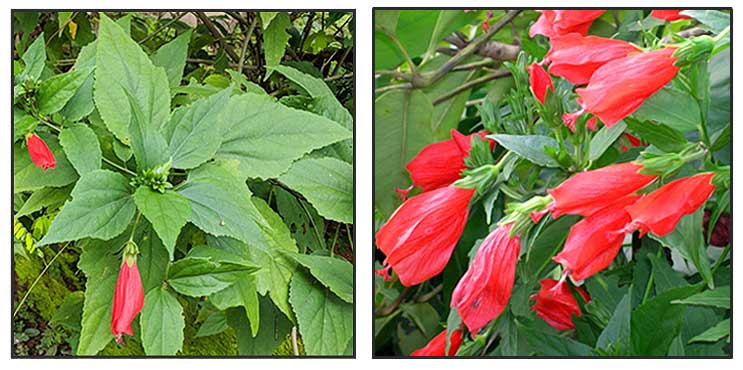
Common names for species in the genus are confusingly shared, including: Turk's cap mallow, wax mallow, sleeping hibiscus, and mazapan.
- It belongs to a group of genera that differ from the closely related Hisbiscus in possessing a fruit divided into 5 separate parts (a schizocarp), and having a style surmounted by 10, rather than 5 capitate or capitellate stigmas.
(16)
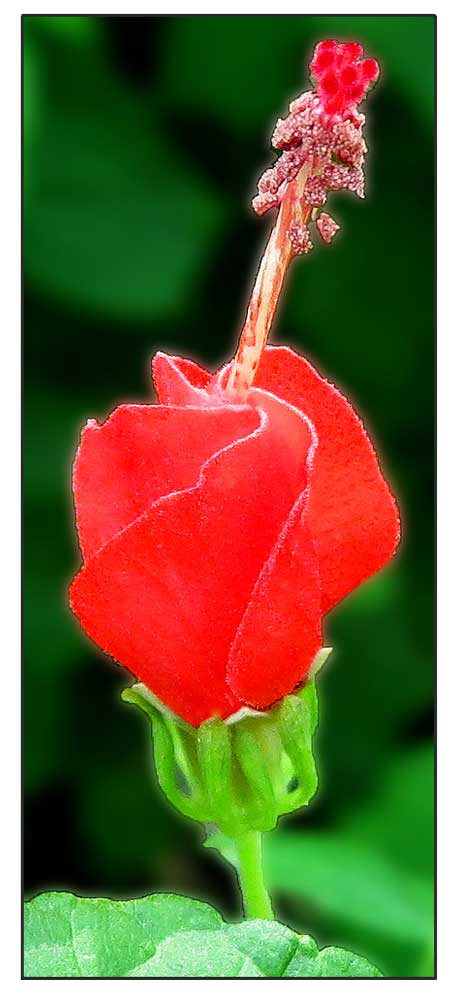
- Sleeping hibiscus derives from the flowers
appearing like unopened Hibiscus flowers,.
Botany
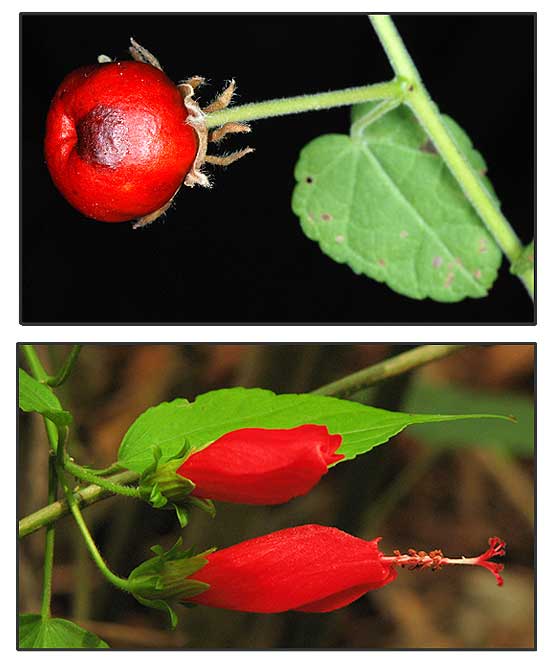
• Erect undershrubs or shrubs, about 1-4 m tall. Stems woody, branches with simple and stellate hairs, later becoming glabrate. Leaves alternate, unlobed or shallow 3-5 lobed after the middle part towards the apex, broadly ovate-elliptic to lanceolate, about 4-22 x 3-13 cm across, base rounded 5-9 veined, margins coarsely crenate-serrate or rarely entire, apex acute to acuminate, sparsely pubescent with simple and stellate hairs both above and beneath, Petiole puberulent, about 2-5 cm long, stipules linear spathulate, caducous, about 3-5 mm long. Flowers bisexual, ascending, pedicel slender, puberulent, about 5-15 mm long, involucellar bractlets linear spathulate, calyx 5 lobed, distinctly nerved, campanulate, lobes lanceolate, base connate, apex acute to acuminate, persistent, corolla showy, scarlet red, whitish, orange, campanulate or cylindric, about 2.5-3 cm long. Fruit capsule, globose-cylindrical, about 1.5 cm across, fleshy, edible. Seeds reniform or subglobose, brownish. (3)
 Distribution Distribution
- Naturalized.
- Along forest margins and moist and wet thickets.
- In Luzon: Benguet; Mindanao: Davao del Norte.
- Native to Belize, Colombia, Costa Rica, El Salvador, Guatemala, Honduras, Mexico Central, Mexico Gulf, Mexico Northeast, Mexico Northwest, Mexico Southeast, Mexico Southwest, Nicaragua, Panamá, Peru, Texas, Trinidad-Tobago, Venezuela. (2)
Constituents
- LC-HR-ESI-MS metabolic profiling of crude extract of aerial parts revealed presence of a variety of phytochemicals, mostly phenolics. Detailed analysis of the most active fraction - ethyl acetate - isolated and identified six compounds for the first time in the genus: four phenolic acids; ß-resorcylic, caffeic, protocatechuic, and 4-hydroxyphenylacetic acids, plus two flavonoids; trifolin and astralgin. (see study below) (6)
- Leaves and flowers show presence of constituents like flavonoids, anthocyanins, and phenolic acids, along with sterols, terpenoids, and fatty acids. Leaf constituents include protocatechuic acid, chlorogenic acid, gallic acid, p-coumaric acid, ferulic acid, and hydroxybenzoic acid. (14)
- Ethanolic extract of entire aerial parts contains cardenolides, carbohydrates, glycosides, and/or nitrogenous compounds. Flowers contain total soluble flavonoids such as kaempferol, myricetin, quercetin, and rutin. (14)
-
Aerial parts also contain four phenolic acids, namely ß-resorcylic, cafffeic, protocatechuic, and 4-hydroxyphenylacetic acids, along with two flavonoids, trifolin and astragalin. (14)
- Study of leaves and flowers for volatile composition identified 39 components, 365 from leaves and 11 from flowers, with greater contribution of oxygenated compounds (89.54% in leaves and 89.35% in flowers) to total volatiles. Phenolic ethers (41.64%) and ketones (21.57%) were major chemical groups emitted by flowers, while ketones (27.40%) and carboxylic acids (18.16%) dominated volatile blends of leaves. Anethole(32.32%), methyl isobutenyl ketone (19.18%), and methyl chavicol (9.32%) were most abundant floral volatiles, while acetic acid (18.16%0 was major constituents of leaves, followed by 2-cyclohexenone (9.60%) and anethole (7.39%).
Properties
- Studies have suggested hepatoprotective, antioxidant, hypoglycemic, antidiabetic, gastroprotective, anticonvulsant, vasorelaxant, anti-alopecia, antihyperlipidemic properties.
Parts used
Flowers, leaves.
 Uses Uses
Edibility
- In Mexico and Central America, leaves and flowers used for making herbal teas and dyes, and preparation of salads.
- Fruit is a small, edible, red berry, resembling a tiny beefsteak tomato; mildly sweet, apple-like or with a subtle tart flavor. Some consider the flavor mawkish and unappetizing. Fruits used for making herbal teas, jams and jellies.
Folkloric
- No reported folkloric medicinal use in the Philippines,
- Traditionally, flowers and leaves used for treatment of dysentery, nosebleeds, stomach pains, sore throat, and kidney diseases. (4)
- In the West Region of Cameroon, used to treat various diseases, including epilepsy. (7)
- Used by Panamanian, Guatemalan, and Mexican healers for treatment of fever, respiratory complications, dysentery, liver and gallbladder problems, stomachache, and gastritis. (10)
- In Mexico, used for treatment of hypertension.
- In West Java, used as herbal treatment to increase hair growth. (13)
- Decoction of leaves used for treatment of cystitis, diarrhea, fever, and gastritis. Decoction of flowers used as gargle for sore throat, nursing infants with cold, bronchitis, diarrhea, thrush, and tonsillitis. (14)
- Liniment from base of plant used for dressing burns. Stems used for treatment of measles, hair loss, seborrhea, lice, aphthae, and chinch pickets. (14)
Others
- Pollination: The flowers do not fully open, which help attract butterflies and hummingbirds. (3) In Texas, it is a common understory shrub and an important food source for female and juvenile Ruby-throated hummingbirds (Archilochus colubri) and Black-chinned Hummingbirds (A. alexandri). Each flower lasts a mere two days but contains more nectar on the first day. (5)
Studies
• Hepatoprotective / CCl4-Induced Toxicity / Aerial parts: Study evaluated the hepatoprotective potential of M. arboreus extracts and fractions of aerial parts against carbon tetrachloride (CCl4)-induced hepatotoxicity in rats. Results showed the ethyl acetate and dichloromethane fractions significantly alleviated liver injury in rats evidenced by reduced levels of ALT, AST, alkaline phosphatase, total bilirubin and malondialdehyde (MDA), along with enhancement of total antioxidant capacities of the liver. Maximum effect was recorded with ethyl acetate fractions. Protective action of the fractions were comparable to silymarin (100 mg/kg), substantiated by histopathological evaluation. Hepatoprotective effect was attributed to phenolic principles, along with synergistic antioxidant properties. (see constituents above) (6)
• Anticonvulsant / Leaves: Study evaluated the anticonvulsant effect of aqueous lyophilisate of decoction of flowers, leaves, stems, and roots of MN. arboreus on a model of acute epileptic seizures. M. arboreus leaves showed the best anticonvulsant effect and the aqueous lyophilisate was the best extract. The latter significantly protected animals against convulsions induced by PTZ (pentylene-tetrazole), PIC (picrotoxin) and STR (strychnine).The aqueous lyophilisate of leaves produced its anticonvulsant effect via potentiation of GABAergic and glycinergic neurotransmissions, but not cholinergic signaling. It showed no acute or subacute toxicity and revealed a high content of flavonoids. saponins, tannins, and alkaloids, and antioxidant activity in vitro. (7)
• Effect of Incorporation on Goat Milk Yoghurt / Flowers and Leaves: Study evaluated the effects of incorporating different concentrations (1% and 2%) of M. arboreus flower (FE) and leaf (LE) extracts as functional ingredients in goat milk yoghurt. Study showed reduction in viability of lactic acid bacteria, particularly L. delbrueckii subsp. bulgaricus, suggesting antimicrobial property of the extract. FE at 2% improved both antioxidant and textural properties while reducing syneresis by end of storage period, suggesting potential as functional food ingredient. (8)
• Hypoglycemic Potential / Leaves: Study evaluated the antidiabetic potential of leaf extracts of M. arboreus in alloxan-treated albino rat model. Results showed decreased in blood glucose levels. Histopathological exam of the pancreas revealed reduced inflammation and congestion in the treated groups. The M. arboreus extracts showed anti-diabetic activity. (9)
• Gastroprotective / Kaempferol Glycosides / Leaves: Study evaluated the gastroprotective effect of aqueous extract of flowers using ethanol-induced gastric ulcer experimental testing in male rats. Fresh flowers were dried and macerated with water. Results showed gastroprotective effect. The organic fraction (MaEA) showed protection of 91.2, 96.0m and 99,4% at 125, 250, and 500 mg/kg respectively. Compared to famotidine at 10 mg/kg and 83% gastroprotection, the EA fraction showed better protection. (10)
• Vasorelaxant / Stems and Leaves: Study evaluated the vasorelaxant activities of organic extracts of M. arboreus stems and leaves by ex vivo rat thoracic aorta assay. Vasorelaxant activity was determined by measuring the relaxant capability of extract to decrease contraction induced by noradrenaline. The hexane extract induced a significant vasorelaxant effect in a concentration- and endothelium-dependent manner. LC/QTOF-MS revealed secondary metabolites, such as polyunsaturated fatty acids, terpenes and one flavonoid. (11)
• Antioxidant Potential of Flowers: Study evaluated the methanol extracts of red and pink flowers of M. arboreus for antioxidant potential. The flowers are a rich source of phytochemicals like phenols, flavonoids, tannins, etc. Antioxidant potential of both varieties were screened by ABTS, DPPH, chelating potential, FRAP, and CUPRAC. The red flowers showed higher antioxidant potential. However, even though the antioxidant potential of the flowers were lower than standard ascorbic acid, it can still be used as primary antioxidants. (12)
• Anti-Alopecia / Leaves: Study evaluated the anti-alopecia activity of 70% ethanol and ethyl acetate and hexane fractions of M. arboreus. The hair growth stimulator activity was based on Tanaka modification method, using minoxidil 2% as positive control. The extract showed significant activity with 15% concentration with the same growing power as the positive control. The n-hexane fraction showed most optimum hair growth. Results suggest Wera leaf showed hair growth stimulating effect and has potential for use as anti-alopecia treatment. (13)
• Antihyperlipidemic / Leaves: Study evaluated the therapeutic efficacy of ethanolic extract of M. arboreus leaves against HFD-induced hyperlipidemic in rats. Oral administration of EEMA showed significant dose-dependent protection against HFD-induced hyperlipidemia evidenced by improved lipid profile and liver function biomarkers. Maximum effect was observed with dose of 600 mg/kbw. (17)
• Effect as Functional Ingredients in Goat Milk Yoghurt / Flower and Leaves: Study evaluated the effects of incorporating different concentrations (1% and 2%) of flower and leaf extract as functional ingredients - physicochemical, bioactive, antioxidant, rheological, textural, and sensory properties - in goat milk yoghurt over a 28-day storage period. Extracts significantly enhanced the yoghurt's antioxidant activity and strengthened its ability to inhibit lipid oxidation during storage, along with reduction in viability of lactic acid bacteria, improved textural properties, while reducing syneresis the end of storage period. Results suggest significant potential as functional food ingredient. (19)
Availability
- Wild-crafted.
- Seeds, plants in the cybermarket. |