HOME    •    SEARCH      •      EMAIL    •     ABOUT  •     DONATE


Family • Araceae
Sweetheart plant
Philodendron hederaceum (Jacq.) Schott
HEARTLEAF PHILODENDRON

Scientific names Common names
Arum hederaceum Jacq. Heartleaf philodendron (Engl.)
Philodendron hederaceum (Jacq.) Schott Parlor ivy (Engl.)
Pothos hederaceus (Jacq.) Aubl. Sweetheart plant (Engl.)
Accepted infraspecifics (3) Velvet-leaf philodendron (Engl.)
Philodendron hederaceum var. hederaceum Vile vine (Engl.)
Philodendron hederaceum var. kirkbridei Croat  
P. hederaceum var. oxycardium (Schott) Croat  
Philodendron hederaceum is an accepted species. KEW: Plants of the World Online

Other vernacular names
CHINA: Chou jie cao.
INDIA: Ruhawh-hlo (Mizo).
NEPALI: Dampate, Ankuree.
THAI: Kadae (Peninsular), Muong day.
VIETNAMESE: Me tien, Moc meo.

Gen info
- Araceae is a family of monocotyledonous flowering plants in which flowers are borne on a type of inflorescence called a spadix. Also known as the arum family, members are colloquially known as aroids. The family contains 114 genera and about 3,750 known species. (5)
- Etymology: The genus name Philodendron derives from Greek words Philo, meaning "love", and dendron, meaning "tree". Specific epithet hederaceum means "resembling ivy".
- Under the synonym Philodendron scandens it has gained the Royal Horticultural Society's Award of Garden Merit.

Botany
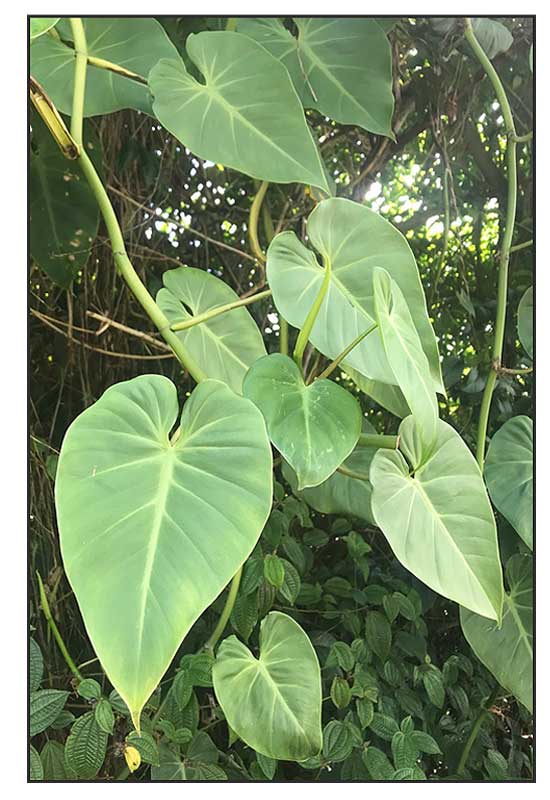
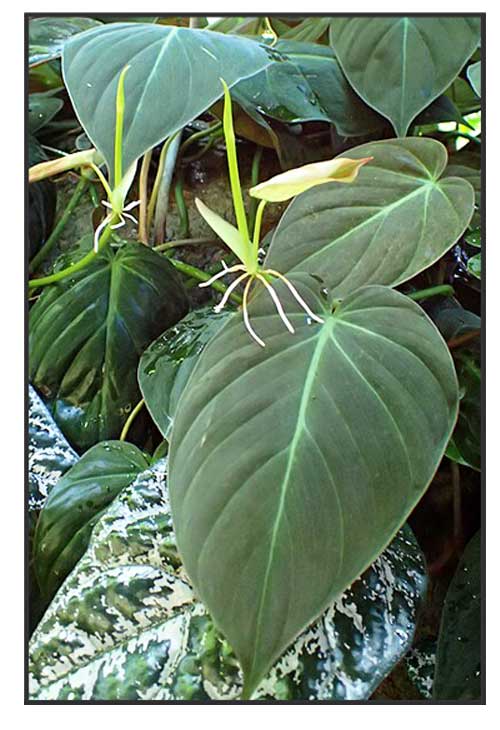
• Growth form: An evergreen hemi-epiphytic vine, usually found growing on trees or rocks, can reach to a length of about 3 - 6 m. Foliage: Heart-shaped leaves, measuring about 10 - 20 cm by 8 - 15 cm, leaf stalk measuring about 4 - 7 cm long, pointed tips. Juvenile plants have leaves blades that are velvety and red on the underside. The character is lost after the plant matures. Flowers: Yellowish-green spathes of white flowers (spadix) occasionally blooming, spathes measuring about 5 - 6 cm, spadix cylindrical in shape and pistillate part measuring about 4 - 5 m long. Flowers are sterile and do not set seed. (Flora & Fauna Web)

Distribution
- Naturalized. (1)
- In Luzon: Laguna; Mt. Makiling.

- Native to Belize, Bolivia, Brazil North, Brazil Northeast, Brazil South, Brazil Southeast, Cayman Is., Central American Pacific Is., Colombia, Costa Rica, Cuba, Dominican Republic, Ecuador, El Salvador, Guatemala, Honduras, Jamaica, Leeward Is., Mexico Central, Mexico Gulf, Mexico Northeast, Mexico Southeast, Mexico Southwest, Nicaragua, Panamá, Peru, Puerto Rico, Suriname, Trinidad-Tobago, Venezuela, Windward Is. (2)

Constituents
- GC-MS/MS analysis for P. hederaceum leaf methanol extract identified 68 compounds, each of which possessed unique phytochemical activity. Top compound was 9-octadecenamide (28%), followed by
1-heptaconasol (13.73%), phytol (8.20%), and performic acid trimethylsilyl (6.13  %). (see study below) (4)

Properties
- Studies have suggest analgesic, anti-inflammatory, antioxidant properties.
- Toxicity: Contains insoluble calcium oxalate crystals: needle-like crystals released when chewed or bitten. Ingestion causes mouth irritation, burning, swelling of lips and tongue, and difficulty swallowing. Sap can cause skin irritation. Calcium oxalate crystals can deposit in organs such as kidneys, and cause cardiac-related issues in humans. Also known to be toxic to mice and rats. There is conflicting info regarding toxicity to cats.
- Considered one of the best types of houseplants to remove formaldehyde in high concentration and to absorb formaldehyde from water-based pains, roofing felt, glues in fitted carpets, or even laminated wood floors. (6)

Parts used
Leaves.

Uses

Edibility
- Not edible.
- Toxic to humans and pets.
Folkloric
- No reported medicinal use in the Philippines.
Others

- Agroforestry: Use as ground cover or on arbors or trellises, around patios, windowsills, and pools.
- Air-cleaning: House plant used for air-cleaning property, particularly for removal of formaldehyde. (1)

- Ornamental: Ornamental foliage.

Studies
• Antioxidant / Analgesic / Anti-Inflammatory / Leaves:
Study evaluated the antioxidant, analgesic, anti-inflammatory potentials of P. hederaceum methanol leaf extract (PHL-ME). GC-MS/MS analysis identified 68 potential bioactive compounds. Extract exhibited strong anti-inflammatory effects, with 85.16% protective effect on HRBC membrane stabilizing assay and significant antioxidant activity, with IC50s of 82.57 µg/ml and 46.20 µg/mL in ABTS and DPPH assays, respectively. At 400 mg/kg, the extract exhibited moderate analgesic activity (p<0.01) in acetic acid-induced writhing and mild activity (p<0.05) in both formalin-induced licking and hot plate test. (4)
• Acute Toxicity Study of Leaf Extract: Acute toxicity study of PHL-ME during 8-hour and 3-daty observation showed no adverse behavioral changes, morbidity, or deaths after oral doses of 1000, 2000, or 4000 mg/kg, indicating is practically non-toxic under experimental conditions, supporting safety of selected pharmacological doses (200 and 400 mg/kg) in subsequent assays. (4)

Availability
- Introduced, highly popular, affordable ornamental houseplant.

October 2026

                                                 PHOTOS / ILLUSTRATIONS
IMAGE SOURCE: Philodendron hederaceum var. hederaceum / © Krzysztof Ziarnek, Kenraiz / CC BY-SA 4.0i / Image modified / Click on image or link to go to source page / Wikipedia
IMAGE SOURCE: Heart-leaf Philodendron - Philodendron hederaceum / © Brittany Savoie / Some rights reserved / CC BY 4.0 International / Image modified / Click on image or link to go to source page / iNaturalist

Additional Sources and Suggested Readings
(1)
Araceae: Philodendron hederaceum / Co's Digital Flora of the Philippines
(2)
Philodendron hederaceum
/ KEW: Plants of the World Online

(3)
Araceae / Wikipedia
(4)
Assessment of antioxidant, anti-inflammatory, and analgesic potentials of Philodendron hederaceum leaf methanolic extract: an integrated in vitro, in vivo, and in silico approach with GC-MS/MS analysis / Sayed Al Hossain Rabbi, Md Zamil Hossain, Md Jahirul Island Mamun, Delower Hossain et al / Beni-Suef University Journal of Basic and Applied Sciences, 2026; Art 15 / DOI: 10.1186/s43088-026-00798-z
(5)
Araceae / Wikipedia
(6)
Review on Philodendron Species-Plant Seeking For Validation of Its Therapeutic Approaches / Pankaj Nainwal / J Pharm Sci & Res., 2019; 11(5): pp 2003-2006 / ISSN: 0975-1459

•

DOI: It is not uncommon for links on studies/sources to change. Copying and pasting the information on the search window or using the DOI (if available) will often redirect to the new link page. (Citing and Using a (DOI) Digital Object Identifier)

                                                            List of Understudied Philippine Medicinal Plants
                                          New plant names needed
The compilation now numbers over 1,750 medicinal plants. While I believe there are hundreds more that can be added to the collection, they are becoming more difficult to find. If you have a plant to suggest for inclusion, native or introduced, please email the info: scientific name (most helpful), local plant name (if known), any known folkloric medicinal use, and, if possible, a photo. Your help will be greatly appreciated.
•

•
HOME      •      SEARCH      •      EMAIL    •     ABOUT