 Gen info Gen info
• Rhizophoraceae is a family of tropical and subtropical flowering plants. It includes around 147 species distributed in 15 genera. Although known for its mangrove members, only the genera under Rhizophoreae grow in mangrove habitats, the rest live in inland forests. (10)
• Etymology: The genus Ceriops derives from Greek words keros meaning "wax" and -ops meaning "resembling" or "appearance", referring to the thick, shiny, wax-like substance found at the base of the stipules. Alternatively, it is ceras-opsis, meaning "horn-like" in appearance, referring to the shape of the small hypocotyl. The specific epithet tagal derives from the Tagalog name for the plant: tagal or tangal.
Botany
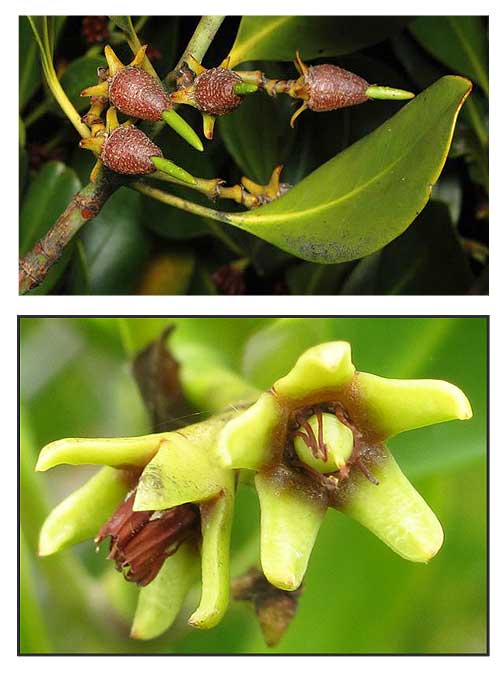
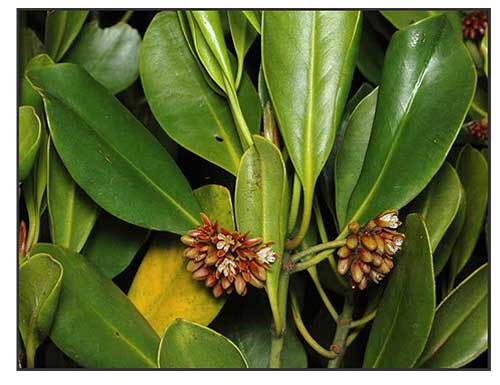
• Tañgal is a small tree growing up to 8 meters or less in height, with many buttresses at the base. Bark is dark red. Leaves are ovate, 5 to 7.5 centimeters long, 2 to 5 centimeters wide, blunt at the tip and pointed at the base. Flowers are about 6 millimeters in length, borne on short stalks. Calyx lobes are linear, with pointed tips. Petals are five, smooth; tips are flat or notched, with three of four club-shaped appendages. Stamens are ten. Fruit is small, club-shaped or subovoid, surrounded near the base by the reflexed segments of
the calyx.
 • Ceriops tagal is a medium-sized tree growing to a height of 25 meters (80 ft) with a trunk diameter of up to 45 cm (18 in). Growth habit is columnar or multi-stemmed and the tree develops large buttress roots. The radiating anchor roots are sometimes exposed and may loop up in places. Bark is silvery-grey to brownish-orange, smooth with occasional pustular lenticels. The leaves are in opposite pairs, glossy yellowish-green above, obovate with entire margins, up to 6 cm (2.4 in) long and 3 cm (1.2 in) wide. The flowers are borne singly in the leaf axils; each has a long stalk and a short calyx tube, and parts in fives or sixes. The paired stamens are enclosed in the petals, which open explosively when disturbed. Fruits are ovoid, up to 3 cm (1 in) long suspended from the shrunken calyx tube; brown at first, they change color as they mature and as the hypocotyl emerges. Hypocotyl is long and slender, growing to about 35 cm (14 in) long, and is ribbed, a characteristic that distinguishes this mangrove from the Ceriops australis. (Wikipedia) • Ceriops tagal is a medium-sized tree growing to a height of 25 meters (80 ft) with a trunk diameter of up to 45 cm (18 in). Growth habit is columnar or multi-stemmed and the tree develops large buttress roots. The radiating anchor roots are sometimes exposed and may loop up in places. Bark is silvery-grey to brownish-orange, smooth with occasional pustular lenticels. The leaves are in opposite pairs, glossy yellowish-green above, obovate with entire margins, up to 6 cm (2.4 in) long and 3 cm (1.2 in) wide. The flowers are borne singly in the leaf axils; each has a long stalk and a short calyx tube, and parts in fives or sixes. The paired stamens are enclosed in the petals, which open explosively when disturbed. Fruits are ovoid, up to 3 cm (1 in) long suspended from the shrunken calyx tube; brown at first, they change color as they mature and as the hypocotyl emerges. Hypocotyl is long and slender, growing to about 35 cm (14 in) long, and is ribbed, a characteristic that distinguishes this mangrove from the Ceriops australis. (Wikipedia)
• Growth form: Small to medium-sized tree, growing up to 20 m approx. In Singapore, trees tend to be 10 m or less. Trunk: Smooth bark, sometimes fissured, grayish brown in color, flanged stem base. Roots: Short buttress roots forming from short stilt roots originating from the base of a mature trunk. Foliage: Rounded, glossy-green leaves 5.5 - 10 by 2 - 3.5 cm, obovate-elliptic and often having an inwardly-curled margin. Flowers: 5 - 10 flowered, pendulous flower head measuring 2 by 10 - 20. It has a long, slender stalk, is resinous and occurs at the ends of new shoots or in the axils on older ones. Calyx lobes are erect in flower, recurved in fruit, 4 - 5 mm in length, with a 2 mm long tube. Stamens have long, slender filaments that extend far beyond the blunt anthers. Fresh flowers are white in color and they turn brown quickly. Flowers emit a faint fragrance which attracts moths and bees. Fruit: Inverted hypocotyl with angular ridges, slender and measuring 4 - 25 cm in length. Characteristic white collar below the calyx. (It is the only mangrove species with flattened terminal buds)
(Flora & Fauna Web)
Distribution
- Native to the Philippines. (13)
-
Abundant in mangrove swamps throughout the Philippines.
- Also native to Aldabra, Andaman Is., Bangladesh, Bismarck Archipelago, Borneo, Cambodia, Caroline Is., China Southeast, Comoros, Djibouti, Hainan, India, Jawa, Kenya, KwaZulu-Natal, Laccadive Is., Lesser Sunda Is., Madagascar, Malaya, Maluku, Mozambique, Mozambique Channel Is., Myanmar, New Caledonia, New Guinea, New South Wales, Nicobar Is., Northern Territory, Pakistan, Queensland, Seychelles, Solomon Is., Somalia, Sri Lanka, Sulawesi, Sumatera, Tanzania, Thailand, Vanuatu, Vietnam, Western Australia. (13)
- Listed as "vulnerable" on the Red List of threatened plants of Singapore.
(19)
- The demand for C. tagal bark in the Philippines led to the harvesting and smuggling in Sabah by illegal immigrants.
 Constituents Constituents
- Aerial parts yielded three new lupane-type triterpenes, 3a-O-trans-feruloylbetulinic acid, 3a-O-trans-coumaroylbetulinic acid and 3ß-O-cis-feruloylbetulin, with 10 known triterpenes.
- Phytochemical screening of stems and leaves yielded
flavonoids, anthraglycosides, bitter principle, saponins, terpenoids, and essential oils. (See study below) (12)
- Total phenolic content of wood and bark extracts in gallic acid equivalent (GAE) were
141.86 mg GAE/100 g sample and 181.91 mg GAE/100 mg g sample, respectively. (see study below) (14)
- Water soluble amino
acids constituents of Ceriops tagal fruit were lysine, threonine, valine, phenylalanine, tryptophan, and proline, while hypocotyl yielded arginine, glutamic acid, tryptophan, and alanine. (see study below) (15)
- Study of hypocotyls and fruits of Ceriops tagal yielded three new dammarane triterpenes, cereotagaloperoxide (1), cereotagalo A (2), and cereotagalol B (3), together with four known dammarane triterpenes, an oleanane triterpene, and 13 known lupane triterpenes. (18)
- Study of stems and twigs yielded seven dolabrane-type diterpenes, namely tagalsins A-G, along with the norditerpene tagalsin H. (23)
- Study of the edible mangrove fruit yielded a high total protein content, ash content (4.3%), and a fiber content of 15.64%. (26)
-
Study of ethanolic extract isolated two new phenylpropanoids, tagalphenylrpopanoidins A-B (1,2), along with a known analogue, 2,3,6-trimethoxy-5-(1-propenyl)phenol (3). (Compounds showed no cytotoxicity against MCF-7 and HLO-60 cancer cell lines) (33)
Properties
- Whole plant is considered astringent.
- Stem-bark considered vulnerary and anti-infective.
- Bark is astringent, hemostatic, and used as quinine substitute.
- Studies have suggested antitumor, antihyperglycemic, antibacterial, fungitoxic, antioxidant, corrosion inhibition, immunosuppressive, anticoagulant properties.
Parts used
Bark, leaves, stems.
 Uses Uses
Edibility
- Fruit reportedly eaten by natives of the Andamans (19)
Folkloric
- In the Philippines, bark extracts used for obstetric and hemorrhagic conditions.
-
Decoction of the bark used to stop hemorrhages; applied to malignant ulcers.
- In folk medicine, used for treatment of hemorrhage, ascariasis, wound infection, malaria, diabetes and ulcers.
- Bark used for diabetes.
- In China, used for treatment of sores, hemorrhages, malignant ulcers, and malaria.
- In the African Coast, decoction of shoots used as substitute for quinine.
- Malay women use a decoction of bark in childbirth.
- In India, bark used as hemostatic.
- In Malaysia, bark lotion used for treatment of malignant ulcers and abdominal ailments.
- In India, chewing of stem bark is used to cure injury infection. Juice from stem bark used to stop hemorrhage and to cure eczema (25)
Others
- Dye: In eastern Africa and Asia, stem bark used for dyeing and tanning. Bark and sap yield red and black dyes. In SE Asia, source of "soga browns" of Javanese batiks. Also used for tanning leather.
- Tanning: In fishing communities, bark extract used to preserve nets and sails from decay.
- Wood: Durable, but with excessive shrinkage; used for house construction: poles, planks and wattlework for house building.
- Fuel: Favored as firewood. Used in the manufacture of charcoal.
- Fermenting: In the Philippines, barok extracts from dried bark (marka tungog or tangal) used as bittering and fermenting agents for the traditional bahalina palm wines, providing a deep orange-brown color and a bitter tangy aftertaste. (27)
Studies
• Dolabrane Diterpene / Tagalsin / Cytotoxicity:
Study isolated a new dolabrane-type diterpene, tagalsin, together with six known analogues. Cytotoxicity of the isolated compounds was evaluated against HeLa human cervical carcinoma cancer cell line. (2)
• Anti-Tumor / Triterpenes:
Study of 95% ethanol extract from embryo of Ceriops tagal yielded four triterpenes and tested against three cell lines. Compounds 1 and 3 were effective in inhibiting cell proliferation and growth of H-7402 and HeLa. (4)
• Antihyperglycemic:
Study evaluated the antihyperglycemic effect of the crude extract of Ceriops tagal showed significant improvement of glucose tolerance in sucrose-loaded normal rats and a 10.9% reduction of hyperglycemia in STZ-induced diabetic rats. (5)
• Antihyperglycemic / Hexose Uptake Stimulation:
Study on the effect of an ethanolic extract and its fractions on H-2-deoxyglucose uptake by cultured L6 rat muscle cells showed enhancement of glucose uptake comparable with insulin and metformin. Results suggest the n-hexane soluble fraction might be a potential source of new antihyperglycemic compounds. (7)
• Antibacterial / Leaves and Bark:
Study evaluated the antibacterial activity of the leaves and bark extracts of Ceriops tagal and Pemphis acidula against human pathogens such as P. aeruginosa, K. pneumonia, V parahemolyticus, S aureus and V cholera. P acidula showed higher antibacterial potency than C tagal. In all the tests, the crude methanolic extracts showed better inhibition. (6)
• Antitumor:
Dolabrane diterpenes of Ceriops tagal exhibited significant antitumor effect in the LLC mice probably through induced apoptosis of tumor cell and the lower expression of the tumor-associated transcription factor NF-KPp65. (8)
• Dolaborane Diterpenes / Tagalsins / Roots / Anticancer:
Study investigated the anticancer activity of tagalsins A-G isolated from the roots of C. tagal. Tagalsins A- G induced apoptosis through activation of caspase-3 enzyme. Tagalsin A was the most active. Results suggest a potential for the development of anticancer agents with novel mechanisms of actions. (9)
• Antioxidant / Stems and Leaves:
Study evaluated the antioxidant activity and phytochemicals in stems and leaves of C. tagal. Study confirmed the free radical scavenging potential of C. tagal. The leaves showed higher dose-dependent reducing power. Phytoscreening yielded flavonoids, anthraglycosides, bitter principle, saponins, terpenoids, and essential oils. (12)
• Total Phenolic Content / Fungitoxic Property / Bark:
Study evaluated bark and wood water soluble extracts of mangrove "tangal" as a potential antifungal agent against wood pathogenic fungi Lasiodyplodia theobromae. The bark extract was more effective in controlling fungal growth when compared with the wood extract. Results suggest some of the phenolics in tangal could inhibit fungal growth and development. (see constituents above) (14)
• Potential for Supplementing Animal Feed: Study analyzed organic and inorganic constituents of fruit and hypocotyl of Ceriops tagal. Both showed high concentration of carbohydrates and crude fibers, with very low amounts of fat and protein. It was rich in Na, K, and Ca, and was fairly high in calorific values. Results showed a potential source for supplementing animal feed. (see constituents above) (15)
• Bioactive Terpenoids / Antidiabetic / Leaves:Study of air dried leaves showed promising antidiabetic activity (PTPase inhibitory activity). Bioassay guided fractionation yielded 12 chemical molecules. Four molecules stearic acid (94.2%), betulin (94.4%), ß-hydroxy betulinic acid (90.5%) and ursolic acid (91.6%) showed promising PTPase activity at 100 µg/ml. (16)
• Proanthocyanidines / Antioxidant / Leaves: Study evaluated the relationships between degree of polymerization and antioxidant activities of subfractions obtained by fractionation of proanthocyanidins from Ceriops tagal leaves. (17)
• Cytotoxicity / Anticancer / Fruit: Study evaluated the anticancer activity of methanol extract of fruit of C. tagal against MDA-MB-231 (breast cancer) and HCT-116 (colon cancer) cell lines. Results showed anticancer activity with IC50 values of 50.57 µg/ml and 38.51 µg/ml for MDA-MB-231 and HCT-116 cell lines, respectively. (20)
• Antibacterial / Phenolic Content / Bark: Study evaluated various extracts of dried leaves and bark for phenolic content and antibacterial activity. The methanolic bark extract showed higher total phenolic content of 6.063 ± 0.205 mg GAE/g extract. Antimicrobial activity was tested against B. cereus, E. coli, S. aureus, and S. typhi using paper disk diffusion method. The methanol extracts of bark showed best activity. None of the extracts showed activity against E. coli. (21)
• Antifouling Metabolites / Roots: Study of roots yielded a new diterpene methoxy-ent-8(14)-pimarenely-15-one (1) and three known metabolites: ent-8(14)-pimarene-15R,16-diol (2), stigmasterol (3) and β-sitosterol (4). Compounds 1, 2, 3, and 4 exhibited significant antifouling activities against cyprid larvae of the barnacle Balanus albicostatus Pilsbry, with EC50 of 0.32, 0.04, 4.05 and 18.47 µg/cm2, respectively, with low toxicities towards cyprids (LC50 values all above 10 µg/cm2. (22)
•
Cytotoxic Effect / WiDr Colon Cancer Cell Lines / Polyisoprenoids / Leaves: Study evaluated the cytotoxic effects of polyisoprenoids from R. mucronata and Ceriops taga leaves. The polyisoprenoids of RM and CT leaves exhibited toxicity against WiDr cell line, with IC50s of 278 ± 5.77 and 276 ± 0.54 µg/ml, respectively. The polyisoprenoids significantly induced apoptosis and caused cell cycle arrest in G0/G1 pases, and decreased expression of Bcl2- and cyclin D1. Results showed the polyisoprenoids have potential to be developed as anti-colon cancer agents. (24)
•
Anticorrosive / Antioxidant / Leaves: Study evaluated the antioxidant and anticorrosive properties of Ceriops taga. Leaves were washed, shade-dried, and powdered, and extracted with methanol. Total phenolic content (TPC) and total flavonoid content (TFC) were 101.52 and 35.71 mg/g respectively. The extract (100 µg/mL) exhibited 83.88, 85, and 87% antioxidant property against DPPH, NO, and H2O2 free radicals. At 600 ppm the extract showed 95% corrosion inhibition against 1 M HCl attack on mild steel at 303 K. Scanning electron microscopy (SEM) showed notable changes in both uninhibited and inhibited mild steel, suggesting a better alternative than other synthetic inhibitors. (28)
•
Anticoagulant / Leaves: In a study of Ceriops tagal and C. decandra crude extracts of leaves, both plants showed significant decrease in prothrombin time in a concentration dependent manner. (29)
•
Vomifoliol / Immunosuppressive: Vomifoliol, a natural sesquiterpene compound, is a secondary metabolite isolated from the mangrove plant Ceriops tagal. Study evaluated the immunosuppressive effects and underlying mechanisms on Jurkat cells in vitro. At low concentrations, vomifoliol significantly inhibited calcineurin (CN) at concentrations in relatively low cytotoxicity. It also exhibited inhibitory effect on phorbol 12-myristate 13-acetate (PMA)/ionomycin (Io) -induced Jurkat cells and dephosphorylation of NFAT1, and also reduced expression of IL-2. Results suggest vomifoliol may inhibit immune response of Jurkat cells and may use CN as target enzyme to inhibit NFAT signaling pathway. Study suggests potential for vomifoliol as a low-toxic natural immunosuppressant. (30)
•
Natural Dye for Cotton and Silk / Bark: Synthetic dyes carry toxic and allergic risks. Study evaluated the use of natural dyes from bark of two mangrove species viz., Ceriops taga and Rhizophora mucronata for dyeing cotton and silk fabrics. Aqueous bark extracts along with various chemical and natural mordants were used to produce various shades of colors ranging from brown, light brown, yellow, black to gray on both cotton and silk. Results revealed color fastness of the dyed sample in measures of washing,, rubbing, and exposure of the fabrics to sunlight. (32)
Availability
Wild-crafted. |





.jpg)