 Gen info Gen info
- Fabaceae or Leguminosae, commonly known as the legume pea, or bean family, is a large and agriculturally important family of flowering plants that includes trees, shrubs, and perennial or annual herbaceous plants. It is widely distributed and is the third largest land plant family, behind only Orchidaceae and Asteraceae, with about 765 genera and nearly 20,000 known species. (9)
-
Strongylodon is a genus of flowering plants in the legume family, Fabaceae. It includes 16 species of lianas native to the western Pacific. The most well-known species in the genus is Strongylodon macrobotrys. (8)
- Taxonomy: The genus was named by Juliua Rudolf Theodor Vogel in 1836.
-
Strongylodon macrobotrys was discovered in 1841 on the jungle slopes of Mt. Makiling, Luzon, Philippines, by the United States Exploring Expedition led by US Navy Lt. Charles Wilkes. (4)
- Etymology: The genus name Strongyodon derives from Greek "strongylos" meaning "round", and "odous" meaning teeth, referring to the rounded teeth of the calyx. The species epithet "macrobotrys" derives from Greek words: macros (large) and botrys (cluster), likely referring to the long, hanging inflorescences. (4) (7)
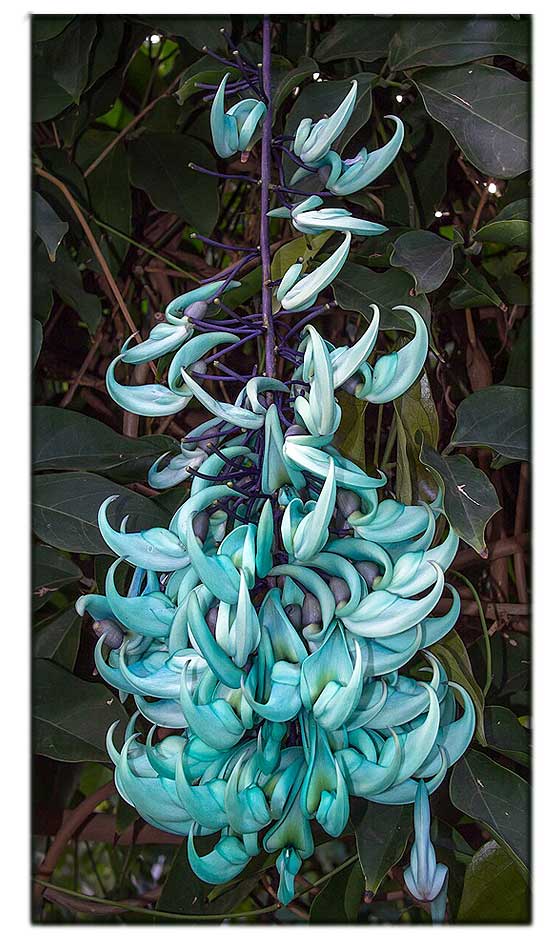
- Beauty: With its long cascading translucent jade-green flowers
beneath a canopy of pale green foliage, it is considered one of the most beautiful and elegant of tropical climbers. (6)
- The plant has been grown at Kew for many years but had never produced seed, until 1995. Scientists from the Jodrell Laboratory managed to pollinate flowers successfully so that seeds developed. (5)
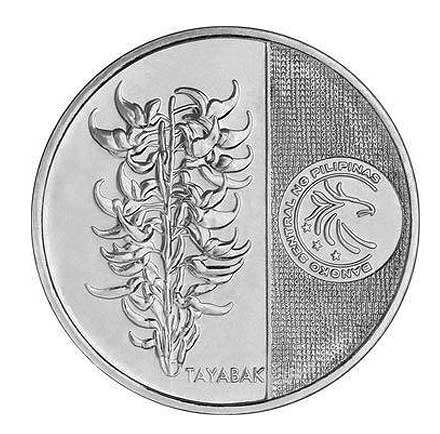
- Five-peso coin: Jade vine (Tayabak) is featured on the reverse side of the Philippine five-peso coin; on the obverse side, the Philippine national hero, Andres Bonifacio.
Botany
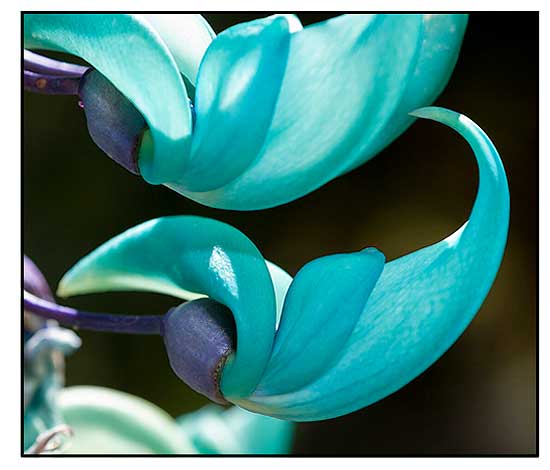
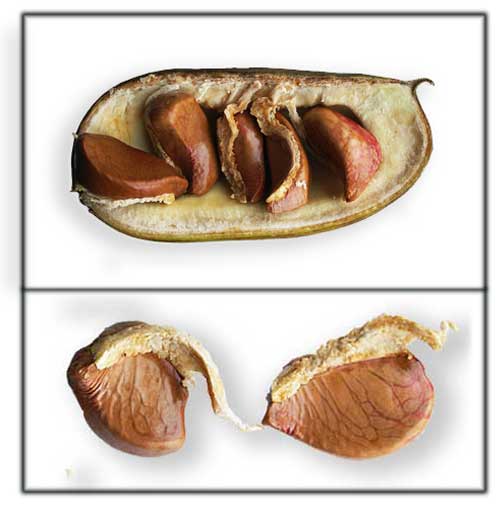
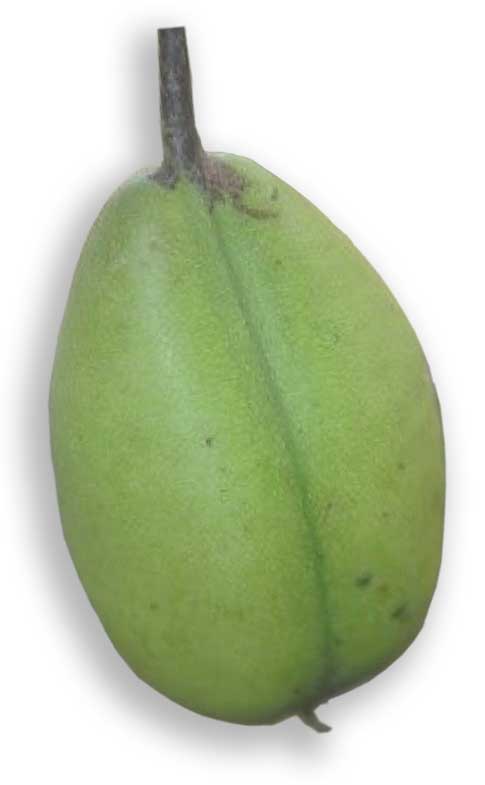
• Strongylodon macrobotrys, locally known as Tayabak, is a species of leguminous liana (woody vine), with stems that can reach up to 18 m long. Foliage is pale green, consisting of three leaflets. Leaves are usually dark green, up to 25 cm long. Vine stalk is relatively wide, about 2.5 cm wide. Inflorescences are only produced by mature vines. Claw-shaped flowers are borne in pendent trusses or pseudoracemes of 75 or more flowers and can reach as much as 3 m long. Flowers vary from blue-green to mint green in color, similar to colors of minerals like turquoise and jade. Seed pods are short oblong, and fleshy, up to 15 cm long, containing up to 12 seeds.
• Growth form: Evergreen, woody climber with twining growth habit. Stem: Woody stem has gray, smooth bark. Foliage: Light green leaves are trifoliate, consisting of 3 oblong leaflets (leaves 25 cm long, leaflets 8 - 13 cm long). Flowers: Claw-shaped flowers have a unique bluish green color (8 - 13 cm long). Flowers are arranged in long, hanging inflorescences known as pendent trusses or pseudoracemes (1.5 - 3 m long). Fruits:Fruit is a fleshy oblong or round pod (5 - 15 cm long) that has a short curly beak at the apex. It contains up to 12 light brown, oblong seeds. (Flora & Fauna Web)
 Distribution Distribution
- Native of the Philippines.
- Endemic to the Philippines.
- Grows wild in damp forests, beside streams or ravines of Luzon and Mindoro.
- Destruction of rainforests in the Philippines threatens the species in the wild.
- Ornamental cultivation.
- IUCN Red Listed as vulnerable.
- Introduced into India, Malaya, New Guinea, Trinidad-Tobago.
 Constituents Constituents
- Chemical investigation of dichlormethane extracts isolated taraxerone (1), stigmasterol (2), ß-sitosterol (3), and triglycerides (4) from the stems; 2,3, and ß-stigmasteryl 3-O-ß-D-glucopyranoside (5) from the flowers; and polyprenol (6), lutein (7), squalene (8), and chlorophyll (8) from leaves. (see study below) (5)
- Qualitative phytochemical analysis of methanol flower extract
revealed saponins, alkaloids, flavonoids, phenols, steroids and triterpenes. Quantitative analysis showed crude flavonoids as the major phytochemical constituent. (see study below) (11)
- Chemical profiling of flowers by LC/MS in conjunction with NMR experiments identified four carbohydrates, four amino acids, three organic acids, one alkaloid, ten flavonoids, mainly from apigenin and kaempferol. (see study below) (12)
Properties
- Pollinated by birds and bats. Flowers attracts a species of wasp, and are home to a species of butterfly. (4)
- Studies have suggested antimicrobial, antioxidant, molluscicidal properties.
Parts used
Flowers, stems.
Uses
Edibility
- While seed pods of the legume species are technically edible, the plant is not for consumption. It is cultivated as an ornamental species.
- Flowers reportedly used for stir-fry meals.
Folkloric
- No reported folkloric medicinal use in the Philippines.
Others
- Decorative / Ornamental:- Cultivated in gardens trellises for its spectacular festoon of green flowers resembling lobster claws. In Hawaii, used in the making of leis.
 Studies Studies
• Flower Color Chemistry / Malvin:Saponarin: The flower contains an anthocyanin (malvin) and a flavone (saponarin) in an approximate 1:9 molar ratio (malvin:saponarin). The characteristic flower color is an example of co-pigmentation of malvin and saponarin, with colors varying according to pH. The characteristic blue-green is the result of co-pigmentation of anthocyanin with flavone in alkaline cell sap (pH 7.9), In slightly alkaline condition, flavone shows a strong yellow color, which gives a greenish tone to the flower color. (1)
• Anthocyanin / Malvin: The flower's luminous blue green color attracts bats for pollination. Study investigated the chemical basis of the flower color of Strongylodon macrobotrys. The flower yielded an anthocyanin, malvin, and a flavone (saponarin) at 1:9 molar ratio.
• Saponins: Study of seeds of Strongylodon macrobotrys isolated two saponins as dimethyl esters with structures identical with the dimethyl esters of pseudo-ginsenoside-RP1 and zingibroside-R1.
• Potential Biologic Activities and Anti-Cancer Properties of Isolated Constituents: Study of stems, flowers and leaves yielded 9 constituents. While no biologic activity tests were conducted on the isolated compounds, all nine have reported diverse biologic activities, (1) Taraxerone: Reported to exhibited antioxidant properties, anti-Giardia lambia, anti-leishmanial, antiviral activities and anti-tumor activity on K562 leukemic cell line. (2) Stigmasterol: Efficacy against Ehrlich ascites carcinoma bearing mice and has lowering effect on cholesterol. (3) ß-sitosterol: Growth inhibitory effects on human breast MCF-7 and MDA-MB-231 adenocarcinoma cells; potential anti-colon carcinogenesis effect and down-regulation of Akt in MCA-102 murine fibrosarcoma cells. (4) Triglycerides: Exhibited antimicrobial activity. Linoleic acid has shown anticarcinogenic effect in animal models and shown to reduce risk of colon and breast cancer. (5) ß-stigmasteryl 3-O-ß-D glucopyranoside: ß-sitosteryl and stigmasteryl glucosides have been reported as selective DNA polymerase B lyase inhibitors and potentiators of bleomycin cytotoxicity in A549 human lung cancer cell line. (6) Polyprenols: Hepatoprotective effects in CCl4-induced toxicity in rats and antitumor activity. (7) Dietary lutein: Inhibition of tumor growth by selectively modulating apoptosis and by inhibiting angiogenesis. (8) Squalene: Suppression of colonic ACF formation and crypt multiplicity, which suggest chemopreventive activity against colon carcinogenesis. (9) Chlorophyll: Studied for wound healing and anti-inflammatory properties and use as effective agent in photodynamic cancer therapy and chemopreventive effects in humans. (5)
• Antimicrobial / Stems: Study evaluated stem extracts of S. macrobotrys for antimicrobial efficacy in inhibiting growth of Bacillus subtillis (AT CC 6633), Escherichia coli (ATCC 25922), Salmonella typhimurium (ATCC 13311), and Staphylococcus aureus (ATCC 6538) using Kirby-Bauer method. The methanol extract of stem showed antibacterial effect, with more potency against Gram(+) strains, especially B. subtilis, with no activity against Gram(-) strains of E. coli and S. typhimurium. (10)
 • Antioxidant / Flowers: Study evaluated S. macrobotrys methanol flower extract for phytoconstituents and antioxidant capacity assessed by DPPH, total flavonoids, and ABTS assay. DPPH and flavonoid content increased with increase concentration of the extract. The MIC of the flower extract required for 50% ABTS free radical scavenging was 60 µg/ml. (see constituents above) (11) • Antioxidant / Flowers: Study evaluated S. macrobotrys methanol flower extract for phytoconstituents and antioxidant capacity assessed by DPPH, total flavonoids, and ABTS assay. DPPH and flavonoid content increased with increase concentration of the extract. The MIC of the flower extract required for 50% ABTS free radical scavenging was 60 µg/ml. (see constituents above) (11)
• Molluscicidal Activity / Flowers: Chemical profiling of flowers by LC/MS in conjunction with NMR experiments identified four carbohydrates, four amino acids, three organic acids, one alkaloid, ten flavonoids, mainly from apigenin and kaempferol. The compounds identified in pre-purified polar extracts exhibited moluscicidal activity against the giant African land snail, Achatina fulica, with highest concentration of mortality at concentration of 1000 mg/l. (12)
• Pitting Corrosion Inhibitor of Steel: Study evaluated the inhibition of pitting corrosion in mild steel around heavy salt deposits by selected secondary plant metabolites—alkaloid extract, saponin extract, and flavonoid extract of Strongylodon macrobotrys using electrochemical impedance spectroscopy, potentiodynamic polarization, gravimetric and gasometric experimentation. Results showed selected secondary plant metabolites were excellent inhibitors of mild steel in salt water environment. Inhibition efficiency was recorded at 99.2%, 92.6%, and 84.7% for alkaloid, saponin, and flavonoid extract. (13)
Availability
Wild-crafted.
Seeds in the cybermarket.
|


.jpg)