 Gen info Gen info
- Tadehagi triquetrum is a species of flowering plant in the family Fabaceae. It is widespread in all South Asian, East Asian, and Southeast Asian countries. It consists of
6 species.
Botany
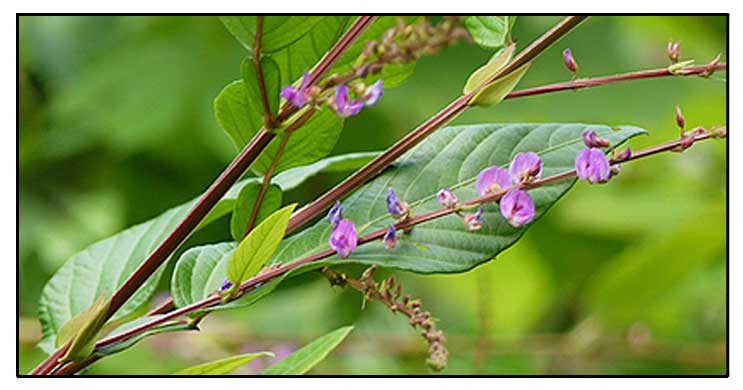
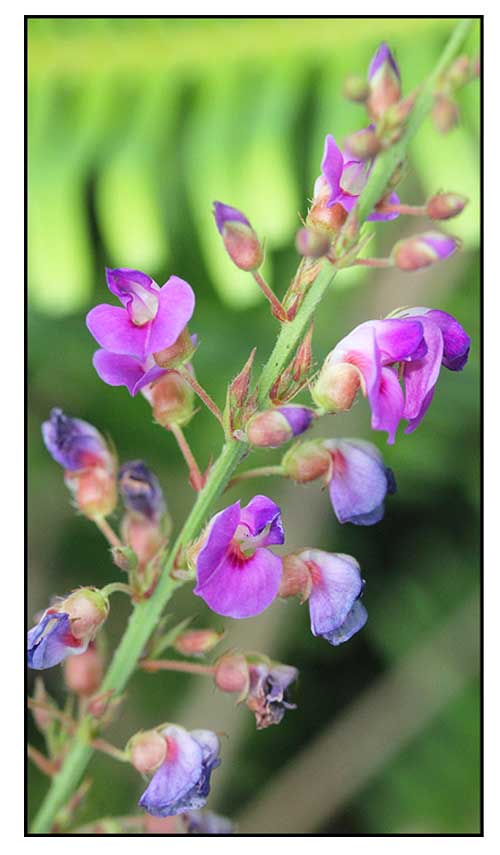
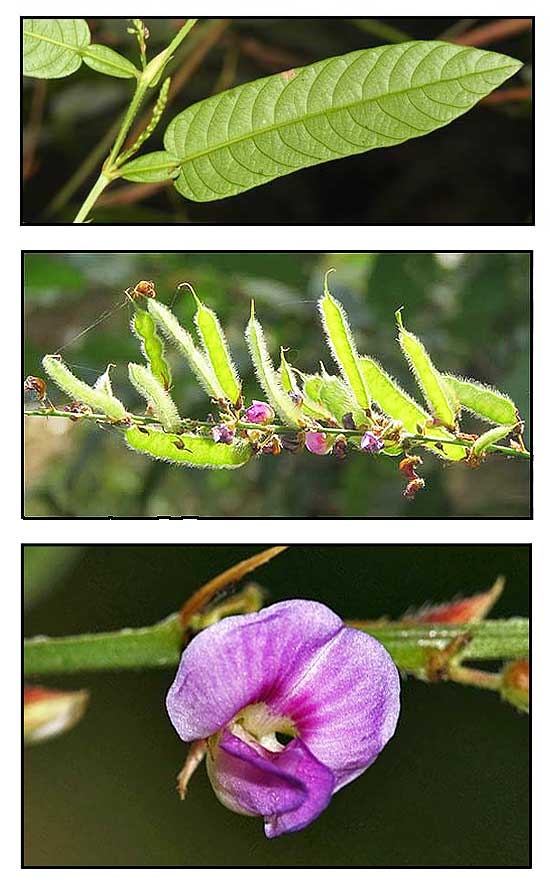
• A subshrub up to 3 m tall, branchlets glabrescent; leaflet narrowly elliptical to obovate, 3.5-20 cm × 1-6 cm, usually more than 3 times longer than broad, apex acute, upper surface finely pubescent, lower surface variably pubescent, petiole 1-5 cm long, prominently winged, stipules 8-25 mm × 4-7 mm; calyx 4-5 mm long, hairy, corolla 5-6 mm long, pink, red or blue; pod distinctly stalked, 5-8-jointed, densely clothed with yellowish or whitish soft hairs both on the sutures and the lateral surface, not reticulate-veined, articles mostly 2.5-3.5 mm × 5-6 mm. In Malesia only subsp. triquetrum is present. (3)
• Winged-Stalk Desmodium is a subshrub, growing up to 1-2 m tall, with erect stems which are almost woody. Branches are triangular in cross section, velvety. Leaves are alternately arranged, and the leaf stalk has prominent wings. Leaves are linear-oblong, ovate or heart-shaped, with a tapering tip. Flowers arise in many-flowered racemes in leaf axils. Flowers are small, shaped like pea flowers, pink to pale violet, with a nearly circular standard petal, notched at tip; wings obovate, eared, clawed; keel arcuate, eared, clawed. Legumes are hairy, 5-8 jointed. (Flowers of India)
Distribution
- Native to the Philippines. (1)
- In CULION; in Luzon: Abra, Benguet, Mountain Province, Rizal, Zambales; In MINDANAO: Bukidnon; in PALAWAN.
- In lowland and medium elevation thickets.
- Also native to
Andaman Is., Assam, Bangladesh, Bismarck Archipelago, Cambodia, China South-Central, China Southeast, East Himalaya, Hainan, India, Laos, Malaya, Myanmar, Nansei-shoto, Nepal, New Guinea, Sri Lanka, Taiwan, Thailand, Vietnam, West Himalaya. (2)
- T. triquetrum is found on a variety of soils in evergreen or semi-deciduous forest, in the vicinity of watercourses, on bunds of rice fields, savanna and grasslands from sea-level up to 1500(-2000) m altitude. (3)
 Constituents Constituents
- Study of roots isolated two alkaloids: C₁ (5-(4-[(methylcarbamoyl) amino]-2-oxopyrimidin-1(2H)-yl) tetrahydrofuran-2-yl) methyl methyl carbamate is novel alkaloid and C₂ 13-Docosenamide is a known alkaloid. (8)
- Study of powdered leaves for phytochemical constituents revealed alkaloids, flavonoids, phenolic compounds, steroids, saponins, tannins, glycosides, and carbohydrates. Roots yielded alkaloids, flavonoids, terpenoids, phenolic compounds steroids, saponins, tannins, glycosides, and carbohydrates. (see study below) (9)
-
Study of ethanol extract isolated three new prenylated isoflavones, triguetrumones A, B, and C (1-3), and one new prenylated biisoflavanone, (R)-triquetrumone D (4), along with 16 known compounds. (see study below) (11)
- Phytochemical screening of coarse powdered leaves yielded flavonoids, starch, reducing sugar, glycosides, saponins, tannins,
α-amino acids, and carbohydrates.
Alkaloids were present with Wagner's reagent. (12)
- Study of ethanol extract of D. triquetrum yielded 6′-O-cis-p-coumaroyl-3,5-dihydroxyphenyl-β-D-glucopyranoside (1), tadehaginoside (2), rutin (3), quercetin-3-O-β-D-glucopyranoside (4), quercetin-3-O-β-D-galactopyranoside (5), 6-O-(E)-p-hydroxy-cinnamoyl-β-glucose (6), 6-O-(E)-p-hydroxy-cinnamoyl-α-glucose (7), kaempferol-3-O-β-D-rutinoside (8), and 3-O-β-D-galacopyranosyl (6-1)-α-L-rhamnosyl quercetin (9). (see study below) (13)
- Study of methanol extract of leaves isolated two known compounds, p-hydroxybenzoic acid (1) and kaempferol (2).
(see study below) (16)
- Hydrodistillation, GC-FID and GC-MS analysis for essential oil identified 58 organic compounds. Major EO components were palmitic acid (22.46%), 1-Octen-3-ol (14.07%), caryophyllene (7.20%), (Z)-18-octadec-9-enolide (6.04%), and 3-hexen-1-ol (4.55%).
(see study below) (17)
- Study isolated 10 new phenylpropanoid glucosides, tadehaginosides A-J (1-10_, and the known compound tadehaginoside (11).
(see study below) (19)
Properties
- Studies have suggested antioxidant, antimicrobial, phosphodiesterase-5 inhibitory, anthelmintic, antihyperlipidemic, antihepatotoxic, hepatoprotective, cytotoxicity, anti-acetylcholinesterase, mosquito larvicidal, antidiabetic, anti-inflammatory, antiasthma, wound healing properties.
Parts used
Leaves, roots.
 Uses Uses
Edibility
- Leaves used for making tea.
- In China, leaves and roots used for making medicinal soup to improve digestion, clear heat, and induce diuresis. (21)
Folkloric
- No reported medicinal used in the Philippines.
- In Cambodia, decoction of roots used as poultice on bruises. In Laos, root decoction used as febrifuge. In Vietnam, infusion of roots taken for kidney complaints. Infusion of leaves drunk for stomach discomfort. In Thailand, decoction or infusion of roots or aerial parts drunk or used as baths for a variety of afflictions. Decoction drunk for chronic coughs and tuberculosis. (3)
- Decoction of leaves used for treatment of hemorrhoids. Infusion of leaves drunk for stomach discomfort. Leaves applied externally for treatment of lumbago. Leaves and seed pods used as diuretic to treat kidney and bladder gravel. Roiots used as febrifuge. (5)
- In Chinese traditional medicine, used clearing heat, detoxifying, draining dampness, eliminating phlegm, expelling parasites, and treating blood stasis. Long used for treatment of colds, acute tonsillitis, acute pharyngitis, hookworm disease, lung abscess, nephritic edema, dysentery, jaundice, arthritis, hepatitis, and scabies. (6)
- In Vietnam, used for treating urinary problems, stomach ache, diarrhea, and as tonic and general restorative. (7) Used for a wide ranges of other ethnomedicinal needs: appetite and restorative, uterine pain, flatulence, constipation, headache, fever, common colds, as heart and flood fortifier, liver disease, cough and sore throat, mild sedative, fractured bones, stomatitis, among others.
- Fresh leaves applied to wounds and abscesses. Paste of bruised leaves with kamala applied to indolent ulcers and itching. Fresh juice of plant give to children for cough. (12)
- In Indonesia, used for treatment of hemorrhoids and as tonic, diuretic, and anti-inflammatory. (16) In West Java, leaves used as analgesic in treating hemorrhoids and lumbago; fruits for treating kidney stones.
Others
- Insecticide / Larvicidal: Used as insecticide. (5) It has potent repellent effect and moderate larvicidal effect on Chrysomya megacephala fly larvae. In Japan, used in the preparation of miso to prevent the growth of maggots. (18)
- Fermentation: Used for traditional preparation of fermented products. In Laos, widely used in preparation of fermented fish by placing it on top of the fish in the mouth of earthenware fermentation jar. In Myanmar, used as additive in producing fly larvae-free nga-pi. (18)
Studies
• Antioxidant / Antimicrobial / Phosphodiesterase-5 (PDE-5) Inhibitory Activity / Leaves: Ethanolic and water extracts showed potent antioxidant activity using DPPH and ABTS assays. Water extract showed highest antioxidant activity with IC50 of 12.45 µg/mL. Polar extracts inhibited growth of S. aureus, E. coli, and P. aeruginosa. Non-polar extract( suppressed fungal growth. Thai folk formulation of water extract inhibited PDE-5 activity by 60.45%, suggesting potential for enhancement of sexual and physical performance. (9)
• Anthelmintic / Estrogen Receptor Binding: Study of ethanol extract isolated three new prenylated isoflavones, triguetrumones A, B, and C (1-3), and one new prenylated biisoflavanone, (R)-triquetrumone D (4), along with 16 known compounds. Compounds 1-3 exhibited mild anthelmintic bioactivity. Compound 3 showed significant binding ability of the estrogen receptor. (11)
• Antihyperlipidemic: Study of ethanol extract of D. triquetrum isolated 9 compounds. Compounds 1, a phenolic compound, and 2 (tadehaginoside and rutin) significantly reduced the intracellular content of total cholesterol and triglycerides. (see constituents above) (13)
• Hepatoprotective / Tadehaginoside / Antihepatotoxic against CCl4 Toxicity: Study evaluated the potential hepatoprotective role of tadehaginoside (TA) on liver lesions induced by carbon tetrachloride (CCl4). Results showed TA dose-dependently suppressed cell proliferation of HpeG2 cells, and effectively inactivated the phosphorylated level of IkBα. TA significantly lowered levels of ALT, AST, immunoglobulin E (IgE), and leukotrine (LT) in CCl4-lesioned rats. TA significantly mitigated CCl4-induced hepatocellular damage. Levels of γ-glutamylcysteine (γ-GCS), GSH, and CAT in liver were gradually elevated, along with marked upregulation of COX) mRNA expression in hepatocytes, and progressively increased nuclear factor E2-related factor 2 (Nrf2) and Kelch-like ECH-associated protein 1 (Keapl) levels. Results showed TA protects against CCl4-induced oxidative injury and inflammatory reaction in hepatocytes, via activation of Nrf2 signaling pathway and inhibition of the NF-kB pathway, attenuating oxidative stress and reducing inflammation in liver cells. (15)
• Cytotoxicity Against Murine Cell Leukemia / Leaves: Study of methanol extract of leaves isolated two known compounds, p-hydroxybenzoic acid (1) and kaempferol (2). Compounds 1 and 2 showed weak cytotoxicity against murine cell leukemia P-388 with IC50s of 55.0 and 24.7 µg/mL respectively. (16)
• Antioxidant / Anti-Acetylcholinesterase / Essential Oils: Study evaluated the chemical compositions of essential oils (EOs) from Tadehagi triquetrum and their antioxidant and anti-cholinesterase activity. Hydrodistillation, GC-FID and GC-MS analysis identified 58 organic compounds. Major EO components were palmitic acid (22.46%), 1-Octen-3-ol (14.07%), caryophyllene (7.20%), (Z)-18-octadec-9-enolide (6.04%), and 3-hexen-1-ol (4.55%). Antioxidant activity of EOs by ABTS, DPPH, and FRAP assays showed IC50s of 2.12 mg/mL, 4.73 mg/mL, and 117.42 mM/g, respectively. Besides antioxidant activity, the EOs also showed moderate anti-acetylcholinesterase activity. (17)
• Mosquito Larvicidal Against Aedes aegypti / Antioxidant / Leaves: Study evaluated leaf extracts of Tadehagi triquetrum for antioxidant and larvicidal potential against Ae. aegypti 4th instars larvae. The 95% EtOH extract showed highest antioxidant activity with IC50 of 1.64 µg/mL by DPPH free radical scavenging assay. Larvicidal activity of crude extracts by WHIO standard method were in the range of 0.0125 to 0.2 g/100 mL. The highest knockdown of Aedes larvae was at concentration of 0.2 g/100 mL of EtOH extract, with highest mortality rate of 99.20%. EtOH extract also showed highest lethal concentrations activity with LC50 of 0.0183 g/100 mL and LC90 of 0.0727 g/100 mL. Results suggest potential for both EtOAc and 95% EtOH fractions from leaves for treatment of oxidative stress and alternative sources of mosquito control agents. (18)
• Antidiabetic / Tadehagionosides / Phenylpropanoid Glucosides / Leaves: Study isolated 10 new phenylpropanoid glucosides, tadehaginosides A-J (1-10_, and the known compound tadehaginoside (11). Compounds 3-11, particularly 4, significantly increased the basal and insulin-elicited glucose uptake. Molecular docking, luciferase analysis, and ELISA indicated the increase glucose uptake may be due to increases in peroxisome proliferator-activated receptor-γ (PPARγ) activity and glucose transporter-4 (GLUT-4) expression. Results suggest the phenylpropanoid glucosides, particularly compound 4, have potential for development into antidiabetic compounds. (19)
• Hypoglycemic Lignan / Aerial Part: Study of aerial parts isolated a new lignan, tadehaginodin, together with a known compound, 3,4-dihydro-4-(4'-hydroxyphenyl)-5,7-dihydroxycoumarin. Evaluation for hypoglycemic effects showed both isolates possessed capability to increase glucose consumption by HepG2 cells. (20)
• Anti-Inflammatory / Lignan / Aerial Part: Study focused on in silico studies of isolated flavonoids baicalein, naringin, and neohesperidin isolated from T. triquetrum. Inhibitory activity against 5-lipoxy-genase in vitro was tested as potential agents for treatment of asthma. Compared to conventional dexamethasone, the isolated flavonoids showed perfect biding affinity to 5-lipoxygenase with equivalent Glolide scores and Glide energy values. Inhibitory concentration values for the isolated flavonoids were 66.75, 112.25, and 136.65 µg/ml respectively. Compared to dexamethasone, the inhibitory effects on
5-lipoxygenase were dosage-dependent. Results suggest baicalein may be of benefit for asthma patients as complementary or alternative therapy. (23)
• Wound Healing / Leaves: Study evaluated an ethanol extract of dried leaves of Desmodium triquetrum for wound healing effect using incision, excision, and dead space wound models in rats. Results showed significant increase in wound contraction rate, skin breaking strength, granuloma strength, and dry granuloma weight and significant decrease in epithelization period. Prohealing effects were attributed to increased collagen deposition, better alignment, and maturation. (24)
Availability
- Wild-crafted.
- Herbal products in the cybermarket.
|





.jpg)