|
 Gen info Gen info
• Helminthostachys is a fern genus in the Ophioglossaceae (adder's tongue) family. A monotypic genus with Helminthostachys zeylanica as the only recognized species.
• Helmintostachys zeylanica is a terrestrial, herbaceous fern of southeastern Asia and Australia. The species, like other members of the family, has clusters of sprorangia on stems of fertile, spike-like fronds. (29)
• The genus was first described by Linnaeus in 1753 with the binomial Osmunda zeylanica in his Species Plantarum. (29)
- Etymology: The genus name Helminthostachys derives from Greek words helminthos (worm) and stachys (spike), referring to the worm-like, segmented appearance of the fertile spike or sporophore. The specific epithet zeylanica refers to Ceylon (Sri Lanka), where the species was initially located.
Botany
• Tukod-langit is a terrestrial, herbaceous stipitate fern, growing a foot or more in moist ground. Rhizomes are short, thick, and creeping,
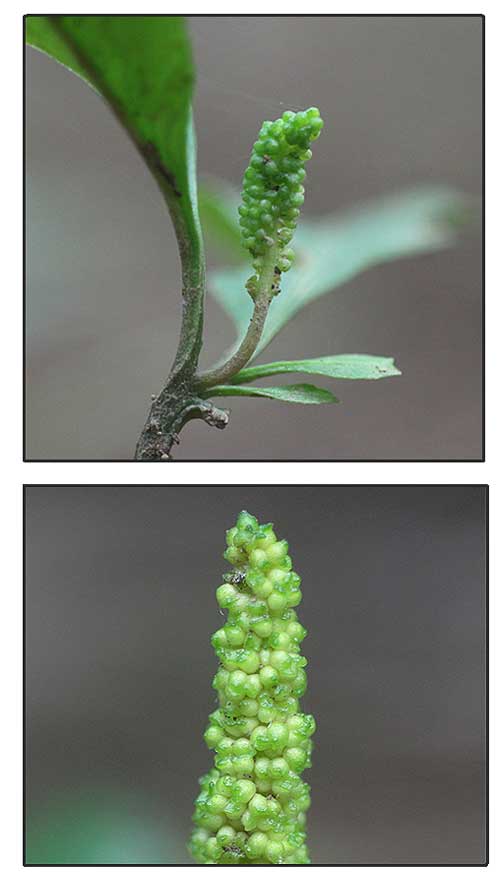
Stipes are erect, 15 to 30 centimeters long. Fronds grow singly from the underground rhizomes, and the appearance is characteristic. Leaf blade spreads out almost horizontally, resembling an umbrella, hence the common name. It has three segments, each of which may be divided into two to five parts. Ultimate segments are 7 to 15 centimeters long, and 2 to 4 centimeters wide, and lanceolate. Mature leaves have a spike, 7 to 20 centimeters long, that extends upward from the leaf stalk, roughly following the latter in length. Upper portion of the spike contains the spores.
• The rhizome of the annual plant is short, creeping, underground and stout, and can bear a solitary frond or several fronds. Leaves are lanceolate with margins entire or irregularly serrate. Fronds arise from the base of leaves with its own stipe. Below the spike is a sterile leafy segment, the trophophore. Both it and the sporophore arise from a common petiole.
• Erect herb, 45 to 60 cm high; rhizomes slender creeping; roots fleshy; stem glabrous. Leaves sterile, whorled at the tip of trophophore and below the spike. Both trophophore and sporophore arise from a common petiole. The common stalk up to 40 cm long covered with membranous sheath at base. Sterile leaves palmatifid to palmate, 5-11 sub sessile leaflets are horizontally arranged on the stem, oblong-lanceolate, crenulate, obtuse to finely acute, base cuneate; midrib prominent. Spike solitary, arising from the base of the peduncle, green when young, turns brown to purplish brown on maturity, 10 – 13 cm long; sporangia arranged on the stem of fertile spike like frond, green when young but turns brown when mature. Spores globose and dark brown, exine verrucoid. (37)
Distribution
- Native to the Philippines. (16)
- Throughout the Philippines. Terrestrial in open bushy places near sea level on damp ground, especially along banks of streams. 0 to 100-275 m.
- Often found in thickets, around bamboo clumps.
- New fronds usually initiated at the beginning of the rainy
season.
- Also native to Assam, Bangladesh, Bismarck Archipelago, Borneo, Cambodia, Caroline Is., China South-Central, China Southeast, East Himalaya, Hainan, India, Laos, Lesser Sunda Is., Malaya, Maluku, Marianas, Myanmar, Nansei-shoto, Nepal, New Caledonia, New Guinea, Nicobar Is., Northern Territory, Queensland, Santa Cruz Is., Solomon Is., Sri Lanka, Sulawesi, Sumatera, Taiwan, Thailand, Vanuatu, Vietnam, West Himalaya, Western Australia. (16)
 Constituents Constituents
- Studies yielded stilbenes and flavonoids with antioxidant activities.
- Yields four flavonoids -- ugonin A, B, C, and D, stigmasterol, fucosterol and dulcitol.
- Study of purified rhizomes isolated 8 new prenylated flavonoids, ugonins M-T (1-8), together with five known compounds, ugonins J−L (9−11), 5,4′-dihydroxy-4′′,4′′-dimethyl-5′′-methyl-5′′H-dihydrofurano [2′′,3′′:6,7] flavanone, and quercetin. (see study below) (6)
- Phytochemical study of H. zeylanica identified 21 natural compounds including nine phenolic compounds (1-7, 14 and 19). five alkaloids (8-11 and 13), one nucleoside (12), three saccharides (15-17), one steroid (18),and two furfural derivatives (20, 21).
(33)
- Study of rhizomes isolated 8 new flavonoids including 6 cyclized geranylflavonoids, ugonins V-X (1-3), (10R,11S)-ugonin N (4), (10R,11S)-ugonin S (5), and ugonin Y (6), as well as two quercetin glucosides, quercetin-4′-O-β-d-glucopyranosyl-(1→2)-β-d-glucopyranoside (7) and quercetin-3-O-β-d-glucopyranosyl-4′-O-β-d-glucopyranosyl-(1→2)-β-d-glucopyranoside (8). (see study below) (34)
- Phytochemical analysis of acetone extract of aerial parts revealed presence of phenolics, tannins, flavonoids, triterpenoids, and steroids.
Chromotographic analysis for biologically potential compounds yielded N, N′, N″-Trimethyl ditrimethylene triamine, N-(4-Aminobutyl) Aziridine, N-(3-Methylaminopropyl) Aziridine, Butanamide, 2-(1-Methyltetrazol-5-Ylthio)-3-Oxo-N, N-Dimethyl, Acetamide, N-(Aminocarbonyl), among others. (see study below) (37)
- H. zeylanica is a good source of phosphorus, calcium, and iron. Per 100 g edible portion, young leaves contain approximately 1.5 g ash, with P 350 mg, Ca 30 mg and Fe 15 mg.
(17)
Properties
- Expectorant, good antidote for snakebites,
antiasthmatic.
- Considered aperient, aphrodisiac.
- Studies have suggested
antioxidant, neuroprotective, aphrodisiac, anti-inflammatory, hepatoprotective, cytotoxic, bone promoting, antidiabetic, antihyperuricemic, antiasthma, antiosteoporotic, antibacterial, fracture-healing properties.
Parts
utilized
· Rhizome.
· Wash and dry under the sun.
- Use rhizomes for propagation; preferably
in shaded and moist area.
 Uses Uses
Edibility
- Young leaves popular as salad vegetable.
- Young, cooked petioles eaten as substitute for asparagus.
(17)
- Excellent source of phosphorus and iron; a fair source of calcium.
Folkloric
· For coughing due to tuberculosis,
asthma, poisonous snakebites: boil 6 to 10 grams dried drug in a cup of
water and drink the decoction.
· For snakebites: crush the fresh plant and poultice the wound.
· For fractures and bone strengthening.
· Rhizome is chewed with betel for whooping cough.
· In India, used
in Kerala for the treatment of hepatic disorders; rhizome also used for curing
impotency; rhizome is chewed with areca for whooping cough.
-
In Arunchal Pradesh rhizome used for treatment of dysentery, catarrh, sciatica, malaria. Also used as pain killer; sometimes for snake bites. Tonic from rhizome or dry rhizome powder used for spermatorrhea and for improving memory power. (37)
- Decoction of rhizome used for treatment of impotency. Leaf juice used to treat blisters of the tongue. Powdered rhizome in cow's milk used as brain tonic and to increase vitality. Decction of rhizome boiled in cow's milk mixed with black pepper used for treatment of leucorrhea.
Rhizome powder giver for spermatorrhea and for improving memory. (18)
· In Bangladesh, Khagrachari tribe use the plant to stop hemorrhages. Decoction of rhizome used in impotency. In Bandarban, root juice used with other plants for treatment of jaundice. Leaf Juice used for tongue blisters.
· In China, rhizome is used as antipyretic and antiphlogistic.
· In Malaysia, rhizome
used as a tonic. Decoction of leaves used as tonic after childbirth. Rhizome mixed with Piper betel for cough and venereal diseases.
· In Java, used
for dysentery, catarrh, phthisis. In early stages of tuberculosis, porridge is prepared from the rhizome, eaten and also spread over the chest.
(17)
- In Indonesia, used by Talang Mamak tribe for treatment of inflammation, cough, dysentery, and malaria. In China, used for treatment of diabetes. (32)
· In the Moluccas,
used to relieve constipation. Rhizome eaten with betel for whooping cough. In Malaysia,
used as a tonic. The Sakai use it to treat syphilis. (17)
· The Khumi tribe in Bangladesh used a mixture of roots of H. zeylanica and Lygodium flexuosum for treatment of fever, red urine, and urinary bladder pain. (25)
· In Malaysia,
dried leaves smoked to treat bleeding nose. In India, used for impotence.
Others
· Crafts: In the Philippines and Java, petioles of old leaves used for wickerwork and handicraft. (17) Used as source of fiber in many South-East Asia countries.
Studies
• Hepatoprotective / Rhizome:
Study of ethanolic extracts of rhizomes of HZ showed significant hepatoprotective
effect against CCl4-induced damage liver damage in rats and presents
scientific rational for its folkloric use in liver diseases.
(1)
• Antioxidants / Flavonoids / Rhizomes:
Study yielded eight flavonoids, ugonins E-L (1-8) from the rhizomes
of HZ. Compounds 6, 7 and 8 showed significant antioxidant activity. (2)
• Antioxidants / Stilbenes / Rhizomes: Study yielded three new cyclized stilbenes, ugonstilbene A,. B and
C which exhibited moderate antioxidant activity. (3)
• Neuroprotective / Rhizomes:
Study has isolated Ugonin K, a flavonoid from the rhizomes of H zeylanica. Results suggest ugonin K has neuroprotective activity through activation of ERK1/2 and PI3K/Akt signal pathways which protects against H2O2-induced apoptosis. (4)
• Anti-Inflammatory / Flavonoids:
Study isolated 8 new prenylated flavonoids, ugonins M-T together with five known compounds, ugonins J−L (9−11), 5,4′-dihydroxy-4′′,4′′-dimethyl-5′′-methyl-5′′H-dihydrofurano[2′′,3′′:6,7]flavanone, and quercetin. Compounds 1, 3, 5, 7, 8, and 11 showed inhibition of superoxide anion generation and elastase release by human neutrophils in response to FMLP/CB. (6)
• Aphrodisiac / Rhizome:
Administration of a methanol extract of H. zeylanica rhizome to male mice significantly stimulated the sexual behavior as shown by increase in number of mounts, mating and reproductive performance. (7)
• Antioxidant Flavonoids:
Eight flavonoids, ugonins E-L were isolated from the rhizomes of Helminthostachys zeylanica. Compounds 3-8 were evaluated for their antioxidative activity in a DPPH assay. Compounds 6,7 and 8 were more active than Trolox. (9)
• Ugonin J Flavonoid / Antioxidant:
Study isolated Ugonin J from the dried rhizomes of H. zeylanica. A previous study has shown antioxidant activity with Ugonin J, K, and L. (13)
• Cytotoxicity / Toxicity of Combinations:
Study evaluated three plants viz., Tacca integrifolia, Helminth-stachys zeylanica, and Eurycoma longifolia for cytotoxicity. All three were cytotoxic to human cell lines, Hep2 and HFL1. A combined extract of E. longifolia and H. zeylanica was more cytotoxic than a single extract on Hep2 cell line. Study suggests there is higher toxicity risk of consuming combination of H. zeylanica with either T. integrifolia or E. longifolia, and products using these combinations should be avoided. (14)
• Ugonin K Flavonoid / Promotion of Osteoblastic Differentiation and Mineralization:
Study showed a potential anabolic effect of ugonin K on bone probably through activation of p38- and ERK-mediated Runx2 and osterix expressions to induce synthesis of osteoids and formation of bone nodule. (15)
• Subchronic Toxicity Test / Rhizome: Study evaluated the sub-chronic toxicity of ethanol extract of rhizome on albino rats, Rattus noverticus, Wistar strain. Doses of 68, 136, 272, and 584 mg/kbw were used. Results showed no toxic symptoms, using parameters of body weight, hematologic and biochemical properties, macroscopic organs and relative organ weight. (19)
• Antidiabetic / Ugonins J ad K / Roots: Study of roots isolated two flavonoid compounds identified as ugonin J and K, which were evaluated for antidiabetic activity using α-glucosidase inhibitor assay. Results showed moderate activity with IC50s of 273,13±0,402 ppm and 138,21±0,263 ppm for Ugonin J and K, respectively. Results suggest plants can be used traditionally as antidiabetic medicine. (20)
• Metabolic Disorders / Invention: Invention presents the application of a formula consisting of H. zeylanica, ugonin and a compound for treating or preventing metabolic diseases, viz., excessive fat accumulation, fatty liver, hepatic steatosis, cirrhosis, dyslipidemia, liver cancer, among others. (21)
• Ugonin M / Prevents LPS-Induced Acute Lung Injury: Study evaluated the effect of Ugonin M, a unique flavonoid isolated from H zeylanica in an LPS-induced acute lung injury model. Ugonin M inhibited the production of pro-inflammatory mediators i.e., NO, TNF-α, IL-1ß, and IL-6 and ameliorated the severity of pulmonary edema. It also significantly suppressed LPS-stimulated protein levels of iNOS and COX-2. It suppressed NF-kB and MAPK activation via degradation of NF-kB and IkB-a and inhibited protein expression level of TLR4. Results suggest Ugonin M could be one of the major components of H. zeylanica in the treatment of inflammatory disorders. (22) H. zeylanica water extract reduced lung injury in mice by reducing oxidative stress and inflammatory responses in LPS-induced acute lung injury in mice. The HZW also reduced inflammatory responses in human lung epithelial cells. (28)
• Alleviation of Hepatic Steatosis and Insulin Resistance: Study evaluated the effect of HZ on high fat diet induced obesity, nonalcoholic fatty liver disease (NAFLD) and insulin resistance. Major components of the extract were ugonins J and K. Results showed protection of the high-fat diet fed mice from hyperlipidemia and hyperglycemia. Fat accumulation was reduced int he liver. Also, insulin sensitivity-associated index, which evaluated insulin function, was also significantly restored. (23)
• Cyclohexylmethyl Flavonoids / Suppression of Breast Cancer Stem Cells: Study evaluated natural cyclohexylmethyl flavonoids isolated from rhizomes of H. zeylanica, of which five were identified that can inhibit expansion of NANOG cells. Among the flavonoids, ugonins J and K were able to suppress propagation of CD24 and CD44 breast cancer stem cells both in vivo and in vitro. Results showed the flavonoids can suppress propagation of breast cancer stem cells via downregulation of the pleuripotent gene NANOG involved in self-renewal of breast cancer stem cells. (24)
• Antihyperuricemic Effect / rhizome: Study on Swiss male mice evaluated the antihyperuricemic effect of ethanol extract of H. zeylanica compared to that of allopurinol. Results showed hypouricemic potency. Based on percentage of degradation of uric acid level and extract concentration, the ED50 value of the extract is 135.76 mg/kbw. (26)
• Suppressive Effect of Ugonin on Vascular Smooth Muscle Cells and Restenosis: Neointimal hyperplasia (restenosis) is primarily due to excessive proliferation and migration of vascular smooth muscle cells (VSMCs). Study evaluated the inhibitory effects and mechanisms of ugonin J on VSMC proliferation and migration and neointimal formation. Balloon angioplasty-induced neointimal formation was induced in rat carotid artery model. Ugonin J induced cell-cycle arrest at the G0/G1 phase and apoptosis to inhibit VSMC growth and exhibited marked suppressive activity on VSMC migration. It reduced expressions and activity levels of matrix metalloproteinase-2 and matrix metalloproteinase-9. Results suggest ugonin J has potential for application in the prevention of balloon injury-induced neointimal formation. (27)
• Attenuation of Inflammatory Response of Asthma: Previous studies have shown H. zeylanica extract could ameliorate lipopolysaccharide-induced acute lung injury in mice. Study evaluated water (HZW) and ethyl acetate (HZE) extracts for efficacy in suppressing eosinophilic infiltration and airway hyperresponsiveness (AHR) in asthmatic mice, and decreasing the inflammatory response and oxidative stress in tracheal epithelial cells. Results showed HZW significantly inhibited levels of proinflammatory cytokines, chemokines, and reactive oxygen species in activated BEAS-2B cells. Findings suggest HZW attenuated the pathological changes and inflammatory response of asthma by suppressing Th2 cytokine production in OVA-sensizited asthmatic mice. (30)
• Anticancer Effects on Human Gastric Cancer Cells: Gastric cancer is the second most prevalent cancer worldwide and 8th most common cause of tumor-related death in Taiwan. Study evaluated H. zeylanica extract (E1 and E2) for potential treatment for gastric cancer (GC). Results showed HZ-E2 induced apoptosis through caspase 3/7.Bc;-2.Bax.COX-2, and increased autophagy by stimulating autophagy-related proteins and inhibiting COX-2 activity in GC cells. HZ-E2 also exhibited anti-proliferation activity through cell cycle arrest in G0/G1 and G2/M and suppressed migration of GC cells. The anticancer effect might be mediated partly through inhibition of TNF-α-activated proinflammatory cytosolic phospholipase A2 (cPLA2)-COX-2-prostaglandin E2 (PGE2) pathway. Results suggest potential for HZ E2 as novel adjunctive agent for GC treatment. (31)
• Antidiabetic / Rhizome: Study evaluated the antidiabetic effect of H. zeylanica by assessing the α-glucosidase inhibitory effect of various extracts of rhizome extract. Results showed antidiabetic activity of n-hexane, dichloromethane (DCM), ethyl acetate (EtOAc), methanol, and ethanol extracts with values of 380.88, 190.76,671.16, 47.85, 60.78, respectively. Acarbose was used as standard. (32)
• Anti-Inflammatory / Antiosteoporosis / Flavonoids / Rhizome: Study of rhizomes isolated 8 flavonoids including six cyclized geranylflavonoids and two quercetin glucosides. Compounds were evaluated for anti-inflammatory and antiosteoporosis activities. All compounds, except for 1, 5, and 13, exhibited anti-inflammatory activity on lipolysaccharide-induced nitric oxide (NO) production in microglial cells with IC50s of 6.2-10.1 µM, and were more potent than positive control pyrrolidine dithiocarbamate. Compounds 1, 2, 5, 6, and 10-13 were tested for antiosteoporotic activities, and ugonin K (10) exhibited highest inhibitory activity against RANKL-induced osteoclast differentiation in RAW264,7cells with IC50 of 1.8 µM. (34)
• Antibacterial / Roots: Study evaluated the antibacterial activity of Helminthostachys zeylanica root extracts (n-hexane, dichloromethane, ethyl acetate, and water) against pathogenic bacteria using agar diffusion method, MICs and MBCs. The dichloromethane and ethyl acetate extracts showed inhibitory activity against Bacillus subtilis ATCC 1965, Staphylococcus aureus ATCC 6538, B. cereus ATCC 10876, Vibrio parahaemolyticus ATCC 17802, V. alginolyticus ATCC 17749, Listeria monocytogenes ATCC 7644, and Salmonella typhimurium ATCC 142028. MIC range of DCM extract was 125-500 µg/mL, while ethyl acetate was 500 µg/mL. MBC for DCM against B. subtilis and V. parahaemolyticus were 250 µg/mL. Results suggest a potential source of new antimicrobial agents. (35)
• Effect on Post-Surgical Recovery with Ankle Fracture / Double-Blind Study: In Taiwan, -Di-U-Gon is known for its anti-inflammatory and antiedema effects and commonly used to treat edema in patients with fractures. The ugonin K component of HZ can induce osteogenesis and promote bone mineralization. A double-blind, randomized, controlled study evaluated the use of HZ orally in 45 patients with ankle fractures requiring surgery. Radiographic healing time was shorter in the treatment group compared to control. HZ for 42 days increased serum PINP level (serum amino-terminal propeptide of type 1 procollagen). Results suggest HZ can be used to treat patients with ankle fractures requiring surgical treatment. (36)
• Chemical Composition and Bio-Potency / Aerial Parts: Study evaluated the chemical constituents and biopotency of aerial parts of HZ acetone (HZAAE) extracts. GC-MS analysis revealed 10 compounds. All ten possessed natural product-likeness properties. HZAAE extracts exhibited dose-dependent antioxidant, anti-inflammatory, α-amylase inhibitory activity and cytotoxicity. Biological activity results confirmed the antioxidant, anti-inflammatory, and antidiabetic properties of HZAAE. Further studies, isolation, and purification of HZAAE for biologically active compounds may provide an alternative source of therapeutic agents. (see constituents above) (37)
Availability
Wild-crafted. |