Gen info
- Fabaceae or Leguminosae, commonly known as the legume pea, or bean family, is a large and agriculturally important family of flowering plants that includes trees, shrubs, and perennial or annual herbaceous plants. It is widely distributed and is the third largest land plant family, behind only Orchidaceae and Asteraceae, with about 765 genera and nearly 20,000 known species.
- Polhillides velutina is a species of flowering plants in the legume family, Fabaceae. It is the sole species in the genus Polhillides.
- The genus was circumscribed in 2019 by Hiroyoshi Ohashi and Kazuaki Ohashi.
- Etymology: The genus name Polhillides honors Roger Marcus Polhill (b.1937), an English botanist at Kew Gardens who focused on Fabaceae, collected plants in Africa, and wrote a book in 2001 "Flora of tropical East Africa". The specific epithet velutina derives from Latin velutinus, meaning "velvety," referring to the soft, velvety texture of the leaves covered in fine golden, reddish, or white hairs.
 Botany
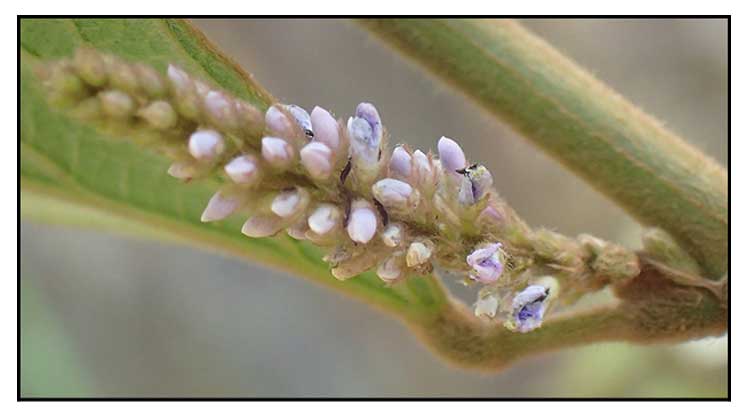
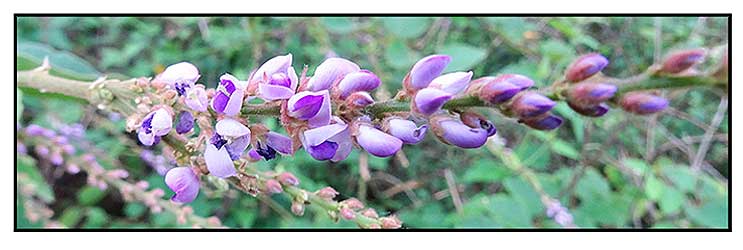
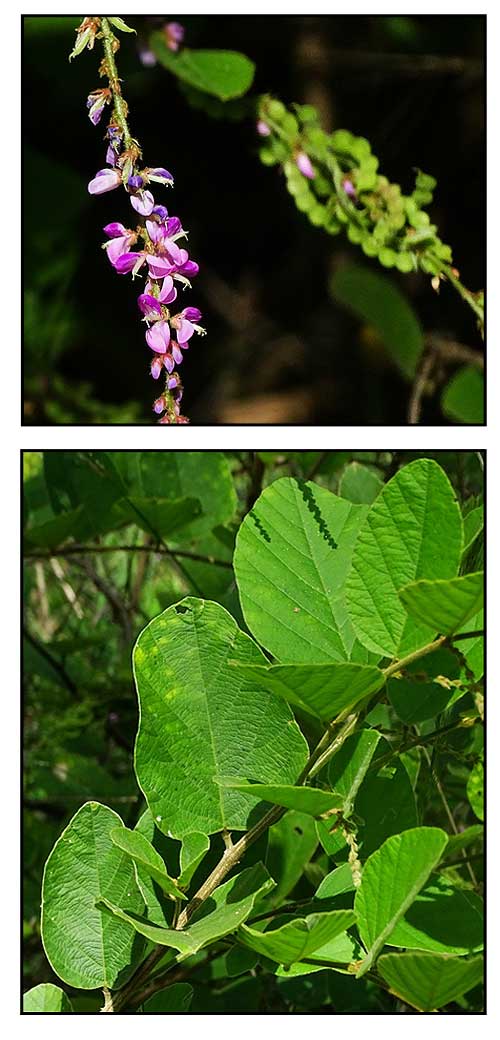
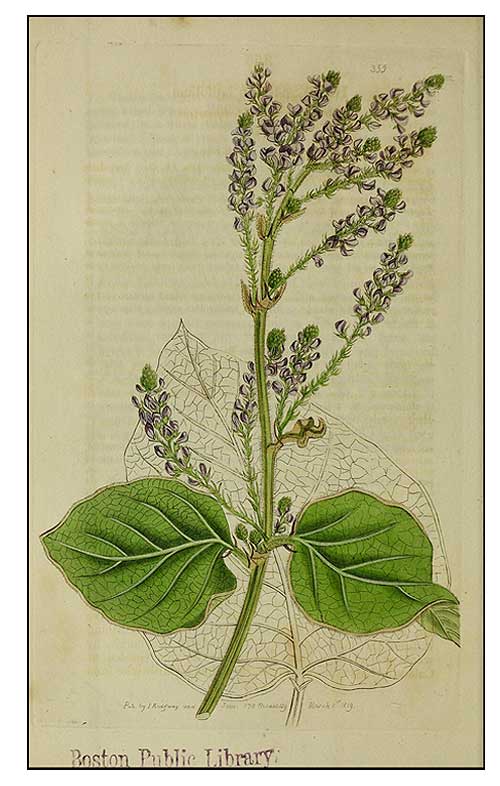
• Velvet-Leaf Desmodium is an upright woody perennial herb, subshrub, or shrub, up to 3 m tall. Leaves 1-foliolate (rarely 3-foliolate), occasionally opposite. Leaflets are light green to blue-green or darker above, paler beneath and with prominent pallid veins, roundish to elliptic to rhombic- ovate, 3–9.4 cm long, 2–7 cm wide, entire or repand (indented at the termination of the lateral veins) and ciliate, thick, mostly soft velvety on both surfaces with long stiff golden, reddish or white hairs. Inflorescences arise in leaf axils, and at the end of branches. They are densely flowered racemes up to 10 cm or more long, at least the terminal ones often paniculately branched. Flowers are white to pink, to blue, mauve or brilliant purple, usually appearing whitish or pale when dry. (Flowers of India)
• An erect shrub, usually 100-300 cm tall, branches often dark red, young parts densely hairy, rootstock thickened. Leaves 1-foliolate, sometimes mixed with 3-foliolate leaves, stipules narrowly triangular, 2-15 mm long, leaflets very variable in size and shape, 4-20 cm × 2.5-13 cm, chartaceous to coriaceous, upper surface continuously appressed-pubescent, lower surface densely velutinous, lateral veins 8-10, extending to the margin. Inflorescence terminal and axillary, racemose or paniculate, up to 20 cm long. Flowers in clusters of 2-5, calyx 4-lobed, densely hairy, corolla pink, purple, blue or reddish-violet, androecium diadelphous. Pod (1-)1.6-2.5 cm × 2.2-3.5 mm, (3-)5-7-jointed, articles broadly oblong, densely covered with hairs; seeds very broadly or depressed ovate, 1.3-1.6 mm × 1.8-2.5 mm.
(PROSEA)
Distribution
- Native to the Philippines. (1) (2)
- Throughout the Philippines in low and medium elevation thickets and grasslands. 0-1000 m. (1)
- Also native to Andaman Is., Angola, Assam, Bangladesh, Benin, Bismarck Archipelago, Burkina, Burundi, Cambodia, Cameroon, Central African Republic, Chad, China South-Central, China Southeast, Congo, DR Congo, East Himalaya, Ethiopia, Gabon, Gambia, Ghana, Guinea, Guinea-Bissau, Gulf of Guinea Is., Hainan, India, Ivory Coast, Jawa, Kenya, Laos, Lesser Sunda Is., Liberia, Malawi, Malaya, Mali, Mauritius, Mozambique, Myanmar, Nepal, New Guinea, Niger, Nigeria, Northern Provinces, Northern Territory, Rwanda, Senegal, Sierra Leone, Sri Lanka, Sudan-South Sudan, Sulawesi, Sumatera, Taiwan, Tanzania, Thailand, Togo, Uganda, Vietnam, West Himalaya, Zambia, Zimbabwe. (2)
Constituents
- Study of methanol leaf extract for polyphenol profile revealed kaempferol as the principal polyphenol in the extract/fraction. The ethyl acetate fraction showed higher concentration of catechin than kaempferol. Total phenolic content (TPC) was directly proportional to the antioxidant activities of extract and fraction. Ethyl acetate fraction showed higher TPC (787.1 GAE/g) than crude methanol extract (710.9 mg GAE/g) and n-butanol fraction (759.2 mg GAE/g). (see study below) (7)
- Study of roots isolated five pterocarpans, desmovelutins A-E and two isoflavans, desmovelisoflavans A and B, together with 7 known compounds. (see study below) (8)
- Leaf extract of leaves revealed presence of alkaloids, saponins, flavonoids, steroids, cardiac glycosides, phenolics, and tannins. (see study below) (9)
Properties
- Studies have suggested gastroprotective, antiulcer, anticancer, antioxidant, antiproliferative, antifungal, anti-inflammatory properties.
 Parts used
Roots, leaves.
Uses
Edibility
- While it is used as livestock forage, there is no reported edible use for humans.
Folkloric
- No reported medicinal use in the Philippines.
- In Papua New Guinea,
squeezed leaves are chewed with salt for treatment of diarrhea.
- Leaves and roots are chewed (without swallowing) to relieve toothaches.
- In Africa and Asia, reportedly used for treatment of headaches, cancer, hematuria;, and as aphrodisiac. (3)
- In Nigeria, used for treatment of headaches, fever, diarrhea, toothaches, ulcers, and painss. (6)
- In Kenya, leaves used for treatment of sore eyes. (12)
- In DR Congo, poultice of leaves used for treatment of wounds.
Others
- Repellent: In Asia, used as insect repellent. (3)
Studies
• Gastroprotective / Ethanol-Induced Ulcer / Leaves and Honey: Study evaluated the toxicity and anti-ulcer effects of a combination of methanol leaf extract of D. velutinum and honey in rats. Crude extract doses of 100, 250, aand 500 mg/kg were combined with 1 ml of honey. Acute toxicity study showed an LD50 >5000 mg/kg, with no mortality in mice at 5000 mg/kg dose. Extract dose of 500 mg/kg and 1 ml honey showed 42.9% and 71.76% inhibition of ulceration, respectively, while a combination showed 100% inhibition. (6)
• Anticancer in Lung Adenocarcinoma / Antiproliferative / Leaves: Study evaluated D. velutinum methanol leaf extract for antioxidant activity and effect on lung adenocarcinoma (A549) cell line. Total phenolic content (TPC) was directly proportional to the antioxidant activity. The ethyl acetate fraction performed best in antioxidant assays. D.velutinum inhibited oxidative damage to supercoiled plasmid DNA and suppressed proliferation of A549 cells in a dose-dependent manner. Results show D. velutinum has protective potential against many diseases linked with reactive oxygen species. (see constituents above) (7)
• Cytotoxic Flavonoids / Roots: Study of roots isolated five pterocarpans, desmovelutins A-E and two isoflavans, desmovelisoflavans A and B, together with 7 known compounds. Several compounds were evaluated for cytotoxic activities against four human cancer cell lines (A549, HepG2, HuCCA-1, and MOLT-3). Desmovelutin D, desmovelisoflavan A, 1-methoxyerythabyssin II, gangetin, gangetial, and desmodin showed significant cytotoxicity against MOLLT-3 cells with IC50s in range of 3.4-27.9 µM. (8)
• Food Safety Study / Leaves: Study evaluated the antifungal properties of D. velutinum leaves extracts against Aspergillus flavus, the most prevalent fungus isolated from ready-to-eat fried chicken sol in Ihiala, Anambra State. Antifungal activity was evaluated using agar-well diffusion and tube dilution methods. The ethanolic extract exhibited greater antifungal activity (16 mm) compared to aqueous extract (14 mm), compared to ketoconazole (21.50 mm). MIC and MFC values demonstrated inhibitory and cidal effects of the extracts. Results suggest D.velutinum as potential alternative therapy for diseases associated with A. flavus, and highlights the potential of plant-based extracts against food-borne fungal infections. (see constituents above) (9)
• Lipid Lowering Safety Study / Leaves: Study evaluated aqueous leaves extract of D. velutinum for lipid-lowering effect in albino Wistar rats fed a high fat diet (10 mg/kg) for 12 days. Treatment groups received 5 mg/kg of atorvastatin and 5 mg/kg of D. velutinum. Results showed a significant reduction (p<0.05) in serum TC, HDL-C, LDL-C,and TG. (The level of HDL-C varied significantly in the treatment groups.) (10)
• Anti-Inflammatory / Leaves: Study evaluated the comparative anti-inflammatory activities of methanol extracts, hexane and ethyl acetate fractions of leaves of Desmodium velutinum and D. scorpiurus using egg-albumin induced edema and proten denaturation methods. D. velutinum extracts showed presence of flavonoids, saponins, tannins, and sterols. Extracts and fractions exhibited anti-inflammatory activities not significantly different (p<0.05) from reference drug Diclofena sodium. Hexane fraction of D. velutinum exhibited most pronounced effect of 76.9% at dose of 2000 µg/;ml in invitro model, and 27.2% in the in vivo model. (11)
Availability
- Wild-crafted. |