|
Gen info
• Nauclea is a genus of flowering plants in the family Rubiaceae. The species are evergreen trees or shrubs that are native to the paleotropics.
• Nauclea orientalis is the type species of the genus, originally named Cephalanthus orientalis by Linnaeus in the first edition of Species Plantarus but transferred to Nauclea when the genus was erected in the second edition in 1762. (26)
• Etymology: The generic name Nauclea derives from Ancient Greek words naus, meaning "ship" and kleio, meaning "to close", alluding to the "resemblance of the cells of the capsule to a ship's hull". However, no part of the plant is remotely boat-like. Perhaps, Linnaeus may have attributed a boat-like part of another plant to the species. (26) (27)The specific epithet orientalis means "eastern". The common name Leichhardt tree is named for the German explorer Ludwig Leichhardt, who encountered the tree in his first expedition from Moreton Bay to Port Essington (ca 1844 to 1845). (27)
• The plant is closely related to, and sometimes confused, with bulubangkal tree (Nauclea sibdita).
Botany
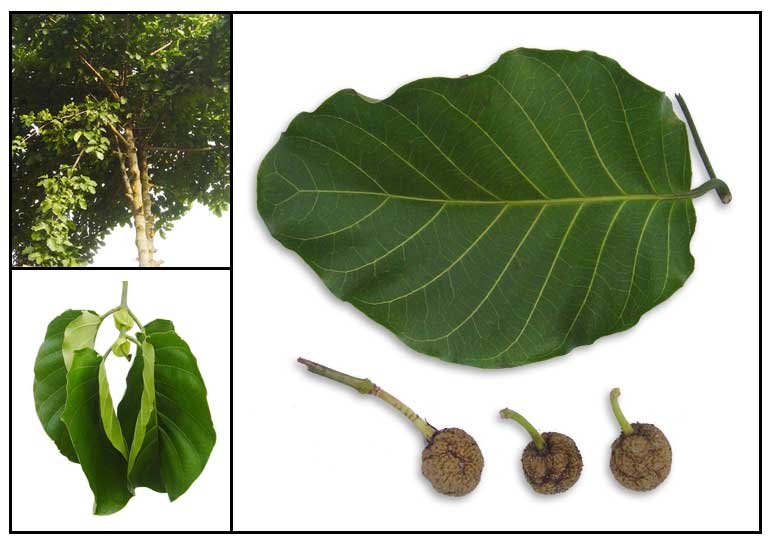
• Bangkal is a smooth tree, 7 to 16 meters
high. The leaves are leathery, elliptic to oblong-ovate, 11 to 25 centimeters long,
blunt-tipped and rounded or heart-shaped at the base. Stipules are green,
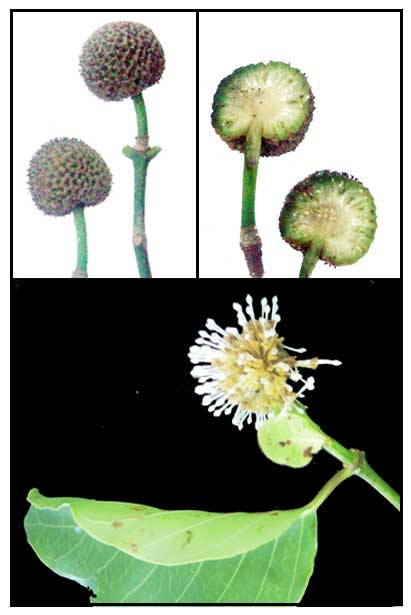
ovate to elliptic, 1 to 3 centimeters long. Flowers heads are solitary, peduncles and terminal,
4 to 5 centimeters in diameter. Flowers are fragrant, round, yellow or orange with white spikes.
 • Leichhardt trees are medium to tall trees, reaching maximum height of around 30 m (98 ft) with a diameter of 1 m (3.3 ft); deciduous, shedding their leaves during the dry season. Bark surface are grayish-to-reddish-brown and may be smooth or fissured and flaky, and orange-to-yellow in color when cut. Leaves are broadly ovate smooth (glabrous), opposite, about 7 to 30 cm (2.8 to 11.8 in) by 4 to 18 cm (1.6 to 7.1 in) in size; the upper surface is glossy green, and the bottom side with raised prominent yellow venation. Like most members of the family Rubiaceae, the stipules are interpetiolar, erect and pressed together, resulting in strongly flattened vegetative buds, which are large, around 1 to 3.5 cm (0.39 to 1.38 in) long. On their inside surfaces are a number of small red glands that can resemble insect eggs. Flowers are small, fragrant, tubular, and yellowish-to-orange with white stamens, grouped into a spherical cluster originating from a central point about 3 cm (1.2 in) in diameter. In Australia they bloom from September to January,in the Philippines from August to October. Individual flowers are small, about 8 to 10 mm (0.31 to 0.39 in) long and 3 to 5 mm (0.12 to 0.20 in) in diameter, with a perianth (each composed of five petals and sepals in separate whorls), The internal surface of the corolla are yellow-to-orange and sweet-smelling, frequently partly fused together, forming a long corolla tube tipped with the individual lobes of the petals. Flowers are bisexual, with five short and separate stamens attached to the perianth. Calyces are also fused together, resulting in the spherical shape of the flower head. They are epigynous, with the ovary inferior. After three months, the flower heads develop into a fleshy globular multiple fruit (syncarp) joined by their calyces (each flower becoming a fruitlet containing one seed). They are around 4 to 5 cm (1.6 to 2.0 in) in diameter, about the size of a golf ball. Fruit is rugose (wrinkled), brown, and strongly aromatic, and indehiscent. Seeds are ovoid to ellipsoid seeds are small, around 1 to 10 mm (0.039 to 0.394 in) in length and are not winged, very numerous, but do not remain viable for long. Being recalcitrant (unable to survive drying and freezing temperatures), it's impossible to store them. The seeds germinate above ground (epigeal germination) around 15 days after being sown. (27) • Leichhardt trees are medium to tall trees, reaching maximum height of around 30 m (98 ft) with a diameter of 1 m (3.3 ft); deciduous, shedding their leaves during the dry season. Bark surface are grayish-to-reddish-brown and may be smooth or fissured and flaky, and orange-to-yellow in color when cut. Leaves are broadly ovate smooth (glabrous), opposite, about 7 to 30 cm (2.8 to 11.8 in) by 4 to 18 cm (1.6 to 7.1 in) in size; the upper surface is glossy green, and the bottom side with raised prominent yellow venation. Like most members of the family Rubiaceae, the stipules are interpetiolar, erect and pressed together, resulting in strongly flattened vegetative buds, which are large, around 1 to 3.5 cm (0.39 to 1.38 in) long. On their inside surfaces are a number of small red glands that can resemble insect eggs. Flowers are small, fragrant, tubular, and yellowish-to-orange with white stamens, grouped into a spherical cluster originating from a central point about 3 cm (1.2 in) in diameter. In Australia they bloom from September to January,in the Philippines from August to October. Individual flowers are small, about 8 to 10 mm (0.31 to 0.39 in) long and 3 to 5 mm (0.12 to 0.20 in) in diameter, with a perianth (each composed of five petals and sepals in separate whorls), The internal surface of the corolla are yellow-to-orange and sweet-smelling, frequently partly fused together, forming a long corolla tube tipped with the individual lobes of the petals. Flowers are bisexual, with five short and separate stamens attached to the perianth. Calyces are also fused together, resulting in the spherical shape of the flower head. They are epigynous, with the ovary inferior. After three months, the flower heads develop into a fleshy globular multiple fruit (syncarp) joined by their calyces (each flower becoming a fruitlet containing one seed). They are around 4 to 5 cm (1.6 to 2.0 in) in diameter, about the size of a golf ball. Fruit is rugose (wrinkled), brown, and strongly aromatic, and indehiscent. Seeds are ovoid to ellipsoid seeds are small, around 1 to 10 mm (0.039 to 0.394 in) in length and are not winged, very numerous, but do not remain viable for long. Being recalcitrant (unable to survive drying and freezing temperatures), it's impossible to store them. The seeds germinate above ground (epigeal germination) around 15 days after being sown. (27)
 Distribution Distribution
- Native to the Philippines.
-
In secondary forests at
low and medium altitudes from the Batan Islands and northern Luzon to Mindanao, in most islands and provinces.
- Also native to Bangladesh, Bismarck Archipelago, Borneo, Cambodia, Jawa, Laos, Lesser Sunda Is., Maluku, Myanmar, New Guinea, Northern Territory, Philippines, Queensland, Solomon Is., Sri Lanka, Sulawesi, Sumatera, Thailand, Vietnam. (15)
- Cultivated for ornamental purposes.
Constituents
- Bioassay-guided fractionation of dried stems yielded two novel tetrahydro-beta-carboline monoterpene alkaloid glucosides, naucleaorine (1) and epimethoxynaucleaorine (2), together with known compounds, strictosidine lactam (3), 3,4,5-trimethoxyphenol (4), 3α-hydroxyurs-12-en-28-oic acid methyl ester (5), 3α,23-dihydroxyurs-12-en-28-oic acid (6), 3α,19α,23-trihydroxyurs-12-en-28-oic acid methyl ester (7), and oleanolic acid (8). (see study below) (1)
- Roots yielded a new naucleidinal derivative along with nine known compounds consisting of six indole alkaloids [naucleficine (1), naucleactonin A (2), naucleidinal (3), 19-epi-naucleidinal (5), strictosamide (6), and pumiloside (7)], two secoiridoids [aligenoside (8) and sweroside (9)], and vanillic acid (10).(see study below) (9)
- Study of stems isolated a new α-pinene derivative (1), together with 12 known compounds, including four terpenoids, loganetin (2), loganin (3), sweroside (4), grandifloroside (5), four simple phenols, methyl protocatechuate (6), trans-p-coumaric acid (7), 3-*2,4-dihydroxyphenyl)propanoic acid (8), methyl 3-(2,4-dihydroxyphenyl)propanoate (9), two coumarin glucosides, skimmin (10), adicardin (11), and anthraquinone, aloe emodin (12), and a lignan, (+)-pinoresinol (13). (see study below) ( 17)
- Study of leaves isolated two new indole alkaloid glycosides, 10-hydroxystrictosamide and 6'-O-acetylstrictosamide, as well as the known alkaloids strictosamide and wincosamide. (18)
- Bangkal tree bark contains anti-UV compounds in the form of phenol hydroquinone, flavonoids, steroids, and saponins. (20)
- Study of leaves isolated four new monoterpene alkaloid glycosides, kanluaengosides A-D (1, 2, 8, and 9), along with 12 known compounds i.e., (3S)-pumiloside (3), strictosamide (4), vincosamide (5), 10-hydroxystictosamide (6), 10-hydroxyvincoside lactam (7), paratunamide B (10), paratunamide C (11), vitexin (12), vicenin-2 (13), kaempferol 3-O-rutinoside (14), rutin (15), and eugenyl ß-rutinoside (16). (23)
- Phytochemical screening of ethanolic bark extract
revealed presence of carbohydrates, alakloids, flavonoids, phenols, tannins, and saponins. (see study below) (28)
- Study of stems and leaves isolated a new indole alkaloids, nauclorienine (1), along with seven known alkaloids (2-8). (see study below) (29)
- Study of N. orientalis led to identification of 13 tryptamine-deriived alkaloids: strictosamine and four of its glucosidic derivatives, three oxindole derivatives, and five yellow-colored angustine-type algycones. (see study below) (31)
Properties
- Emetic, vulnerary.
- Considered antimalarial, anticancer.
- Studies have suggested antimalarial, antiproliferative, anthelmintic, antioxidant, cytotoxic, antiplasmodial, phytoremediative, platelet aggregation inhibitory, α-amylase inhibitory, antihyperglycemic, anti-hemolytic properties.
Parts utilized
Bark, leaves, fruits.
Uses
Edibility
- Fruits are edible, though bitter tasting. Eaten by indigenous Australians. (13)
- Fruits palatable to bats and birds. In Malaysia, one of the food sources of proboscis monkeys.
 Folkloric Folkloric
- In the Philippines, lowland farmers apply the leaves on affected arthritic areas. Bark is placed on injured body parts and cloth wrapped around it. (24)
- In the Bicol region, plant used for treatment of swelling.
- In Ifugao, indigenous people use the plant for treatment of wounds by pounding 1 to 2 shoots and applying the ensuing paste as poultice, held in place by strapping, and repeated every 24 hours. (34)
-
Used to treat wounds, fever and headaches.
-
Leaves applied to boils
and tumors.
- Bark decoction for diarrhea and toothaches.
- Elsewhere, bark used as ingredient in birth control concoctions.
- Bark infusions used as emetic. Used to treat stomachaches and animal bites.
- Aboriginal people of North Queensland crush the fruits in water
to use as baby food; also used for coughs, colds, stomach pains and
diarrhea.
- In Laos, decoction of dried stem (chipped stem wood and stem bark) mixed with two other plants used to treat fatigue. (10) Leaves are applied to abscesses. Bark decoction given for diarrhea and respiratory illnesses. (33)
- In Ayurveda, used for toothache, tumors, and diarrhea.
- In Gorontola, Indonesia, bark used as febrifuge.
- Bangkal bark used as body scrub for traditional body care. (20)
- In Sri Lanka, used for treatment of boils, tumors, diarrhea, toothache. (35)
- In Borneo, the Dayak tribe use leaves as anti-leech, and bark for vomiting blood. (36)
Others
- Dye: In Otaheite, leaves used as ingredient in the red dye, or matte, for cloth.
- Poison: Wood was shown to be toxic to the termite Cryptotermes domesticus under laboratory conditions. (13)
- Wood: Wood long used as building material. It has great potential on an industrial scale for carpentry wood, paper pulp, flooring, furniture, molding, wrapping boxes, sculpture and engraving, (20)
- Phytoremediation: Used for phytoremediation of land polluted by acid and heavy metal waste like Hg, Fe, Mn, Zn, Cu, Pb and Cd, (20)
- Cosmetics: Bangkal powder is a mixture of rice flour and Bangkal tree bark. In Indonesia, the powder is used to protect the skin from sunburn, remove black spots on the face, treat acne and skin rashes, and to soften the skin. (20)
- Others: Also used for agroforestry and rehabilitation of degraded land. In the industrial sector, used as cultivation wood with a fast growth category, high wood mass density and roots as erosion control on river banks. (20)
Studies
• Antimalarial / Dried Stem: Bioassay-guided fractionation of anti-malarial-active CHCl3 extract of dried stem of Nauclea orientalis
isolated two novel tetrahydro-B-carboline monoterpene alkaloid glucosides:
naucleaorine and epimethoxynaucleaorine, together with six other known compounds. Compounds 1, 2, 6, and 8 showed moderate in vitro
activities against Plasmodium falciparum. (see constituents above) (1)
• Phytochemicals: New Indole
Alkaloids from the Bark of Nauclea orientalis:
Four new alkaloids, nauclealines A and B and naucleosides A and B, together
with six known compounds were isolated from the bark of Nauclea orientalis. (2)
• Antiproliferative
/ Alkaloids: Study yielded nine indole alkaloids from
ammoniacal extracts of Nauclea orientalis. The compounds were found
to exhibit in vitro anti-prolilferative activity against human bladder
carcinoma T-24 cell line and epidermal growth-factor-dependent mouse
epidermal keratinocytes. (3)
• Anthelmintic / Leaves: Various extracts of Nauclea orientalis leaves were evaluated for anthelmintic activity on adult Indian earthworm (Pheretima posthuma). The extracts exhibited dose-dependent action with inhibition of spontaneous motility and death of earthworms. (4)
• Cytotoxic Indole Alkaloids / Roots: Study yielded a pair of new isomeric indole alkaloids, naucleaoral A and B from the roots. Naucleaoral A showed significant cytotoxicity against HeLa cells with an IC50 of 4.0 µg/mL, while compound B showed very modest cytotoxicity against both HeLa and KV cell lines with IC50 of 7.8 and 9.5 µg/mL, respectively. (5)
• Antioxidant / Leaves: Study of ethanol extract of leaves showed significant antioxidant activity which was attributed to the phenolic constituents. (7) Study of aqueous extracts of some selected plants of the family of Rubiaceae and Acanthaceae showed Nauclea orientalis leaves to possess good antioxidant activity using a DPPH assay. (14)
• Roots / Constituents / Cytotoxicity: Roots yielded a new naucleidinal derivative along with nine known compounds consisting of six indole alkaloids. (See constituents above) The isolated compounds were tested for cytotoxicity on HeLa and KB cell lines. (9)
• Antiplasmodial / Hepatoprotective / Oleanolic Acid: Oleanolic acid isolated from N. orientalis exhibited a modest antiplasmodial property against Plasmodium falciparum and protected against CCl4, acetaminophen, and cadmium chloride-induced liver injury. (10)
• Antioxidant / Stems: Study of stems isolated a new α-pinene derivative (1), together with 12 known compounds, including four terpenoids, loganetin (2), loganin (3), sweroside (4), grandifloroside (5), four simple phenols, methyl protocatechuate (6), trans-p-coumaric acid (7), 3-*2,4-dihydroxyphenyl)propanoic acid (8), methyl 3-(2,4-dihydroxyphenyl)propanoate (9), two coumarin glucosides, skimmin (10), adicardin (11), and anthraquinone, aloe emodin (12), and a lignan, (+)-pinoresinol (13). All compounds were tested for DPPH free radical scavenging and lipid peroxidation inhibitory activities. Compounds 5 and 6 exhibited strong antioxidant activity with IC50s of 6.6 and 67.9 µM, 12.4 and 813,0 µM, respectiively, (17)
• Anti-Staphylococcal / Leaves: Study evaluated the anti-staphylococcal activity of mature leaves of Nauclea orientalis. The crude alcoholic leaf extract of mature leaves showed anti-staphylococcal activity. 100% extract's activity was to comparable to erythromycin. The formulated ointment was also comparable to the wound healing efficacy of erythromycin ointment in terms of duration of healing. (19)
• Inhibition of ADP and Thrombin Induced Platelet Aggregation / Alkaloids / Roots: Study of roots isolated alkaloids, which were evaluated for inhibitory activities on in vitro agonists induced human platelet aggregation. All alkaloids were inactive in the AA induced platelet aggregation. Only compound 2 inhibited ADP induced platelet aggregation with IC50 of 27.01 ± 7.67 µM, with more potency than standard ibuprofen (p<0.05). Compounds 1, 2, 4, 5 and 7 were more potent than the standard drug to inhibit thrombin induced platelet aggregation. Compound 2 could inhibit platelet aggregation through interference of platelet purinergic receptors. Compounds 1, 3, 4, 5 and 7 could have inhibitory effects on thrombin-induced platelet aggregation through proteolytic inhibition without interference of ligand-receptor interaction. (21)
• Phytoremediation of Acid Mined Drainage: Study evaluated the potential for adaptation and phytoremediation of lonkida (Nauclea orientalis) seedlings in a pool of Acid Mine Drainage (AMD). The seeds at 90 days in wetland construction showed high adaptability (100%). Lonkida can absorb and accumulate metals in the order of Fe>Mn>Zn>Cu>Pb>Cd. Results suggest lonkida has potential as phytoremediation plants in AMD on wetland construction. (22)
• α-Amylase Inhibitory / Antihyperglycemic / Antioxidant / Bark: Study evaluated the antioxidant,
α-amylase inhibitory, and antihyperglycemic properties of ethanol bark extract (EBE). The EBE showed IC50 of 20.69 µg/;mL on DPPH radical scavenging assay, compared to standard ascorbic acid with 11.13 µg/mL. α-Amylase inhibitory activity showed IC50 of 242.2 µg/mL. At 400 mg/kg, the EBE reduced blood glucose level and body weight by 27.04% and 19.21% respectively. (see constituents above) (28)
• Cytotoxic Indole Alkaloids / Inhibitory Against Cancer Cell Lines / Stems and Leaves: Study of stems and leaves isolated a new indole alkaloids, nauclorienine (1), along with seven known alkaloids (2-8). All isolated compounds were evaluated for cytotoxicities against 5 human cancer cell lines: HL-60, SMMC-7721, A-549, MCF-7, and SW480 in vitro. Alkaloids 1-4 exhibited significant inhibitory effects against various human cancer cell lines with IC50s comparable to cisplatin. (29)
• Attenuation of Doxorubicin-Induced Cardiotoxicity / Bark: The therapeutic efficacy of anthracycline antibiotic, doxorubicin (Dox), is hindered by dose-dependent cardiotoxicity. Study evaluated the counteraction of aqueous bark extract of N. orientalis in Dox-induced cardiotoxicity in Wistar rats. Acute and subchronic toxicity study with 2.0 g/kg extract revealed biochemical and hemato-
logical parameters to be within physiological range, with no observed histological organ alterations. Dox control group showed significant increase in cardiac biomarkers and lipid peroxidation (p<0.001), along with significantly elevated inflammatory markers, myeloperoxidase, TNF-α expression, caspase-3, and DNA fragmentation. All of these parameters were significant reversed in the extract-treated group. Results suggest N. orientalis at 2.0 g/kg has ability to attenuate Dox-induced oxidative stress, inflammation, apoptosis, and DNA fragmentation in Wistar rats. (30)
• Strictosamide / Tryptamine-Derived Alkaloids: Study of N. orientalis led to identification of 13 tryptamine-deriived alkaloids: strictosamine and four of its glucosidic derivatives, three oxindole derivatives, and five yellow-colored angustine-type algycones. Two different biosynthetic pathways are likely responsible for the overall alkaloid composition. Strictosamide is the key compound in the broader pathway, the most likely source of identified angustine-type aglycones, which may significantly contribute to the yellow color of the wood. (31)
• Anti-Hemolytic / Antioxidant / Bark: Study evaluated the in vitro antioxidant and Human Red Blood Cell (HRBC) membrane stabilizing effects of methanolic bark extract of N. orientalis. Concentrations of 50-800 µg/ml were used for both assays. Concentration dependent antioxidant activity was observed with bark extract. The ME of bark inhibited heat-induced hemolysis at concentration of 400 µg/ml (inhibition of 7.558%) and 800 µg/ml (inhibition of 88.435%) compared to salicylic acid at 45.998%. Phytochemical screening revealed tannins, saponins, terpenoids, glycosides, and coumarins. (33)
Availability
Wild-crafted.
Plants and seeds in the cybermarket. |