| 
General
info
- Curaua is a giant bromelia native to the Amazonia
and belonging to the pineapple plant family.
- Etymology: Ananas lucidus derives from "nanas", which in Guarani means flower, scent; the species name if from the Latin "lucidus" meaning bright or shining, referring to the glossy upper side of the leaves.
(6)
Botany
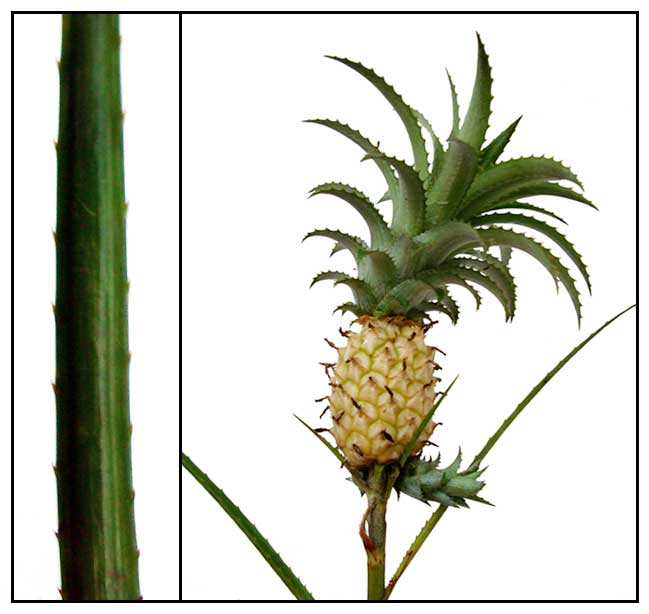
Curaua is a rosette-forming herbaceous evergreen plant.
bearing fruit only once during its existence (monocarpic), acaulescent, terrestrial, formed by a thick rosette of lanceolate leaves, broad up to 60 cm in diameter. Leaves are narrow, elongate, up to 40 cm long and 4 cm wide, rigid and ascending, the apices furnished with a robust thorn and the margins unarmed, glossy green color on the upper side and gray green below due to small silvery scales. Inflorescence at center of the rosette is formed by a floral scape, up to 80 cm long, green, covered by a thin, whitish tomentum, with lanceolate, sharp bracts. Scape ends in an inflorescence formed by 4 cm long spike of hermaphrodite flowers surrounded by pink bracts. Flowers have fleshy green sepals, with reddish edges and petals, 15 mm long and 3 mm wide, white-colored at the base and violet-blute at the apex. Fruit. which lasts on the plant for a long time, is a syncarp (aggregate fruit), 5 cm diameters and 6-8 cm height, pink yellow to pale red, very fibrous and inedible, usually containing a few seeds, sometimes none. (6)
Distribution
- Recently introduced to the Philippines.
- Ornamental cultivation.
Constituents
- The curaua fibers showed a
lignin composition of p-hydroxyphenyl:gualacul:syringyl units in 30:29:41
proportion. Pyrolysis revealed the presence of p-hydroxycinnamic acids
(p-coumaric and ferulic acids) in curaua fibers. The main lipophilic
compounds were long-chain n-fatty acids, n-fatty alcohols, alpha- and
omega-hydroxyacids, monoglycerides, sterols and waxes. (2)
Properties
• The dry curaua fiber is soft to the touch with a very high mechanical
resistance capable to producing high tensions, making it a natural substitute
for glass fiber.
Parts
utilized
Leaves.
Uses
Edibility
- Fruit reportedly inedible, being very fibrous.
Folkloric
- No known folkloric use in
the Philippines.
- In the Amazonia, the medicinal
plant is traditionally used to heal wounds.
Other uses
- Fiber: Cultivated for the fibers from the leaves that are particularly flexible, resistant, long lasting. Utilized fro fabrication of ropes, tissues, and handicrafts. (6)
-
Automobile industry: Largely used in the automotive industry due to its biodegradability, resistance, softness, and reduced weight, with potential to replace fiberglass. (5) (6)
- Also being tested for making hypoallergenic fabrics.
- Paper and chemical pulps: Curaua fiber has been promoted for paper pulp in Brazil and investigated as alternative lignocellulosic material for production of chemical pulps. (8) The curaua fiber is characterized by high holocellulose and a-cellulose contents (92.5 and 66.4, respectively) and a low lignin content (6.5% of total fiber weight) which would make the fiber suitable for papermaking. (2)
Studies
• Antimicrobial:
Microbiological assays from hydroxyalcoholic extract from the leaves
have shown anti-microbial activity of the plant toward Staphylococcus
aureus.
• Hypoallergenic Material:
With high resistance, low density and recyclability, fibers of the curaua
plant are being tested as replacement for fiberglass to reinforce plastic
materials in moulded car parts and for making hypoallergenic fabrics.
• Composite Fiber Material:
Study evaluated the behavior of composite materials with fiber of curaua in matrix of epoxy resin in different corrosive media such as oil, petroleum and water. The fiber of Amazonian origin presents good potential in measures of properties, low cost, and low density.
(7)
Availability
Cultivated.
|