Gen info Gen info
- Ochna kirkii, from the family Ochnaceae, is one of the 86 species of Ochna shrub and trees. It is similar to Ochna serrulata, also called Mickey Mouse plant, which has smaller and serrated leaves and smaller flowers; O. kirkii, in comparison, has larger and rounder leaves and larger flowers.
- Species from the genus are usually called ochnas, bird's-eye-bushes, or Mickey-mouse plants referring to the shape of the drupelet fruit.
(7)
- Etymology: The genus name Ochna comes from the Greek word okhne (oxnh) used by Theocritus, meaning "wild pear" because of its similarity to leaves of the pear tree. The species epithet honors Thomas Kirk, a writer on New Zealand plants. The specific epithet kirkii was named for Sir John Kirk (1832-1922), a Scottish physician, naturalist, explorer and diplomat or Thomas Kirk, a writer on New Zealand plants.
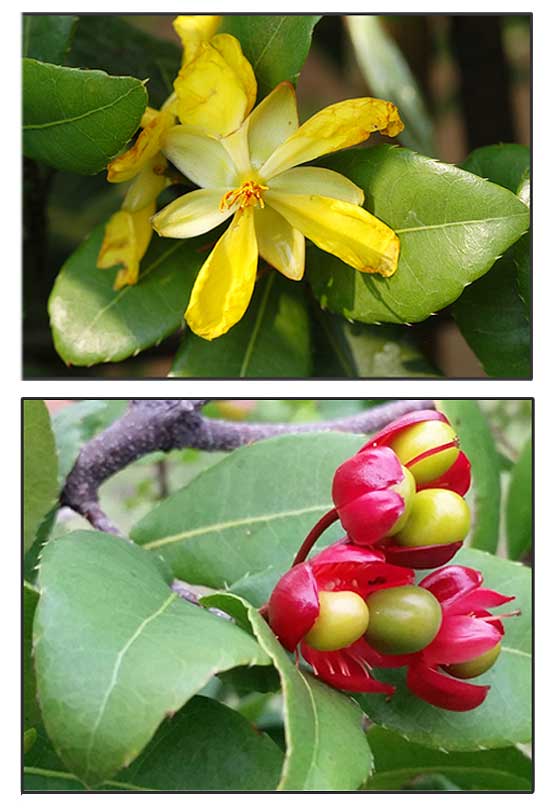
- The common name Mickey Mouse Plant derives from the clusters of dark fruitlets surrounded by red sepals, supplemented by red stamens, which somewhat resembles the Walt Disney cartoon character.
 Botany Botany
• Ochna kirkii is a big shrub or small tree growing to
a height of 3 to 4.5 meters tall. Leaves are glossy and dark green, alternate,
oblong-elliptic to narrow-obovate, cuneate or heart-shaped, blunt or
rounded at the tip, up to 10 centimeters long, margins are entire or undulate,
usually with fine hairs. Flowers are in small panicles or short, lateral
branchlets. Petals are 2.5 centimeters long, calyx is red. Fruit is are black, rounded and glossy, protruding from the swollen base of bright red calyx, resembling Mickey Mouse ears when paired.
• Growth form: Medium to large-sized shrub, able to grow up to 2 m tall. Foliage: Leaves are egg-shaped, oval or oblong (5-10 cm long). Flowers: Large, yellow flowers (3.5-5 cm long) are composed of 5 round, widely spread petals (15-25 mm long). After the petals drop, the calyx or outermost layer of the flower turns bright red and becomes swollen. (Flora & Fauna Web)
• The yellow petals last for only a day after which they fall off. The remaining sepals and flower bases turn red and flesh (flower look-alike). Three small, round fruitlets develop, which turn black on maturing, The fruitlets look like eyes and the sepals like ears of the cartoon character Mickey Mouse. (Tamani Botani Putrajaya)
Distribution
- Native to southeastern Africa.
-
Introduced to the
Philippines after WWII.
- Native to Kenya, Mozambique, Tanzania. (2)
- Cultivated for its colorful flowers.
-
Used as hedge plant.
- Invasiveness: Highly prolific and invasive weed in tropical and subtropical regions. Rapidly spread by birds.
Constituents
- Study of stem and root bark extracts of Ochna thomasiana yielded lophirone A, afzelone D dimethylether, calodenone, a mixture of stigmasterol and β-sitosterol and 3β-acetyl-24-ethylfriedelane. Roots yielded biflavonoids and sterols. (see study below) (3)
- Phytochemical quantification study yielded total ash 5.15% ±0.4623, acid insoluble ash 0.32%
± 0.6214, water soluble ash 10.72% ± 0.2340, alcohol soluble extractive 12.8% ± 1.3370, ether soluble extractives 7.30% ± 1.8341, water content 5.76% ± 0.0040, loss on drying 6.91% ± 2.6133. (4)
- Preliminary phytochemical screening of leaves yielded flavonoids, tannins, phenols, saponins, and triterpenoid.
Total phenolic content was 252.08 mg GAE/g ± 0.4430. (4)
- Study of methanolic extract of root bark isolated the new isoflavonoid kirkinone A (1) and biflavonoid kirkinone B (2) along with six known compounds (3-8) (see study below) (6)
Parts used
Roots, branches, leaves.
 Uses Uses
Edibility
- Only the fleshy outer part of the ripe black fruit is generally edible (a favorite among birds). However, the seeds are inedible, and may cause nausea. Roots and bark reported to contain toxic compounds.
- Caution: While the fleshy part of the fruit is edible, other plant parts are considered mildly toxic. The seeds are inedible, and can cause nausea. An an ornamental plant, children should be cautioned and advised on the chewing seeds and other plant parts. Also, plants should be out of reach to pets.
Folkloric
- Decoction of roots, branches
and leaves used for wound healing.
- In Thailand, root used for diarrhea and
hallucination.
- In Mozambique,it is the most used species used by the traditional healers in Mogovolas district for the treatment of malaria. Cold maceration of roots and leaves used for the treatment of diarrhea, cough and headache. (5)
Others
- Rituals / Superstition: In traditional medicine and magico-religious practices of southern and eastern Afica, considered a potent plant, used for spiritual cleansing and rituals to ward off bad luck, illness, and evil spirits.
Infusion of plant root with Ochna natalitia and Vagueria infausta used as ritual bath for spiritual purification and protection against bad luck.
Studies
• Antibacterial / Cytotoxic / Biflavonoids / Root Bark: Study of methanolic extract of root bark isolated the new isoflavonoid kirkinone A (1) and biflavonoid kirkinone B (2) along with six known compounds (3-8) Calodenin B (4) and lophirone A(6) showed significant antibacterial activity against Gram-positive bacteria Bacillus subtilis with MIC values of 2.2 and 28 µM, and cytotoxicty against MCF-7 human breast cancer cell line with IC50 of 219.3 and19.2 µM, respectively. (6)
Availability
- Wildcrafted.
- Cultivated.
|



;_May_2012.jpg)