 Gen info Gen info
- The Calophyllum genus is composed of about 200 species with a pantropical distribution. Some species are part of many indigenous systems of folkloric treatment for a wide range of maladies – tumors, inflammation, ulcers, pain.
Botany
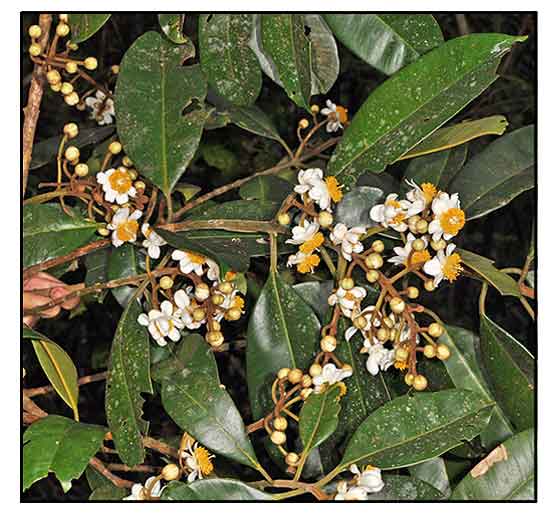
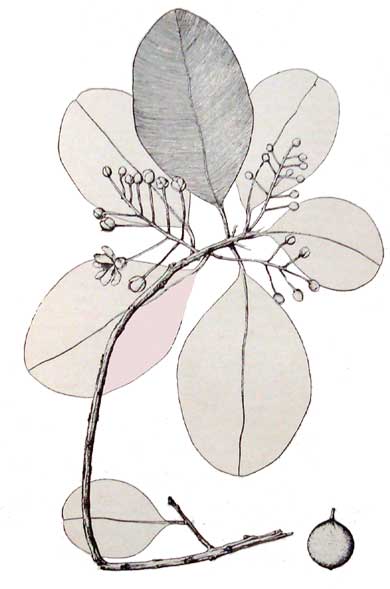
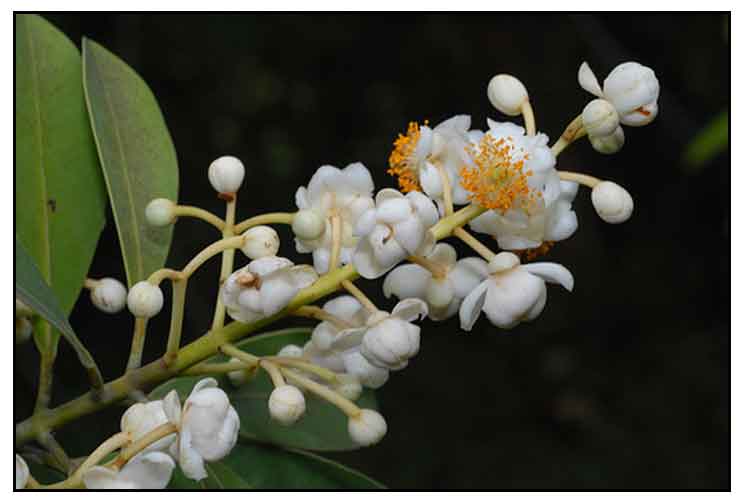
• Bitangol is an erect tree, growing to
a height of about 25 meters. Leaves are opposite, slightly hairy, oblong,
about 10 centimeters long and 3 centimeters wide, with numerous parallel and closely set
veins. Panicles are shorter or equal to the leaves in length, erect or
ascending from the upper leaf axils. Flowers are creamy white, about 2
centimeters across. Fruit is ellipsoid.
• Calophyllum blancoi is a medium-sized to large tree up to 40 m tall with bole up to 60 cm in diameter, without buttresses; twigs 4-angled, terminal bud plump, 6-20 mm long. Leaves elliptical to suboblong, rarely obovate, (3-)5-25(-30) cm long, cuneate or abruptly attenuate at base, acuminate at apex, with 5-18(-22) veins per 5 mm. Inflorescences terminal and/or axillary, branched up to 2 times, 9-many-flowered; flowers with 8-16 tepals. Fruit ovoid to subspherical, 12-22 mm long, with fairly thin, compact outer layer, green, bluish or black. (7)
 Distribution Distribution
- Native to the Philippines.
-
In primary forests, in low
and medium altitudes.
- Abundant from Cagayan to Sorsogon Provinces in Luzon; and in Ambil, Palawan, Masbate, Leyte, Panay, and Mindanao.
- Also native to Borneo and Taiwan.
- Supply in the Philippines is not abundant; supply depleted by logging and shifting cultivating.
Constituents
- Fractionation of acetone extract of seeds yielded six pyranochromanone derivatives: apetalic acid (1), isoapetalic acid (2), apetalic acid methyl ester (3), apetalic acid 5-O-acetate (4), isoapetalic methyl ester (5), and isoapetalic acid 5-O-acetate (6), together with one new dihydrocoumarin derivative, isorecedensolide (7) and recedensolide (8). (see study below) (1)
- Study of roots isolated three new pyranoxanthones, blancoxanthone (1), acetyl blancoxanthone (2) and 3-hydroxyblancoxanthone (3), together with two known pyranoxanthones, pyranojacaeubin (4) and caloxanthone (5). (see study below) (2)
Properties
- Studies have suggested anti-tumor, antiviral, anti-melanoma, antiplasmodial properties.
Parts used
- Bark, leaves, sap.
 Uses Uses
Folkloric
- Sap of the bark, when mixed
with sulphur, used in the treatment of boils and wounds.
- In Mindanao tribal medicine, piece of cloth moistened with sap of bark applied to the breast for treatment of cancer.
(8)
- For foreign body discomfort in the eyes - "napuwing" - infusion of slices leaves used for removal.
Others
- Wood: Heartwood is reddish-brown, with density of 500-650 kg/m3 and 15% moisture. Used for building boats, masts and spars, beams, joists, rafters, furniture and cabinetry.
Studies
• Chromanones / Anti-Cancer / Seeds: Study on the fractionated acetone extract
of Calophyllum blancoi seeds yielded six pyranochromanone derivatives, together with isorecedensolide and recedensolide. Compounds 3, 4, 5, 7, and 8 showed
showed mild activity against KB (human oral epidermoid carcinoma) and
Hela (human cervical epitheloid carcinoma) tumor cell lines. (see constituents above) (1)
• Xanthones / Anti-Viral / Anti-Coronavirus: Root phytochemical studies in Taiwan isolated three
new pyranoxanthones – blancoxanthone, acetyl blancoxanthone, and 3-hydroxyblancoxanthone. Biological study of the isolated xanthones revealed
that blancoxanthone (compound 1) exhibited significant anti-coronavirus activity. (see study above) (2)
• Betulinic Acid / Anti-Melanoma: Three Calophyllum species–C. blancoi, C. gracilipes, C.
teysmannii–isolated betulinic acid, a strongly cytotoxic triterpene
reportedly useful for the treatment of melanoma. (3)
• Anti-Plasmodial Activity: The crude extract of 30 plants species were evaluated for anti-plasmodial activity. Of 14 species that showed significant antiplasmodial activity, C. blancoi was one of six that displayed varying degrees of activity towards both the sensitive and resistant P. falciparum strains, although only weak activity towards the resistant strain. (5)
Availability
Wildcrafted.
|